Custom Chocolate Boxes
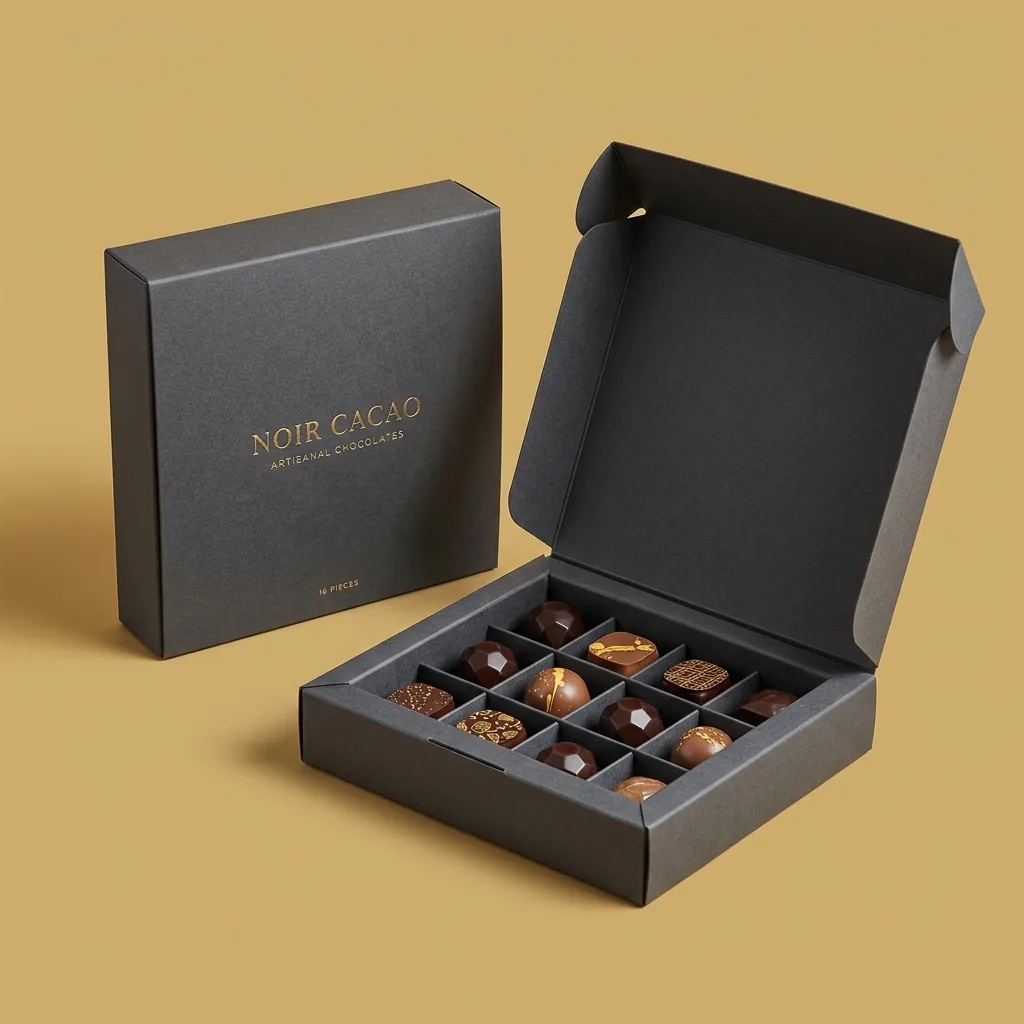
Custom chocolate boxes are food-safe retail and gift packaging built to seat delicate bonbons, truffles, and bars without crushing, smudging, or letting the product bloom. Chocolate is fragile, temperature-sensitive, and bought as much for the moment of opening as for the taste – so the box has to protect a soft-tempered piece and stage it like a jewel at the same time.
Whether you are a boutique chocolatier, a bakery adding a confection line, or a brand assembling holiday and wedding favors, we build the structure, the insert, and the finish together so each piece arrives seated exactly where you placed it. See our full food and beverage packaging range for related lines.
Key takeaways
- Food-safe by design: food-grade board, low-migration inks, and a glassine or food-safe liner for anything touching the chocolate.
- Inserts do the protecting: cavity trays and dividers seat each bonbon or truffle so nothing slides or blooms in transit.
- Sized by piece count: spec 4, 6, 9, 12, 16, or 24-piece assortments, or by bar dimensions for tablets.
- Luxury finish, no setup fees: foil, emboss, and soft-touch on a 100-box minimum with 8–10 day turnaround.
What is a chocolate box?
A chocolate box is food-safe printed retail or gift packaging engineered around a cavity insert tray that seats each bonbon, truffle, praline, or wrapped bar — so hand-tempered ganache shells keep their sheen, dusted truffles keep their coating, and molded pieces arrive in exactly the grid position where the chocolatier placed them.
Unlike a generic confection carton, a chocolate box is designed to prevent piece-on-piece rub and to control the moisture and temperature environment that causes fat bloom and sugar bloom — the two ways chocolate can look dull and streaky by the time it reaches a customer.
Chocolate packaging has three unusual requirements that separate it from most food packaging: cavity insert precision (a bonbon that shifts even a few millimeters rubs the ganache off the next piece), bloom prevention (chocolate blooms above 75°F fat migration or after cold-to-warm condensation shock — the box interior needs to slow moisture ingress and cushion temperature swings), and allergen + certification labeling (FALCPA and EU FIC allergen callouts, cocoa percentage, kosher/halal/vegan marks, ingredient list in descending order — all on the same 4- to 24-piece box).
What custom chocolate packaging is and who orders it
Chocolate packaging is any retail or gift box engineered to present and protect finished confections – filled bonbons, hand-rolled truffles, molded bars, pralines, and seasonal favors. The buyers are chocolatiers selling at counter and online, bakeries and dessert studios extending into confection, event planners producing wedding and holiday favors, and companies ordering branded corporate gifts.
What unites them is a product that melts, marks easily, and is expected to look immaculate the instant the lid lifts.
Box styles that suit chocolate
The right structure depends on the assortment and the price point. Filled bonbon and truffle collections almost always call for a two-piece rigid lid-and-base box, which gives the weight and rigidity a premium confection deserves and holds a cavity tray flat.
Bars and tablets fit a slim folding carton or tuck-end box that wraps the wrapped bar cleanly. When you want the product to sell itself on a shelf, a window box with a clear patch shows the glossy finish inside, and a magnetic-closure box adds the satisfying snap of a keepsake gift.
Inserts and protection
The insert is what keeps chocolate from touching chocolate. We build cavity or divider trays – vacuum-formed for a precise seat around each piece, or die-cut paperboard for a lighter, fully recyclable option – so a 9 or 12-piece assortment stays in its grid from your bench to the customer's hands.
Fixed pieces do not rub, so ganache shells keep their sheen and dusted truffles keep their coating. For shipping, a rigid outer plus a snug insert absorbs the handling that would otherwise leave scuffs and cracks. Read our guide to custom inserts and unboxing for tray options.
Food safety and keeping chocolate from blooming
Anything in direct contact with the chocolate should be food-grade under FDA 21 CFR 176.170. We print with soy-based, low-migration inks and can line trays or the box interior with glassine or a food-safe barrier so nothing transfers to the product. Chocolate blooms – that dull, streaky look – when its cocoa butter migrates to the surface after temperature or moisture shock:
- Fat bloom occurs above 75°F (24°C), when tempered crystals melt and re-set unevenly.
- Sugar bloom occurs from condensation on the surface, typically after cold storage into a warm room.
- Recommended storage: 60-68°F (16-20°C) with humidity below 50%.
Fill and close boxes in a cool, dry space, and use a lined interior to slow moisture ingress. Our food-safe packaging guide covers material basics.
Standard piece-count sizes
| Piece count | Typical cavity grid | Common box size |
|---|---|---|
| 4 | 2 x 2 | 3.5 x 3.5 x 1.25 in |
| 6 | 2 x 3 or 3 x 2 | 5 x 3.5 x 1.25 in |
| 9 | 3 x 3 | 5 x 5 x 1.25 in |
| 12 | 3 x 4 or 4 x 3 | 6.5 x 5 x 1.25 in |
| 16 | 4 x 4 | 6.5 x 6.5 x 1.25 in |
| 24 | 4 x 6 or 6 x 4 | 9.5 x 6.5 x 1.25 in |
Cavities are sized to your piece diameter - most bonbons run 1 to 1.25 in (25-32 mm) across; truffles slightly larger. Send a piece or its diameter and we build the cavity to fit.
Branding and finish for a luxury feel
Confection is an impulse and gift buy, so the finish carries a lot of the value. Foil stamping in gold or copper reads as instantly premium on a lid; blind embossing gives a logo or monogram a tactile, debossed depth; and soft-touch lamination adds the velvet hand-feel people associate with fine chocolate.
Full CMYK plus Pantone matching keeps your brand color exact across every reprint, and spot UV can pick out a single motif against a matte ground. Because we charge no die, plate, or setup fees, these treatments stay affordable even at a 100-box run.
Sizing and how to spec cavities
Chocolate boxes are usually sized by piece count. Common retail and gift formats are 4, 6, 9, 12, 16, and 24-piece assortments, with 9 and 12 the workhorses for gifting. To spec cavities, tell us the finished diameter and height of your largest piece and how many across and down you want them arranged – a 12-piece is typically a 3x4 or 4x3 grid.
For bars, give us the length, width, and thickness of the wrapped tablet. If you are unsure, send us a sample and we will build the dieline and 3D mockup around your real product, free.
Sustainable and gift-ready options
Many chocolate buyers want packaging as clean as the ingredient story. Paperboard cavity trays, uncoated kraft or FSC-certified white stock, and recyclable rigid board let you skip plastic where it is not needed while keeping the food-safe liner only where the chocolate touches.
For subscription and DTC confection lines, a mailer box with a fitted insert ships the same premium experience to the door. Pair any of these with our gift box options for ribbon-ready presentation.
How much do custom chocolate boxes cost?
Custom chocolate box pricing tracks piece count, structure, and finish stack. Typical ranges at a 500-unit run: $0.70 to $1.80 per box for a 4- or 6-piece folding carton or slim tuck-end (small gifts, wedding favors); $1.50 to $3.20 per box for a 9- or 12-piece rigid two-piece box with cavity insert (bakery counter, indie chocolatier retail); $2.50 to $5.00 per box for a 16- or 24-piece rigid with vacuum-formed PET tray + soft-touch + foil (mid-tier prestige); $4.00 to $9.00 per box for a magnetic-closure rigid with EVA/molded pulp insert, satin liner, and stacked prestige finishes (department-store gift, holiday corporate).
Cavity insert adders: vacuum-formed PET $0.30–$1.20, die-cut paperboard $0.15–$0.60, molded pulp $0.25–$0.90. Glassine liner sheet $0.05–$0.20. PET window patch $0.20–$0.50. Per-box cost drops 30–40% moving from 500 to 5,000 units.
No die, plate, or setup fees on any run.
What drives chocolate box price, in order of impact:
- Structure — folding carton cheapest, magnetic-closure rigid 5–10x more expensive. Biggest lever.
- Cavity insert material — vacuum-formed PET and molded pulp cost more than die-cut paperboard but grip better around irregular truffles and pralines.
- Finish stack — foil + soft-touch + emboss is the confectionery prestige standard; each stacked finish adds a small off-press step.
- Wrap paper choice — specialty metallic, pearlescent, and textured wraps carry a premium over standard art paper.
- Quantity — per-box cost drops sharply from 100 to 500 to 1,000+.
- Advent calendar builds — 24 or 25 die-cut perforated doors with individual cavities behind each add a significant tooling step but no plate fee.
Send your piece count, target segment, and finish preference on the quote form for exact per-box pricing.
How long do custom chocolate boxes take to make?
Standard production is 8 to 10 business days after proof approval. Rush production runs in 4 to 6 business days on most orders at no additional charge, including single-finish folding cartons and standard vacuum-formed tray builds. Rigid two-piece and magnetic-closure boxes with hand-assembly add 1 to 2 days.
Stacked prestige finishes (foil + soft-touch + emboss) add 1 to 2 days. Custom advent-calendar builds with 24-25 die-cut perforated doors add 2 to 3 days for the tooling step. Ground freight from Cheshire, Connecticut adds 2 to 5 days to the West Coast — expect a full quote-to-dock timeline of about 2 to 3 weeks for a first indie order, 3 to 4 weeks for a rigid prestige build.
Seasonal chocolate is calendar-driven: Valentine's Day 90 days ahead (order early November), Easter 90 days, Mother's Day 90 days, November–December holidays 120 days ahead (order in June-July for filled inventory by mid-October).
Rigid chocolate box vs folding carton vs window box: which should you choose?
Three main chocolate-box structures cover most confectionery programs. A rigid two-piece box is the prestige standard — heavy chipboard wrapped in printed paper with a cavity insert, hand-assembled, signals immediate quality when the customer picks it up.
A folding carton is the small-batch and wrapped-bar choice — ships flat, unit cost is lowest, works for slim tablets and 4/6-piece gift sets. A window box combines a rigid or folding outer with a die-cut clear-film opening — shows the glossy chocolates at retail shelf where the visual sells the assortment.
| Rigid two-piece | Folding carton | Window box (rigid or folding) | |
|---|---|---|---|
| Board | 1.5–2 mm chipboard wrapped | 18–24 pt SBS printed direct | Either + die-cut PET film patch |
| Ships to you | Assembled or collapsible flat | Flat, folds at pack-out | Flat if folding; assembled if rigid |
| Cavity insert | Vacuum-formed PET or die-cut paperboard | Die-cut paperboard cavity | Either (rigid tray gives cleaner shelf view) |
| Signals | Prestige, gift, keepsake | Value, small-batch, wrapped bar | Retail display, impulse buy, visible artistry |
| Best for | Assortments, gifting, corporate | Bars, wedding favors, single-piece gifts | Bakery counter, retail shelf, boutique display |
| Typical cost (500-run) | $1.50–$9.00 | $0.70–$2.20 | $1.20–$5.20 (adds $0.20–$0.50 for window) |
Many chocolatiers run all three: rigid for a flagship 12- or 16-piece assortment, folding carton for wedding-favor 2-piece sets and wrapped tablet bars, window box for a bakery counter display. A matched art system keeps the family look consistent while each structure hits its own economics.
Pricing, minimums, and turnaround
We run a 100-box minimum with no die, plate, or setup fees, so a small chocolatier can order a real retail box without a mass-market budget. Every order includes free design, a free custom dieline, a free 3D mockup, and a digital proof before print. Production runs 8–10 business days after proof approval, with free shipping across the US.
For a firm number on your assortment, request a quote with your piece count and finish, or contact us to talk options.
Seasonal and occasion formats
A lot of chocolate volume moves in tight seasonal windows — Valentine's, Easter, Mother's Day, and the November-December holiday stretch. Each has its own format expectations that shoppers recognize at a glance. Common builds by occasion:
- Valentine's Day – a heart-shaped rigid box or a red/pink square rigid with a foil-stamped logo. Best-selling formats are 6, 9, or 12 pieces. Order 90 days ahead of Feb 14 to have stock on retail shelves for the first week of February.
- Easter – egg-shaped rigid or window boxes for filled eggs; long slim cartons for bunny and pastel-color assortments. Pastel Pantones with a matte or soft-touch coat read as spring.
- Mother's Day – small-count assortment boxes (4, 6, 9 pieces) in floral or metallic finishes. Often bundled with a card slot inside the lid.
- November-December holidays – the biggest volume of the year. Assortment boxes (12, 24, 36 pieces), advent calendars with 24 or 25 individual cavities, and gift-set tin-or-rigid combos. Order 120 days out to be on shelves by mid-October.
- Wedding favors – single-piece or two-piece boxes in a matched brand color, foil-stamped monogram, and a satin ribbon. Usually printed in short runs of 100–300, exactly what our 100-box minimum covers without a bulk order commitment.
- Corporate gifts – 6-12 piece assortment boxes co-branded with a client logo alongside your maker mark. Often shipped in a printed corrugated mailer for direct-to-office delivery.
Seasonal runs are where a 100-box minimum with no die or plate fees really pays off — you can test a new format with the first 100 units before committing to the full season's order, and reorder in tighter cycles as the season plays out.
Labeling: allergens, cocoa content, and dietary marks
Chocolate has more label requirements than most confections because of dairy, nuts, and soy that touch nearly every production line. A few things to plan panel space for from the first dieline:
- Allergen callout – US FALCPA rules and EU FIC rules both require the top allergens (milk, tree nuts, peanuts, soy, wheat, egg) to be called out. Plan a “Contains: milk, soy, may contain traces of tree nuts and peanuts” line on the back panel. Reserve about 15–20 mm of vertical space.
- Cocoa percentage – craft and single-origin chocolate buyers look for the cocoa % on the front panel. If you sell 70% dark or 40% milk, put the number where the shopper can see it before picking the box up.
- Ingredient list in descending order – standard FDA and EU rule. Cocoa mass or cocoa butter usually leads for dark; sugar leads for milk. Include it verbatim so a compliance review does not slow the run.
- Kosher, halal, vegan marks – if you carry these certifications, the mark is a strong sales signal for the shoppers who look for it. Send the exact certification symbol as supplied by your certifier and we place it correctly.
- Net weight – in both grams and ounces on the front panel. For assortment boxes, net weight is the total chocolate weight, not the box weight.
We flag any missing marks on the dieline proof so nothing gets locked in without space for it. Regulatory wording is your call to confirm, but the layout and space are on us.
Are custom chocolate boxes worth it for a boutique chocolatier?
Yes, and boutique chocolatiers — small-batch bean-to-bar makers, hand-tempered ganache specialists, farmers-market and holiday-only makers, wedding-favor chocolatiers, corporate-gift resellers, and DTC subscription confection brands — are exactly who the 100-box minimum was built for.
Chocolate is unusual in that a printed rigid box at $1.50–$3.20 per box lifts perceived value more than almost any other food-category custom packaging: buyers accept a higher unit cost for a confection that arrives looking immaculate, so the box economics work at the smallest scale.
A boutique chocolatier launching a 9-piece signature assortment at $28 retail can afford a $2.80 printed rigid box because it holds the premium price point that a stock kraft carton with a sticker cannot. Beyond brand lift, chocolate packaging carries a real compliance role: FALCPA (US) and EU FIC (EU) both require top-allergen callouts on any chocolate touching milk, tree nuts, peanuts, or soy on the production line, and cocoa percentage on the front panel is a purchase signal for craft and single-origin buyers.
A stock white box with a hand-written sticker meets neither. Common launch pattern: 100 rigid boxes for a signature 9-piece assortment plus 100 folding cartons for wedding-favor 2-piece sets, then reorder as sell-through builds through seasonal peaks (Valentine's Day, Easter, Mother's Day, holiday).
Direct-ship DTC chocolate brands pair the printed retail box with a corrugated master shipper plus a gel-pack ice pouch for warm-climate summer transit.
Are chocolate boxes recyclable?
Yes for paper-based outer builds; insert-material varies. Rigid chipboard, folding SBS, kraft, and CCNB paperboard chocolate boxes are all curbside-recyclable in nearly every US municipal program — paper and paperboard recovery in the US is 76% per US EPA.
Soy and water-based inks keep the box recyclable and are FDA-compliant under 21 CFR 176.170. Insert-material recyclability differs: die-cut paperboard cavity trays recycle with the box; molded pulp cavity trays recycle; vacuum-formed PET plastic cavity trays do not (they are removable and reusable — many chocolatiers market the empty tray as a truffle-organizer for kitchen storage or reuse).
Glassine liner sheets are food-safe paper and recycle with the box. Heavy laminates, foil stamping, and metallic wrap papers reduce recyclability — small foil accents on a logo or monogram are usually accepted by curbside programs; full-panel metallic wraps are not.
PET or PVC window patches reduce recyclability — bio-film alternatives keep the box in the paper stream. For a fully recyclable chocolate box program, we recommend FSC-certified SBS or rigid chipboard, die-cut paperboard or molded pulp cavity insert (not PET), glassine liner where needed for direct food contact, soy inks, aqueous coating instead of heavy laminate, and single-color foil accent instead of full metallic wrap.
See eco-friendly boxes for the full sustainable range.
Frequently asked questions
Are your chocolate boxes food-safe?
Yes. We use food-grade board and low-migration inks, and we can add a glassine or food-safe liner for any surface that touches the chocolate directly. Tell us your fills and we will recommend the right barrier.
Can you make inserts that hold each piece in place?
Yes. We build cavity and divider trays – vacuum-formed or die-cut paperboard – sized to your exact piece so bonbons and truffles stay seated and do not rub or bloom in transit.
What box sizes do you offer for chocolate?
We size by piece count – commonly 4, 6, 9, 12, 16, and 24-piece assortments – or by bar dimensions for tablets. Send your largest piece size and preferred grid and we build the box around it.
What is the minimum order?
Our minimum is 100 boxes with no die, plate, or setup fees, and every order includes free design, dieline, 3D mockup, and a digital proof.
Which finishes work best for a premium chocolate box?
Foil stamping, blind embossing, soft-touch lamination, and spot UV all read as luxury on confection packaging. Full CMYK plus Pantone matching keeps your brand colors exact across reprints.
Can you print a window box so customers see the chocolates?
Yes. We add clear window patches to folding cartons and rigid boxes so your assortment is visible on the shelf while staying protected and food-safe inside.
How long does production take?
Production runs 8–10 business days after you approve the digital proof, with free shipping across the US.
How far ahead should I order Valentine's or holiday chocolate boxes?
For Valentine's, place the order 90 days out (early November) so packed stock is on retail shelves by early February. For November-December holidays, aim for 120 days out (order in June or July) so filled boxes are in fulfillment by mid-October. Rush is available but eats into the margin.
Do you handle the allergen and cocoa % callouts on the box?
We reserve panel space for the required allergen callout, cocoa percentage on the front, and ingredient list on the back panel. You supply the exact wording (that is a regulatory call), and we lay it out at a legible size in the right place on the dieline before you approve the proof.
Can you print advent calendars with numbered doors?
Yes. Advent calendars are built as a rigid or heavy folding tray with a printed front panel and 24 or 25 die-cut perforated doors. Each door lifts to reveal a numbered cavity holding one piece. We print the numbers, the artwork behind each door, and the outer panel from your files.
What is a chocolate box?
A chocolate box is food-safe printed retail or gift packaging engineered around a cavity insert tray that seats each bonbon, truffle, praline, or wrapped bar — so hand-tempered ganache shells keep their sheen and molded pieces arrive in exactly the grid position where the chocolatier placed them.
Three unusual requirements: cavity insert precision (a bonbon that shifts even a few mm rubs the ganache off the next piece), bloom prevention (fat bloom above 75°F cocoa butter migration, sugar bloom from condensation), and allergen + certification labeling (FALCPA + EU FIC callouts, cocoa % on front, kosher/halal/vegan marks).
How much do custom chocolate boxes cost?
Rough ranges at a 500-unit run: 4- or 6-piece folding carton or tuck-end $0.70 to $1.80 per box; 9- or 12-piece rigid two-piece with cavity insert $1.50 to $3.20; 16- or 24-piece rigid with vacuum-formed PET tray + soft-touch + foil $2.50 to $5.00; magnetic-closure rigid with satin liner and stacked prestige finishes $4.00 to $9.00.
Cavity insert adders: vacuum-formed PET $0.30–$1.20, die-cut paperboard $0.15–$0.60, molded pulp $0.25–$0.90. Glassine liner $0.05–$0.20. Per-box cost drops 30 to 40 percent moving from 500 to 5,000 units.
Rigid vs folding carton vs window chocolate box — which should I choose?
Rigid two-piece: 1.5–2 mm chipboard wrapped, prestige/gift/keepsake, $1.50–$9.00 at 500 — for assortments, gifting, corporate. Folding carton: 18–24 pt SBS ships flat, value/small-batch/wrapped-bar, $0.70–$2.20 at 500 — for bars, wedding favors, single-piece gifts.
Window box: either rigid or folding with die-cut PET film patch, shows glossy chocolates at shelf, $1.20–$5.20 at 500 — for bakery counter and boutique display. Many chocolatiers run all three.
How do you design a bloom-safe chocolate box, step by step?
Six steps: (1) measure the largest piece and pick a grid (bonbons 1–1.25 in, common grids 4/6/9/12/16/24), (2) choose structure by price tier and channel (rigid for prestige, folding for wrapped bars, window for retail display, advent-calendar for seasonal), (3) spec cavity insert material to prevent piece-on-piece rub (vacuum-formed PET for humid climate, die-cut paperboard for recyclable, molded pulp for plastic-free), (4) confirm FDA 21 CFR 176.170 compliance + plan bloom prevention (storage 60–68°F, humidity below 50%, glassine liner), (5) reserve panel space for FALCPA/EU FIC allergen callouts + cocoa % + cert marks, (6) print, finish, insert, ship.
Are custom chocolate boxes worth it for a boutique chocolatier?
Yes — boutique chocolatiers (small-batch bean-to-bar, ganache specialists, wedding-favor makers, DTC subscription confection) are exactly who the 100-box MOQ was built for. Chocolate is unusual in that a printed rigid box lifts perceived value more than almost any other food-category packaging: buyers accept higher unit cost for immaculate arrival.
A 9-piece $28 signature assortment can afford a $2.80 printed rigid box. FALCPA (US) and EU FIC (EU) also require allergen callouts and cocoa percentage — a stock white box with a sticker meets neither.
Are chocolate boxes recyclable?
Paper-based outer: yes. Rigid chipboard, folding SBS, kraft, and CCNB paperboard chocolate boxes are curbside-recyclable — US paper recovery is 76% (US EPA). Insert-material differs: die-cut paperboard and molded pulp cavity trays recycle with the box; vacuum-formed PET plastic trays don't (removable/reusable — often marketed as kitchen truffle-organizer).
Glassine liners recycle. Small foil accents usually OK at curbside; full metallic wraps not. PET/PVC window patches reduce recyclability — bio-film alternatives keep the box in the paper stream.
Who orders custom chocolate boxes?
Custom food and beverage packaging is ordered by operators whose packaging must be food-safe, grease-resistant, and camera-ready in the same moment.
- Bakeries and pastry shops — window cake boxes, cupcake trays, and cookie cartons in grease-resistant SBS with your logo on the lid.
- Restaurants, cafés, and ghost kitchens — takeout containers, sandwich wraps, and delivery-ready boxes that survive a 30-minute delivery bag.
- Craft beverage and coffee brands — 6-pack and 12-pack carriers, coffee bag boxes, and gift crates with FDA-compliant food-contact inks.
- Chocolate and confectionery makers — rigid gift boxes and folding cartons with foil, embossing, and food-safe internal dividers.
- Meal-kit and subscription food services — mailer boxes with cold-chain-compatible liners and recipe-card compartments.
How to order custom chocolate boxes
Five steps from quote to delivery. Every order includes free design support, a free custom dieline, and a digital mockup for approval before anything hits the press.
- Share your specs. Send box dimensions (or a photo of the product), quantity, material preference, and any artwork or logo files. If you're unsure of the size, our design team can advise from a product photo.
- Get a quote and mockup. Within one business day we return a firm quote, a printable dieline, and a 3D digital mockup of your chocolate boxes. No die, plate, or setup fees are added.
- Approve the proof. Review the mockup, request color, layout, or dieline changes, and give final approval. Revisions are unlimited before press.
- Production (8–10 business days). Your order runs on offset or digital press, then moves through finishing — lamination, spot UV, foil stamping, embossing, die-cutting, and assembly if needed.
- Free US shipping. Orders ship flat-packed with tracking. Assembled bundles or master-carton packing are available on request at no charge.
Resources & tools
Free tools and trusted references to help you size, spec, and choose the right chocolate boxes before you order.
Free tools & guides
- Food packaging by product – match the right food-safe box to what you sell.
- Food & beverage packaging hub – compare every food-grade box style we make.
- Packaging materials – compare SBS, kraft, corrugated, and rigid stocks.
Trusted references
- FDA — Packaging & Food Contact Substances – the federal rules on materials that touch food.
- FDA — Food Labeling & Nutrition – the federal rules for food product labels and nutrition facts.
- USDA — Food Safety & Inspection Service – federal food-safety guidance for meat, poultry, and processed foods.
- How2Recycle – the standardized on-pack recycling label for paperboard and kraft packaging.