Custom Chinese Takeout Boxes
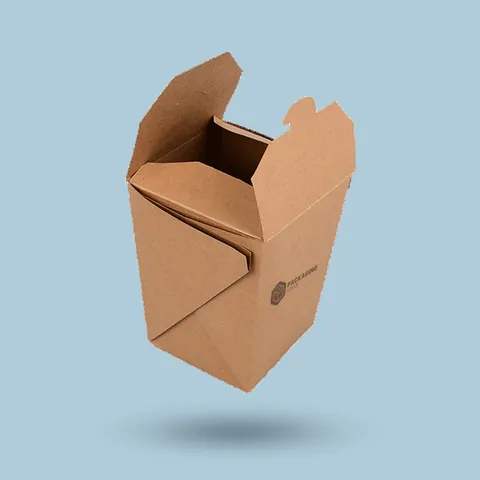
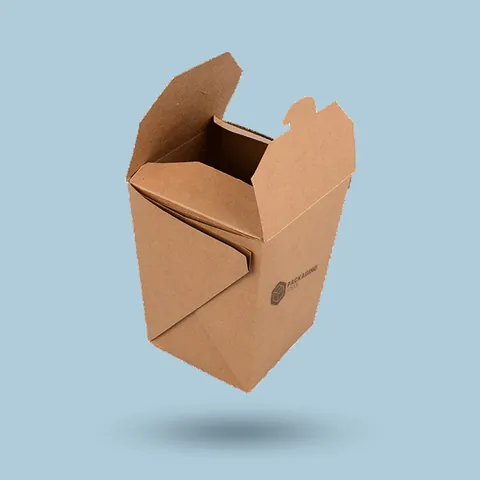
Custom Chinese takeout boxes - also called oyster pails or paper food pails - are the folded, leak-resistant containers that restaurants, ghost kitchens, and food trucks use to serve noodles, fried rice, lo mein, and hot entrees for delivery and carryout.
The classic pail folds up from a flat sheet, locks with a paperboard tab, and carries a wire or folded handle on top. Packaging Vista prints them on food-grade, grease-resistant board with food-contact-safe inks in full CMYK or Pantone-matched color, branded with your logo and artwork.
With a 100-box minimum, free design, dieline, and 3D mockup, and no die, plate, or setup fees, your takeout boxes ship within 8 to 10 business days with free US delivery.
Key takeaways
- The classic oyster pail: folded, tab-locking paper food pails with a wire or folded handle, in mini, 16oz, 26oz, and 32oz sizes.
- Built for food: food-grade board with grease-resistant and poly-lined options so saucy noodles and rice stay contained.
- Low barrier: 100-box minimum, no die, plate, or setup fees, free dieline & 3D mockup, 8-10 day turnaround, free US shipping.
- Go deeper: compare food and beverage boxes, gable boxes, and kraft boxes, then request a free quote.
What is a Chinese takeout box?
A Chinese takeout box — also called an oyster pail or a paper food pail — is a folded, tab-locking food-safe container built from a single flat sheet of paperboard that carries hot noodles, fried rice, saucy stir-fry, and general tso's from restaurant kitchens to customers via counter pickup, drive-thru, and third-party delivery.
The classic pail folds up from a die-cut flat sheet in 3–5 seconds, locks with a paperboard tab, and carries either a wire handle (traditional look, not microwave-safe), a folded paperboard handle (fully recyclable, microwave-safe), or no handle (delivery-optimized).
Standard sizes run 8 oz (sides and sauces), 16 oz (rice and small portions), 26 oz (fried rice and mid-size entrees), 32 oz (full mains and family portions), and 64 oz jumbo (catering and party).
Chinese takeout packaging has three unusual requirements that separate it from most food packaging: reheat compatibility (customers often microwave or oven-heat directly in the pail, so board and coating must be reheat-rated — wire handles must be removed first, folded-handle and handle-free pails are microwave-safe out of the box), tamper evidence for third-party delivery (DoorDash, Uber Eats, and Grubhub expect a visible tamper-strip that breaks when the lid opens), and delivery-bag ergonomics (standard sizes nest efficiently in a 12×12 in delivery bag — 16/26/32 oz pair two-by-two, 64 oz fits one per bag with room for a side).
Takeout box styles and sizes
The pail style and size set the portion, the handle, and the look. These are the takeout box formats we print most often:
Classic oyster pail sizes
The traditional pail comes in a mini size for sides and sauces, a 16oz for rice and small portions, a 26oz for fried rice and mid-size entrees, and a 32oz for full mains and family portions. We build any of these to your dieline so the print wraps cleanly around the panels.
Wire-handle vs folded-handle pails
A wire handle gives the iconic takeout look and an easy carry for hot food, while a folded paperboard handle is fully recyclable and stacks flat for storage. Choose the wire handle for tradition and grip, or the folded handle for a plastic-free, curbside-friendly box.
Window pails and leak-resistant variants
A die-cut window lets customers see colorful noodles or rice before they open the box, a strong fit for grab-and-go displays. For saucy or moist dishes, a leak-resistant, poly-lined variant adds a moisture barrier so the box holds up through delivery.
Standard oyster pail sizes and capacity
| Size | Capacity | Base x top x height | Typical use |
|---|---|---|---|
| Mini | 8 oz (~237 ml) | 2.5 x 2.25 x 2.5 in | Sauces, dips, small sides |
| Small | 16 oz (~473 ml) | 3 x 2.5 x 3.5 in | Rice, small entrees, appetizers |
| Medium | 26 oz (~769 ml) | 3.5 x 3 x 4 in | Fried rice, mid-size entrees |
| Large | 32 oz (~946 ml) | 4 x 3 x 4.5 in | Full mains, family portions |
| Jumbo | 64 oz (~1.9 L) | 5.5 x 4.5 x 5 in | Family / party portions |
Every size folds flat and locks with a paperboard tab. Wire handles are added at pack-out; folded paperboard handles are die-cut into the top panel.
Food-safe and grease-resistant materials
Takeout boxes touch hot, moist food, so the stock matters. We print on food-grade board compliant with FDA 21 CFR 176.170 using food-contact-safe soy-based inks. Barrier options:
- Grease-resistant coating - PFAS-free, blocks oil migration for 60-120+ minutes at food-service temperatures.
- PE (polyethylene) lining - moisture barrier for saucy, high-liquid dishes.
- PLA (compostable) lining - plant-based barrier for commercially compostable programs.
- Uncoated - dry rice, noodles, or fried items with no sauce.
The lining sits on the inside; the outside stays clean for printing. We recommend the right food-safe option for your menu and how the food travels.
Branding the pail
The flat panels of an oyster pail are a built-in canvas. We print your full design in CMYK or Pantone-matched color across every panel - logo, brand colors, patterns, menu callouts, and social handles. Wrap the whole box in a signature color or pattern so it works as a tiny billboard that travels through homes, offices, and delivery bags.
Finishes such as gloss or matte lamination, where food-safe and appropriate, keep the print sharp and the surface easy to wipe.
Custom takeout boxes with your logo
We print Chinese takeout boxes to your exact artwork with a free custom dieline and 3D mockup, so you approve the size, handle, and print before production. The low 100-box minimum makes branded pails practical for a single restaurant location, a new ghost kitchen, or a seasonal menu test - no die, plate, or setup fees, your branding, your dimensions, from the first 100 boxes.
How much do custom Chinese takeout boxes cost?
Custom oyster-pail Chinese takeout box pricing tracks size, barrier coating, handle type, and quantity. Typical ranges at a 500-unit run: $0.20 to $0.50 per box for a mini 8 oz pail (2.5 × 2.25 × 2.5 in) with grease-resistant coating (sauces and small sides); $0.30 to $0.70 per box for a 16 oz pail (3 × 2.5 × 3.5 in) (rice, small entrees); $0.45 to $0.90 per box for a 26 oz pail (3.5 × 3 × 4 in) (fried rice, mid-size entrees); $0.55 to $1.10 per box for a 32 oz pail (4 × 3 × 4.5 in) (full mains, family portions); $0.90 to $1.80 per box for a 64 oz jumbo pail (5.5 × 4.5 × 5 in) (catering, party).
Wire handle adds $0.05–$0.12 per pail (installed at pack-out); folded paperboard handle adds nothing (die-cut into the pail); handle-free is the cheapest. Barrier adders: PFAS-free grease-resistant $0.05–$0.15, PE liner $0.10–$0.25, PLA compostable liner $0.15–$0.35.
Tamper-evident seal-strip adds $0.03–$0.10 per pail. Per-box cost drops 30–40% moving from 500 to 5,000 units. No die, plate, or setup fees on any run.
What drives Chinese takeout box price, in order of impact:
- Size — a 64 oz jumbo pail uses ~4x the board of a mini 8 oz pail.
- Quantity — per-pail cost drops sharply from 100 to 500 to 1,000+. Volume kitchens hit 5,000-pail runs monthly.
- Barrier coating — PLA compostable most expensive, PE mid-tier, PFAS-free grease-resistant cheapest.
- Handle — wire adds cost + pack-out labor; folded paperboard is die-cut free; handle-free saves both.
- Tamper-evident seal-strip — small per-pail cost but essential for third-party delivery.
- Multi-brand variant runs — ghost kitchens print short runs per virtual brand on the same die; digital press keeps unit cost flat across variants.
Send your menu portion sizes, delivery channel (counter pickup vs third-party delivery vs both), and monthly volume on the quote form for exact per-pail pricing.
How long do custom Chinese takeout boxes take to make?
Standard production is 8 to 10 business days after proof approval. Rush production runs in 4 to 6 business days on most orders at no additional charge, including PFAS-free grease-resistant and PE-lined builds. PLA compostable stocks are on-hand and add no lead time.
Wire-handle installation happens at pack-out (30–60 seconds per handle, not during production). Multi-brand ghost-kitchen variant runs (2–4 virtual brands on the same die) add 1 to 3 days for staged press setups. Ground freight from Cheshire, Connecticut adds 2 to 5 days to the West Coast — expect a full quote-to-dock timeline of about 2 to 3 weeks for a first order.
Volume kitchens: back-plan monthly reorders 30 days ahead of when the previous inventory runs out; ghost kitchens launching a new virtual brand: 45 days ahead of the menu-launch date.
Wire handle vs folded handle vs handle-free pail: which should you choose?
The handle choice is the biggest single decision on an oyster pail after size, and it tracks brand story, reheat expectations, and delivery channel. A wire handle is the iconic Chinese-takeout look, gives the strongest one-handed carry for hot food, but is not microwave-safe (customer removes before reheat).
A folded paperboard handle is fully recyclable and plastic-free, microwave-safe out of the box, stacks flat for kitchen storage. A handle-free pail packs the tightest in delivery bags and is the cheapest per unit.
| Wire handle | Folded paperboard handle | Handle-free | |
|---|---|---|---|
| Brand signal | Iconic traditional Chinese takeout | Eco-forward, plastic-free, modern | Delivery-optimized, ghost kitchen |
| Microwave-safe | No (remove wire first) | Yes out of the box | Yes out of the box |
| Carry ergonomics | Strongest one-hand grip | Good for pickup, mid-strong carry | Two-hand only, delivery-bag stacked |
| Storage flat-stack | Wire installed at pack-out (labor + storage) | Fully flat-packed (best storage economics) | Fully flat-packed (best storage economics) |
| Curbside recyclable | Handle separates + recycles differently | Yes, single-stream paper | Yes, single-stream paper |
| Per-pail cost adder | +$0.05–$0.12 wire + pack-out labor | $0 (die-cut into pail) | $0 (cheapest of the three) |
Many restaurants and ghost kitchens run all three across channels: wire-handle pails for counter pickup and the traditional brand story, folded-handle pails for eco-forward menu SKUs (organic bowl, plant-based entree), handle-free pails for the highest-volume delivery routes where every 10% storage improvement pays back in kitchen shelf space.
A matched art system keeps the family look consistent across handle choices.
Pricing, minimums, and turnaround
Takeout box price depends on the pail size, handle type, lining, finishes, and order quantity - and the per-box cost drops as volume rises. There are no die, plate, or setup fees, the minimum is 100 boxes, and standard production runs 8 to 10 business days after proof approval, with rush available.
Every order includes a free dieline, 3D mockup, and free US shipping. Running a US kitchen? See why brands choose a US takeout box manufacturer. Request a free quote with your size, handle choice, and quantity for exact pricing.
Microwave, oven, and reheat-safe takeout pails
Oyster pails and Chinese takeout containers were engineered for reheat as much as transport. Standard uncoated or clay-coated paperboard pails are microwave-safe when the wire handle is removed first (metal handles are not microwave-safe). If your customers reheat directly in the pail, print a small reheat panel on the side (“Remove wire handle before microwaving.
Microwave 60-90 seconds.”) so the instruction stays with the food. For wire-handle-free folded builds, the whole container is microwave-safe out of the box.
Oven-safe pails need a heavier board grade and a food-safe temperature-tolerant coating (usually rated to 400-425°F). This is common for higher-end Chinese and pan-Asian brands that ship “finish at home” entrees. Steam holes or vent scores on the lid keep the pail from ballooning when reheated.
If your menu includes reheat-at-home items, tell us the target reheat temperature and we spec the right stock and vent pattern on the dieline.
Third-party delivery, tamper seals, and multi-item bag builds
Third-party delivery (DoorDash, Uber Eats, Grubhub) added a new job to the takeout box: tamper evidence. A tamper-evident label or a printed seal-strip that visibly breaks when the lid opens tells the customer no one tampered with the food between kitchen and doorstep.
We print a tamper-strip panel that runs across the top folds of the pail so the strip breaks cleanly the first time it opens. It doubles as branded shelf real estate before the shopper opens it.
Multi-item orders need a container mix that packs tightly in a delivery bag. Standard oyster pail sizes (8, 16, 26, 32 oz) nest cleanly two-by-two in a standard 12x12 delivery bag; oversized 42 or 64 oz family-style pails fit one per bag with room for a side.
Print bag-side branding on the taller face of the pail so it faces up in the bag and the driver sees the brand at drop-off. For catering and family-style orders, ask us for a matching corrugated tray that holds three or four pails upright so nothing tips during delivery.
Are custom Chinese takeout boxes worth it for an independent restaurant or ghost kitchen?
Yes, and independent restaurants and ghost kitchens — single-location neighborhood restaurants, food trucks, ghost kitchens operating 2–5 virtual brands from one commercial kitchen, pop-ups and residencies, catering operations, cloud-kitchen delivery-only concepts — are exactly who the 100-box minimum was built for.
A printed 26 oz oyster pail at $0.45–$0.90 per box turns a menu SKU into a branded touchpoint that travels to a customer's home or office and sits on a table alongside DoorDash, Uber Eats, and Grubhub competitor packaging. In third-party delivery specifically, a branded pail is one of the only marketing surfaces a restaurant fully controls — the delivery app owns the discovery experience, but the pail owns the moment the customer opens the bag.
Ghost kitchens have an additional angle: a single kitchen running 3–4 virtual brands can print short runs per virtual brand on the same die (cheap short-run digital press), keeping the physical container consistent while brand art varies by concept.
Beyond brand lift, custom packaging carries a real compliance role for takeout: FDA 21 CFR 176.170 requires food-contact-safe materials for anything touching the food, and state PFAS packaging bans (California AB 1200 effective 2023, plus New York, Washington, Colorado) make PFAS-free grease-resistant coatings a regulatory requirement wherever legacy PFAS-based coatings are banned.
A stock white pail from a restaurant-supply store doesn't guarantee either. Common launch pattern: 100 boxes of a 26 oz pail for a single-restaurant menu debut, then 500–1,000 across 3–4 sizes (16/26/32/64 oz) as sales and third-party delivery volume build.
Direct-competitive kitchens moving to ghost-kitchen multi-brand: 100 pails per virtual brand across a shared dieline, tested and iterated in 30-day cycles.
Are Chinese takeout boxes recyclable?
Yes for most builds. Uncoated and PFAS-free grease-resistant coated oyster pails are curbside-recyclable in nearly every US municipal program — paper and paperboard recovery in the US is 76% per US EPA. Soy and water-based inks keep the pail recyclable and are FDA-compliant under 21 CFR 176.170.
Barrier-coating recyclability varies significantly: PFAS-free grease-resistant coatings stay in the recyclable paper stream (legacy PFAS-based coatings are now banned in California AB 1200 effective 2023, New York, Washington, and Colorado because they contaminate paper recycling); PE (polyethylene) liners are accepted by ~60% of US curbside programs that also take milk cartons; wax coatings are typically NOT curbside-accepted; PLA compostable liners require industrial composting access which is available in limited US markets (typically municipal green-waste programs on the West Coast and Northeast) and require BPI certification (ASTM D6400) to make the "compostable" claim under FTC Green Guides.
The wire handle is the notable non-recyclable component of a traditional oyster pail: the wire itself is metal and separates from the paperboard for curbside metal recycling in most programs, but many consumers don't separate it and the whole pail ends up in landfill.
Folded paperboard handle pails and handle-free pails are fully paper-based and recycle as a single unit. For a fully-recyclable takeout program, we recommend folded-handle or handle-free pails on food-grade paperboard with PFAS-free grease-resistant coating, soy inks, and printing the recycling-stream mark directly on the pail (with wire-handle removal instructions if wire-handle is used).
See eco-friendly boxes for the full sustainable range.
Frequently Asked Questions
Are your Chinese takeout boxes food-safe?
Yes. We print on food-grade board with food-contact-safe inks, and we offer grease-resistant and poly-lined material options for moist or saucy food. We will recommend the right food-safe stock based on your menu and how the food is served.
Will the box hold up to saucy or wet dishes without leaking?
For saucy or moist dishes we use a leak-resistant, poly-lined option that adds a moisture barrier on the inside of the box, so rice, noodles, and sauce stay contained through delivery. The folded, tab-locking pail keeps the contents enclosed while still letting some steam escape.
Can I get the classic wire handle, or a handle-free version?
Both. We build the traditional pail with a sturdy wire handle for the iconic takeout look and an easy carry, a folded paperboard handle for a recyclable, plastic-free box, or a handle-free version if you prefer. The handle choice is built into your dieline.
What sizes do Chinese takeout boxes come in?
Common pail sizes are a mini for sides and sauces, 16oz for rice and small portions, 26oz for fried rice and mid-size entrees, and 32oz for full mains and family portions. We match the size to your typical portion and confirm it on the 3D mockup.
Can you make a custom size or window pail?
Yes. Beyond the standard sizes, we cut takeout boxes to your exact dimensions, given as length x width x depth, and can add a die-cut window so customers see the food before they open the box. Send your portion size or a sample and we will supply a free dieline and 3D mockup.
How much do custom Chinese takeout boxes cost?
Cost depends on the pail size, handle type, lining, finishes, and order quantity, and it falls as volume increases. Because every job is custom, we quote per project rather than list a flat price - but there are never die, plate, or setup fees, and the minimum is just 100 boxes. Send your size and quantity for an exact, no-obligation quote.
What is the lead time and minimum order?
The minimum is 100 boxes with no die or setup fees. Standard production runs 8 to 10 business days after proof approval, with rush available if your launch or menu change is on a tight timeline. Every order ships with free US delivery.
Are your oyster pails microwave-safe?
The paperboard pail itself is microwave-safe; the wire handle is not. For wire-handle builds we print a “remove wire handle before microwaving” note on the side panel. Folded-handle or handle-free pails are microwave-safe out of the box.
Do you make tamper-evident seal strips for third-party delivery orders?
Yes. We print a tamper-evident seal-strip that runs across the top folds so it visibly breaks the first time the pail is opened. This satisfies DoorDash, Uber Eats, and Grubhub tamper-evidence expectations and doubles as branded real estate on top of the pail.
What pail size matches standard rice, noodle, and entree portions?
8 oz for a small rice or side; 16 oz for a standard rice or noodle portion; 26 oz for a shareable entree or two-person side; 32 oz for a family-size entree or shared rice. 42 and 64 oz pails are used for catering and family-style meals. Tell us your typical portion sizes and we can help you pick a two- or three-size lineup that covers your menu.
What is a Chinese takeout box?
A Chinese takeout box (also called an oyster pail or paper food pail) is a folded, tab-locking food-safe container built from a single flat sheet of paperboard that carries hot noodles, fried rice, saucy stir-fry, and Chinese entrees from kitchens to customers via pickup, drive-thru, and third-party delivery.
Folds up in 3–5 seconds, locks with a paperboard tab, carries wire handle (traditional look, not microwave-safe), folded paperboard handle (recyclable, microwave-safe), or no handle (delivery-optimized). Standard sizes: 8/16/26/32/64 oz. Three unusual requirements: reheat compatibility, tamper evidence for third-party delivery, and delivery-bag ergonomics.
How much do custom Chinese takeout boxes cost?
Rough ranges at a 500-unit run: mini 8 oz $0.20 to $0.50 per pail; 16 oz $0.30 to $0.70; 26 oz $0.45 to $0.90; 32 oz $0.55 to $1.10; 64 oz jumbo $0.90 to $1.80. Wire handle adds $0.05–$0.12 per pail (installed at pack-out); folded handle die-cut into pail at no extra cost; handle-free is cheapest.
Barrier adders: PFAS-free grease-resistant $0.05–$0.15, PE liner $0.10–$0.25, PLA compostable $0.15–$0.35. Tamper-evident seal-strip $0.03–$0.10. Per-box cost drops 30 to 40 percent moving from 500 to 5,000 units. No die, plate, or setup fees.
Wire handle vs folded handle vs handle-free — which should I choose?
Wire handle: iconic Chinese-takeout look, strongest one-hand carry, +$0.05–$0.12 per pail + pack-out labor, NOT microwave-safe (customer removes first). Folded paperboard handle: eco-forward and plastic-free, microwave-safe out of the box, stacks flat for kitchen storage, $0 extra (die-cut into pail).
Handle-free: delivery-optimized, packs tightest in delivery bags, cheapest of the three. Many restaurants and ghost kitchens run all three across channels.
How do you design a delivery-safe custom Chinese takeout box, step by step?
Six steps: (1) match pail size to menu portion and delivery-bag fit (16/26/32 oz pair two-by-two in a 12×12 in delivery bag), (2) choose barrier by menu type (PFAS-free grease-resistant for saucy stir-fry, PE for soups, PLA for compost claims, uncoated for dry rice), (3) spec handle style (wire for traditional look, folded for microwave-safe eco, handle-free for delivery-optimized), (4) add reheat spec if customers heat in the pail (microwave-safe uncoated + steam vents; oven-safe 400–425°F for finish-at-home entrees), (5) reserve tamper-evident seal-strip for third-party delivery (DoorDash/Uber Eats/Grubhub), (6) print + die-cut + ship flat-packed for kitchen assembly.
Are custom Chinese takeout boxes worth it for an independent restaurant or ghost kitchen?
Yes — single-location neighborhood restaurants, food trucks, ghost kitchens operating 2–5 virtual brands, pop-ups, catering, and cloud-kitchen delivery-only concepts are exactly who the 100-box MOQ was built for. A printed 26 oz pail at $0.45–$0.90 turns a menu SKU into a branded touchpoint that owns the moment the customer opens the delivery bag (the delivery app owns discovery; the pail owns unboxing).
Ghost kitchens can print short runs per virtual brand on the same die. FDA 21 CFR 176.170 compliance + state PFAS bans (CA AB 1200, NY, WA, CO) also make custom packaging a regulatory floor a stock white pail from restaurant-supply doesn't guarantee.
Are Chinese takeout boxes recyclable?
Yes for most builds. Uncoated and PFAS-free grease-resistant coated pails are curbside-recyclable — US paper recovery is 76% (US EPA). PE liners accepted by ~60% of programs that also take milk cartons. Wax typically NOT curbside-accepted. PLA compostable requires industrial composting access (limited US) and BPI certification (ASTM D6400).
The wire handle is the notable non-recyclable component (metal separates for curbside metal recycling but many consumers don't separate it). Folded-handle and handle-free pails are fully paper-based and recycle as a single unit.
Who orders custom chinese takeout boxes?
Custom food and beverage packaging is ordered by operators whose packaging must be food-safe, grease-resistant, and camera-ready in the same moment.
- Bakeries and pastry shops — window cake boxes, cupcake trays, and cookie cartons in grease-resistant SBS with your logo on the lid.
- Restaurants, cafés, and ghost kitchens — takeout containers, sandwich wraps, and delivery-ready boxes that survive a 30-minute delivery bag.
- Craft beverage and coffee brands — 6-pack and 12-pack carriers, coffee bag boxes, and gift crates with FDA-compliant food-contact inks.
- Chocolate and confectionery makers — rigid gift boxes and folding cartons with foil, embossing, and food-safe internal dividers.
- Meal-kit and subscription food services — mailer boxes with cold-chain-compatible liners and recipe-card compartments.
How to order custom chinese takeout boxes
Five steps from quote to delivery. Every order includes free design support, a free custom dieline, and a digital mockup for approval before anything hits the press.
- Share your specs. Send box dimensions (or a photo of the product), quantity, material preference, and any artwork or logo files. If you're unsure of the size, our design team can advise from a product photo.
- Get a quote and mockup. Within one business day we return a firm quote, a printable dieline, and a 3D digital mockup of your chinese takeout boxes. No die, plate, or setup fees are added.
- Approve the proof. Review the mockup, request color, layout, or dieline changes, and give final approval. Revisions are unlimited before press.
- Production (8–10 business days). Your order runs on offset or digital press, then moves through finishing — lamination, spot UV, foil stamping, embossing, die-cutting, and assembly if needed.
- Free US shipping. Orders ship flat-packed with tracking. Assembled bundles or master-carton packing are available on request at no charge.
Resources & tools
Free tools and trusted references to help you size, spec, and choose the right chinese takeout boxes before you order.
Free tools & guides
- Food packaging by product – match the right food-safe box to what you sell.
- Food & beverage packaging hub – compare every food-grade box style we make.
- Box Size & Dimensional Weight Calculator – size your box and see the billable weight UPS, FedEx, and USPS charge.
Trusted references
- FDA — Packaging & Food Contact Substances – the federal rules on materials that touch food.
- FDA — Food Labeling & Nutrition – the federal rules for food product labels and nutrition facts.
- USDA — Food Safety & Inspection Service – federal food-safety guidance for meat, poultry, and processed foods.
- How2Recycle – the standardized on-pack recycling label for paperboard and kraft packaging.