Custom Sleeve Boxes
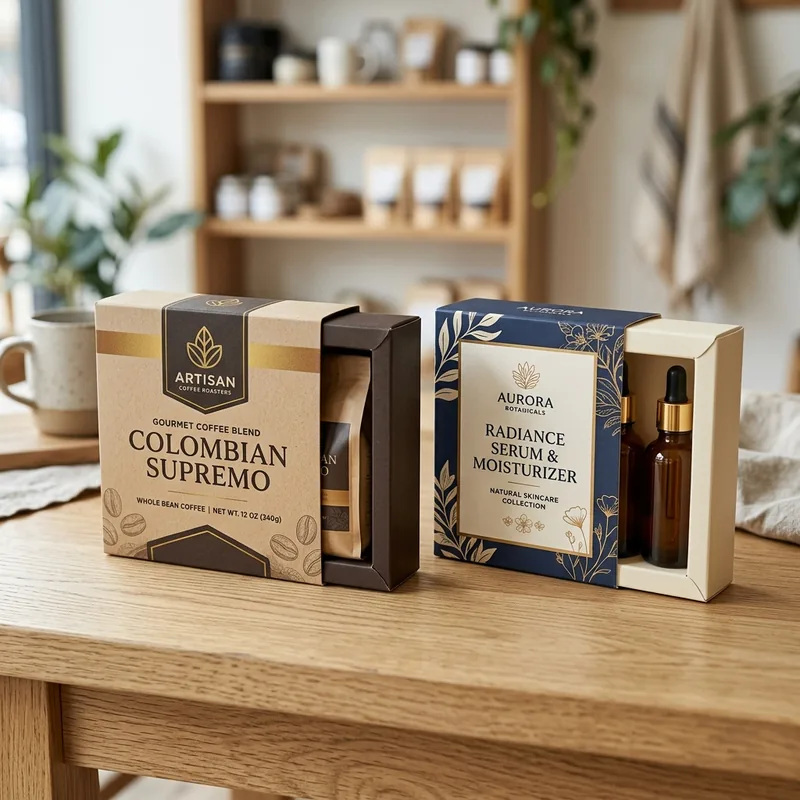
Custom sleeve boxes are a printed outer sleeve that slides over an inner tray or box. They give products a smooth slide-to-open reveal that feels premium without the cost of a full rigid box.
The family includes sleeve-and-tray (drawer) boxes, a sleeve that wraps a folding carton or rigid base, and lighter belly bands that wrap just the middle of a product. Packaging Vista prints sleeve packaging in SBS cardstock, kraft, or rigid chipboard.
Full CMYK and Pantone color, with finishes like soft-touch lamination, foil stamping, embossing, and spot UV. With a 100-box minimum, free design, dieline, and 3D mockup, and no die, plate, or setup fees, your sleeve boxes ship in 8 to 10 business days with free US delivery.
Key takeaways
- Slide-to-open reveal: a printed sleeve slides over an inner tray or box for a premium unboxing moment at a lower cost than full rigid.
- Many forms: sleeve & tray (drawer), sleeve over a folding carton or rigid base, full sleeves, and printed belly bands.
- Low barrier: 100-box minimum, no die, plate, or setup fees, free dieline & 3D mockup, 8-10 day turnaround, free US shipping.
- Go deeper: compare rigid boxes, product boxes, and retail boxes, then request a free quote.
Sleeve box styles
The build sets the unboxing feel and the price. These are the sleeve packaging styles we make most often:
Sleeve and tray (drawer) boxes
An inner tray slides out of an outer sleeve like a matchbox or drawer. Sleeve-and-tray boxes feel playful and hold inserts firmly. A great fit for cosmetics, chocolates, electronics, and premium subscription kits. Both the sleeve and the tray can be fully printed.
Sleeve over a folding carton
An open-ended printed sleeve slides over a stock folding carton or tuck box. This is the cheapest sleeve format. It adds branding and finishes to a plain inner box. You can also swap seasonal or short-run sleeves over the same base carton.
Sleeve over a rigid box
A sleeve wrapped around a rigid base or tray gives a gift-grade, luxury feel. The mix pairs the plush hand-feel of rigid board with the smooth slide reveal of a sleeve. Common for high-end beauty and electronics.
Belly bands
A belly band wraps just the middle of a product or box, covering about a quarter of it. So most of the product stays in view. Bands are made from lighter stock and are mainly about branding and a finishing touch rather than protection. A cheap way to dress up plain packaging.
Full vs partial sleeves
A full sleeve covers the product on all sides for a hidden, guarded reveal. A partial sleeve or band leaves part of the product on view. Full sleeves use thicker cardstock and add support. Partial sleeves and bands use less stock and lead with branding.
Sleeve box format comparison
| Format | Stock (sleeve) | Panel coverage | Best for |
|---|---|---|---|
| Sleeve & tray (drawer) | 14-18 pt SBS or 2 mm rigid | Full four-sided wrap | Cosmetics, chocolate, electronics, premium subs |
| Sleeve over folding carton | 14-16 pt SBS or kraft | Full outer wrap | Seasonal/limited-edition art on plain base |
| Sleeve over rigid box | 16-24 pt SBS | Full outer wrap over 1.5-2 mm base | Luxury beauty, high-end tech |
| Belly band (heavy) | 100-120 gsm coated paper | 25-33% of panel middle | Books, food, gift add-on |
| Belly band (light) | 80-100 gsm text stock | 10-20% band across middle | Wine bottle labels, soap wraps |
| J-fold sleeve | 14-18 pt SBS | Front + spine only | CDs, hardware kits, sample sets |
Sleeve inside should be 1-2 mm larger than the inner tray on each side. That lets it slide smoothly without wobble. Add 1/8 in relief for lamination thickness on both faces.
How sleeves add a premium reveal
The pull of a sleeve box is the moment of opening. As the sleeve slides off the tray, the product comes into view in a slow, thought-through way that feels high-end. That is the kind of unbox buyers photograph and share.
Because the sleeve carries the print and finish while the inner tray can stay simple, you get a luxury look without the full cost of a rigid build. Pair a sleeve with a rigid box base when you want the heft of setup-box build and the slide reveal together.
Materials and finishes
Material sets the weight and feel. Finish sets the impression. We build sleeve boxes in:
- SBS cardstock for a smooth, bright printable face on lighter retail items.
- Kraft for a natural, eco-minded look - see kraft boxes.
- Rigid chipboard for a sturdy, gift-grade sleeve or tray.
Mix finishes to lift the unbox. Soft-touch lamination for a velvet hand-feel. Foil stamping in gold, silver, or color. Embossing or debossing for a raised mark. Spot UV for gloss contrast against a matte sleeve. Window patching to show the product. Everything prints in full CMYK with Pantone-matched color.
Custom sleeve boxes with your branding
We print sleeve boxes to your exact art in full CMYK and Pantone-matched color. A free custom dieline and 3D mockup let you sign off on the slide fit and finish before we print. The dieline tolerances are built around your product sizes. So the sleeve glides on smoothly but holds firmly.
Sleeve packaging suits cosmetics, food and gourmet, subscription and gift sets, and electronics. No die, plate, or setup fees. Your brand and sizes, from the first 100 boxes.
Pricing, minimums, and turnaround
Sleeve box pricing depends on size, format (a sleeve-and-tray or rigid sleeve costs more than a plain sleeve over a folding carton), material, finishes, and count. Per-box cost drops as volume rises. There are no die, plate, or setup fees. The minimum is 100 boxes.
Standard production runs 8 to 10 business days after proof approval, with rush on offer. Every order comes with a free dieline, 3D mockup, and free US shipping. Request a free quote with your size and count for exact pricing.
What is a sleeve box?
A sleeve box is a printed outer sleeve or wrap that slides over an inner container — a paperboard tray or drawer, a folding carton (see tuck end boxes), a rigid setup box (see rigid boxes), or the product itself in the case of belly bands — delivering a slide-to-open reveal moment at a fraction of the cost of a full rigid-luxury build.
The sleeve is engineered with a 1–2 mm larger dimension than the inner base on each side plus 1/8 in laminate relief so it glides smoothly on and holds firmly at rest. The family includes sleeve-and-tray (drawer) boxes with an inner tray that slides out like a matchbox, sleeve over folding carton where a printed sleeve dresses up a plain base, sleeve over rigid box for luxury unboxing, belly bands that wrap only the middle of a product, and J-fold sleeves covering front and spine only.
Sleeve packaging has three unusual properties that separate it from every other structural pack-style: the two-part construction is unique among structural pillars — every other structural format is a single connected blank, while sleeve requires a printed outer PLUS an inner container engineered together with 1–2 mm slide-tolerance and 1/8 in laminate relief, the slide-to-open reveal is a tactile moment the sleeve is specifically engineered to deliver — the friction-fit tolerance is the difference between a wobbly sleeve that feels cheap and a firm-slide sleeve that reads as premium unboxing, and the seasonal-swap capability is unique to sleeve — one shared base carton dieline can host 6–12 different sleeve designs per year (holiday, limited-edition, collaboration, seasonal-flavor variants) at a small marginal cost vs re-tooling the whole carton per variant.
How much do custom sleeve boxes cost?
Sleeve box pricing scales by format, size, stock, finishes, and quantity, with the per-unit price dropping meaningfully as volume rises. Ballpark ranges by format (before finishes and volume discounts, based on a 4×3×2 in benchmark for tray-based formats and same-panel-area for bands):
- Belly band, light (80–100 gsm text stock, 10–20% coverage) — $0.05 to $0.20 per band in 1,000–5,000-unit runs. Wine-bottle labels, soap wraps, and book bands where branding matters more than reveal.
- Belly band, heavy (100–120 gsm coated paper, 25–33% coverage) — $0.08 to $0.30 per band. Book bands, food and gourmet product wraps, gift add-ons.
- Sleeve over folding carton (14–16 pt SBS or kraft, full outer wrap) — $0.25 to $0.70 per sleeve on top of the base carton cost. The cheapest full-sleeve format, ideal when a stock tuck-end base needs seasonal or limited-edition art (adds no tooling to the base).
- Sleeve-and-tray / drawer (14–18 pt SBS sleeve + 14–18 pt SBS tray) — $0.55 to $1.60 per unit including both sleeve and tray. The classic slide-to-open reveal for cosmetics, chocolate, electronics, and subscription reveal-kits.
- Sleeve over rigid box (16–24 pt SBS sleeve + 1.5–2 mm rigid base) — $1.80 to $4.50 per unit including both sleeve and base. Luxury beauty, high-end tech, and premium gifting.
- J-fold sleeve (14–18 pt SBS, front + spine only) — $0.20 to $0.60 per sleeve. CDs, hardware kits, sample sets where side coverage is unnecessary.
Sleeve-specific adders: seasonal-swap program setup (multiple sleeve dielines sharing one base carton) is $0 in additional tooling — each new sleeve variant runs at the marginal per-unit cost above with no plate or die fees. Standard finishes on sleeves: soft-touch or matte lamination $0.05–$0.12, foil stamping $0.08–$0.20 per stamped area, embossing $0.10–$0.25, spot UV $0.05–$0.15, die-cut window with clear PET film patch $0.15–$0.40 (see window boxes).
Request a free quote with format, sleeve + inner-base dimensions, and quantity.
How long do custom sleeve boxes take to make?
Standard sleeve box production is 8–10 business days after proof approval, with rush lanes in 4 to 6 days for launch dates. Add 1–2 days for sleeve-and-tray (drawer) format where both the sleeve and tray require independent dielines. Add 2–4 days for sleeve-over-rigid-box because the rigid base is a longer production step (see rigid boxes).
Add 1–3 days for multi-variant seasonal-swap runs where 3–12 sleeve designs share one base carton.
Launch back-plans unique to sleeve structural pillar: sleeve-and-tray formats follow standard retail back-plans (30–45 day DTC, 60–90 day natural-food/specialty retail, 90–120 day big-box). Seasonal-swap sleeve programs have a two-phase back-plan unique to sleeve: Phase 1 — base-carton production runs once per year (typically 8–10 weeks ahead of the first seasonal drop) with a 5,000–20,000-unit base-carton inventory built at volume-discount pricing.
Phase 2 — sleeve variant swaps run 4–6 weeks ahead of each seasonal drop (100–5,000 units per variant) at the marginal per-unit sleeve cost. This two-phase model lets brands respond to holiday, limited-edition, or collaboration opportunities on a 4–6 week timeline rather than the 10–12 weeks a full-carton re-tool would require.
Sleeve-and-tray vs sleeve over folding vs sleeve over rigid vs belly band vs J-fold
Five common sleeve formats map to price tier, coverage, and use case:
| Format | Panel coverage | Inner base | Reveal moment | Best for | Cost per unit |
|---|---|---|---|---|---|
| Sleeve-and-tray (drawer) | Full four-sided wrap | Paperboard tray | Slide-out drawer reveal | Cosmetics, chocolate, electronics, subscription reveal-kits | $0.55–$1.60 |
| Sleeve over folding carton | Full outer wrap | Stock tuck-end carton | Slide-off + tuck-open reveal | Seasonal-swap, limited-edition, collaboration art | $0.25–$0.70 sleeve + base |
| Sleeve over rigid box | Full outer wrap | 1.5–2 mm rigid setup base | Slide-off + rigid lid lift reveal | Luxury beauty, high-end tech, premium gifting | $1.80–$4.50 |
| Belly band (heavy) | 25–33% panel middle | None (wraps product) | Band slides off, product on view | Books, food, gourmet, gift add-on | $0.08–$0.30 |
| Belly band (light) | 10–20% band middle | None | Minimal — brand accent only | Wine-bottle labels, soap wraps | $0.05–$0.20 |
| J-fold sleeve | Front + spine only | None or minimal tray | Book-cover accent, no reveal | CDs, hardware kits, sample sets | $0.20–$0.60 |
Inner-base row unique to sleeve structural pillar: sleeve is the only structural pillar where the format decision requires specifying both an outer sleeve AND an inner container (or the product itself for belly bands). Every other structural pillar is a single connected blank — the two-part construction is what enables the seasonal-swap model.
Are custom sleeve boxes worth it for a brand that needs seasonal-swap art or a premium slide-to-open reveal?
For brands running holiday programs, limited-edition drops, collaborations, or reveal-focused unboxing moments, sleeve boxes deliver a structural capability no other pack-style matches. The typical buyers of custom sleeve boxes at the 100–5,000 box range include: cosmetic and skincare brands with limited-edition palette drops and holiday collections (see cosmetic boxes); chocolate and confectionery brands with seasonal flavor drops and holiday assortments (see chocolate boxes); electronics brands with tiered product-family SKUs sharing a base carton across generations; DTC subscription-box brands using sleeve-and-tray reveal-kits as the unboxing moment (see subscription boxes); wine and spirits brands with belly-band label programs and limited-release wraps (see beverage boxes); soap and bath-and-body brands with kraft belly bands wrapping wrapped bars (see soap boxes); book publishers and food brands with belly-band programs; luxury beauty brands using sleeve-over-rigid for flagship SKUs (see rigid boxes); and any gift box program where the slide-to-open reveal is the retail moment.
Three reasons sleeve is worth the two-part-construction premium over a single-carton alternative: (1) The two-part construction lets brands split print investment strategically — the sleeve carries the richest finish (foil, emboss, soft-touch, spot UV) while the inner tray or base stays simple, delivering a luxury look at 30–60% of the cost of a full rigid-luxury build. (2) The seasonal-swap capability is unique to sleeve among structural pack-styles — one shared base carton dieline hosts 6–12 sleeve variants per year (holiday, limited-edition, collaboration) with the base ordered once at volume and sleeves ordered as smaller variant runs, enabling 4–6 week seasonal-launch cycles versus the 10–12 weeks a full-carton re-tool would require. (3) The slide-to-open reveal is a tactile moment shoppers photograph and share — the 1–2 mm friction-fit tolerance is engineered specifically to deliver a firm-slide feel that reads as premium, which drives Instagram/UGC share rates on sleeve-and-tray unboxing content.
Are sleeve boxes recyclable?
Plain sleeve box paperboard is broadly curbside-recyclable across virtually every US municipal program — both the outer sleeve and the inner tray or folding-carton base are single-material paperboard with no plastic or metal components in the classic build.
Belly bands (both light text stock and heavy coated paper) are broadly curbside-recyclable. J-fold sleeves are single-material paperboard. Sleeve over folding carton is fully paperboard on both parts. Sleeve-and-tray drawer is fully paperboard on both parts.
FSC-certified paperboard is available across all sleeve stock tiers and is the eco-brand baseline for sleeve programs.
Where recyclability gets nuanced is with sleeve-over-rigid-box builds (the rigid base uses chipboard that recycles but wrap-paper laminate needs consideration — see rigid boxes for the full breakdown) and with laminated sleeve finishes: soft-touch and gloss laminates reduce curbside acceptance because the plastic laminate contaminates paper recycling; matte varnish or aqueous coating is the recyclable-friendly premium alternative.
Die-cut window with clear film patch requires film removal (see window boxes for full film-decision breakdown). For a fully recyclable sleeve build: pair FSC-certified SBS or kraft with matte varnish (skip laminate), skip windows or use PET/RPET, and use the sleeve-over-folding-carton or belly-band formats (avoid sleeve-over-rigid).
FTC Green Guides (16 CFR Part 260) govern "recyclable" claim wording — plain uncoated sleeves + inner bases qualify for the unqualified "recyclable" claim; laminated variants should carry the "recyclable where facilities exist" qualified claim.
Frequently Asked Questions
What is the difference between a sleeve and tray box and a belly band?
A sleeve and tray box is a printed outer sleeve that an inner tray slides into. It covers the product on all sides for a full slide-to-open reveal. A belly band is a lighter strip that wraps only the middle of a product, covering about a quarter of it so most stays in view. Sleeve and tray boxes guard and hide the product. Belly bands are mainly for branding and a finishing touch.
Can a sleeve be paired with a rigid box for a luxury feel?
Yes. We build sleeves that slide over a rigid base or tray. That mix pairs the plush hand-feel of setup-box build with the smooth slide reveal of a sleeve. It is a popular pick for high-end beauty, gifting, and electronics where both heft and presentation matter.
What materials can sleeve boxes be made from?
We make sleeve boxes in SBS cardstock for lighter retail items, kraft for a natural eco-minded look, and rigid chipboard for a sturdy, gift-grade feel. We will pick the right stock for your product weight, then supply a free dieline and 3D mockup. So you can sign off on the slide fit before we print.
What finishes work well on a sleeve box?
Sleeve boxes pair well with soft-touch lamination, foil stamping, embossing or debossing, spot UV, and window patching. The sleeve carries most of the print. So you can put your richest finish there – say a soft-touch matte sleeve with a gold foil logo – while keeping the inner tray plain.
What sizes and dimensions can I get?
Any size – sleeve boxes are made to your product sizes, given as length x width x depth. The tray and sleeve tolerances are built for a smooth but firm slide. If you are unsure, send a sample or product specs. We will size the box and supply a free dieline and 3D mockup to sign off the fit before we print.
How much do custom sleeve boxes cost?
Cost depends on the size, format, material, finishes, and order count. It falls as volume rises. Because every job is custom, we quote per project rather than list a flat price. But there are never die, plate, or setup fees, and the minimum is just 100 boxes. Send your sizes and count for an exact, no-obligation quote.
What is the lead time and minimum order on sleeve boxes?
The minimum is 100 units with no die, plate, or setup fees. So even a small first run stays cheap. Plan for the standard 8 to 10 business-day turnaround after proof approval. Rush production is on offer if your launch date is tight.
What is a sleeve box, and how is it different from other structural styles?
A sleeve box is a printed outer sleeve or wrap that slides over an inner container (paperboard tray or drawer, folding carton, rigid setup box, or the product itself in the case of belly bands), delivering a slide-to-open reveal at a fraction of the cost of a full rigid-luxury build.
The sleeve is engineered with a 1–2 mm larger dimension than the inner base on each side plus 1/8 in laminate relief so it glides smoothly and holds firmly. Three unusual properties: the two-part construction (printed outer + inner container) is unique among structural pillars — every other structural format is a single connected blank; the slide-to-open reveal is a tactile moment specifically engineered via the 1–2 mm friction-fit tolerance; the seasonal-swap capability is unique to sleeve — one shared base carton dieline hosts 6–12 sleeve variants per year at low marginal cost vs re-tooling the whole carton per variant.
How much do custom sleeve boxes cost by format?
Ranges by format on a 4×3×2 in benchmark at 1,000+ units: belly band light (80–100 gsm, 10–20% coverage) $0.05–$0.20; belly band heavy (100–120 gsm, 25–33%) $0.08–$0.30; sleeve over folding carton (14–16 pt SBS or kraft, full wrap) $0.25–$0.70 on top of base carton; sleeve-and-tray drawer (14–18 pt SBS sleeve + tray) $0.55–$1.60 including both parts; sleeve over rigid box (16–24 pt SBS + 1.5–2 mm rigid base) $1.80–$4.50 including both parts; J-fold sleeve (14–18 pt SBS front + spine) $0.20–$0.60.
Finish adders on the sleeve: soft-touch/matte $0.05–$0.12, foil $0.08–$0.20, embossing $0.10–$0.25, spot UV $0.05–$0.15, die-cut window with PET film patch $0.15–$0.40. Seasonal-swap program setup is $0 additional tooling — each new sleeve variant runs at the marginal per-unit cost.
Which sleeve format do I need — sleeve-and-tray, sleeve over folding, sleeve over rigid, belly band, or J-fold?
Match format to reveal moment and price tier. Sleeve-and-tray drawer ($0.55–$1.60) fits cosmetics, chocolate, electronics, subscription reveal-kits — the classic slide-out matchbox reveal. Sleeve over folding carton ($0.25–$0.70 on top of base) fits seasonal-swap, limited-edition, collaboration art where the base carton stays constant and sleeves rotate.
Sleeve over rigid box ($1.80–$4.50) fits luxury beauty, high-end tech, premium gifting — pairs rigid heft with slide reveal. Belly band (light $0.05–$0.20, heavy $0.08–$0.30) fits wine-bottle labels, soap wraps, book bands, gourmet-food add-ons where branding matters more than reveal.
J-fold sleeve ($0.20–$0.60) fits CDs, hardware kits, sample sets where side coverage is unnecessary.
How do I spec a custom sleeve box step by step?
Six steps: (1) Pick the inner base — paperboard tray/drawer, folding carton, rigid setup box, or none (belly band or J-fold). (2) Measure the inner base and apply sleeve tolerances (1–2 mm larger per side + 1/8 in laminate relief for smooth-slide firm-hold engineering). (3) Pick sleeve stock by brand tier and inner-base weight (14–16 pt SBS for folding-carton bases; 14–18 pt SBS or 2 mm rigid for sleeve-and-tray; 16–24 pt SBS over rigid; 80–120 gsm coated for bands). (4) Choose sleeve coverage (full four-sided wrap / partial band 10–33% / J-fold front+spine). (5) Add finishes on the sleeve (soft-touch, foil, emboss, spot UV, window patch) while inner base stays simple. (6) Plan sleeve as permanent SKU-specific outer OR seasonal-swap outer over shared base carton (unique to sleeve).
Are custom sleeve boxes worth it for a brand that needs seasonal-swap art or a premium slide-to-open reveal?
Yes, for any brand running holiday programs, limited-edition drops, collaborations, or reveal-focused unboxing. Three reasons: (1) Two-part construction lets brands split print investment strategically — sleeve carries richest finish (foil, emboss, soft-touch, spot UV) while inner tray or base stays simple, delivering luxury look at 30–60% of full rigid-luxury cost. (2) Seasonal-swap capability is unique to sleeve among structural pack-styles — one shared base carton dieline hosts 6–12 sleeve variants per year with base ordered once at volume and sleeves ordered as smaller variant runs, enabling 4–6 week seasonal-launch cycles vs the 10–12 weeks a full-carton re-tool would require. (3) Slide-to-open reveal is a tactile moment shoppers photograph and share — 1–2 mm friction-fit tolerance is engineered specifically to deliver firm-slide feel that reads as premium, driving Instagram/UGC share rates on sleeve-and-tray unboxing content.
Fits cosmetics, chocolate, electronics, subscription reveal-kits, wine, soap, book publishing, luxury beauty, and premium gifting.
Are sleeve boxes recyclable?
Plain sleeve paperboard is broadly curbside-recyclable across virtually every US municipal program — both the outer sleeve and inner tray or folding-carton base are single-material paperboard with no plastic or metal in the classic build. Belly bands (light text stock and heavy coated paper), J-fold sleeves, sleeve over folding carton, and sleeve-and-tray drawer are all fully paperboard.
FSC-certified paperboard available across all stock tiers. Nuances: sleeve-over-rigid-box uses chipboard + wrap-paper laminate (see /rigid-boxes for full recyclability breakdown); soft-touch and gloss laminates on sleeves reduce curbside acceptance (matte varnish or aqueous coating is recyclable-friendly alternative); die-cut window with clear film patch requires film removal (see /window-boxes for film breakdown).
Most-recyclable build: FSC SBS or kraft + matte varnish (skip laminate) + skip windows or use PET/RPET + use sleeve-over-folding-carton or belly-band formats (avoid sleeve-over-rigid). FTC Green Guides (16 CFR Part 260) govern claim wording.
Who orders custom sleeve boxes?
Custom retail and eco packaging is ordered by brands that need clean, recyclable, shelf-ready boxes without compromising branding.
- Eco-focused consumer brands — kraft and recycled-content boxes with soy-based inks and clear recyclability messaging on the panel.
- Independent retailers and boutiques — branded shopping boxes, gift boxes, and tissue paper for the in-store unboxing.
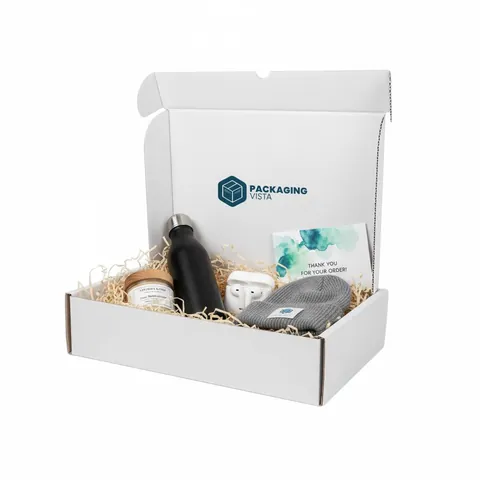
- Subscription-box operators — corrugated mailer boxes with printed inserts, tissue paper, and rip strips for the reveal moment.
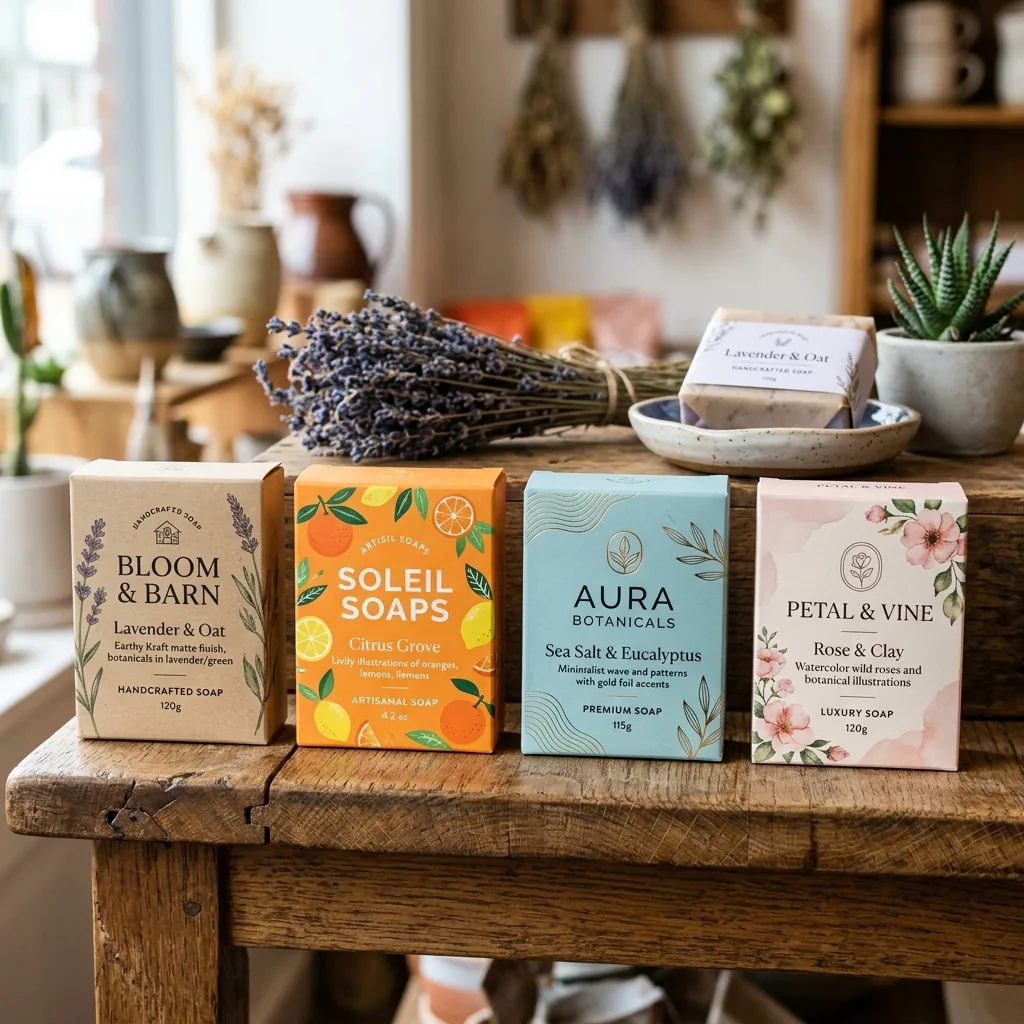
- Candle, soap, and home-fragrance makers — kraft candle boxes, custom soap sleeves, and pillow boxes for gift retail.
- Etsy and DTC handmade brands — low-MOQ 100-box runs so a new SKU can launch without committing to pallet quantities.
How to order custom sleeve boxes
Five steps from quote to delivery. Every order includes free design support, a free custom dieline, and a digital mockup for approval before anything hits the press.
- Share your specs. Send box dimensions (or a photo of the product), quantity, material preference, and any artwork or logo files. If you're unsure of the size, our design team can advise from a product photo.
- Get a quote and mockup. Within one business day we return a firm quote, a printable dieline, and a 3D digital mockup of your sleeve boxes. No die, plate, or setup fees are added.
- Approve the proof. Review the mockup, request color, layout, or dieline changes, and give final approval. Revisions are unlimited before press.
- Production (8–10 business days). Your order runs on offset or digital press, then moves through finishing — lamination, spot UV, foil stamping, embossing, die-cutting, and assembly if needed.
- Free US shipping. Orders ship flat-packed with tracking. Assembled bundles or master-carton packing are available on request at no charge.
Resources & tools
Free tools and trusted references to help you size, spec, and choose the right sleeve boxes before you order.
Free tools & guides
- Packaging materials – compare SBS, kraft, corrugated, and rigid stocks.
- Custom boxes hub – every box style we print, in one place.
- Box Size & Dimensional Weight Calculator – size your box and see the billable weight UPS, FedEx, and USPS charge.
Trusted references
- How2Recycle – the standardized on-pack recycling label for paperboard and kraft packaging.
- Forest Stewardship Council (FSC) – certification for responsibly sourced paper and board.
- FEFCO — International Fibreboard Case Code – the standard code (0201, 0427, etc.) that defines every box style.
- ISTA — International Safe Transit Association – the industry-standard packaging performance test protocols.
- EPA — Sustainable Materials Management – federal guidance on reducing packaging waste at end of life.