Custom Vape Boxes
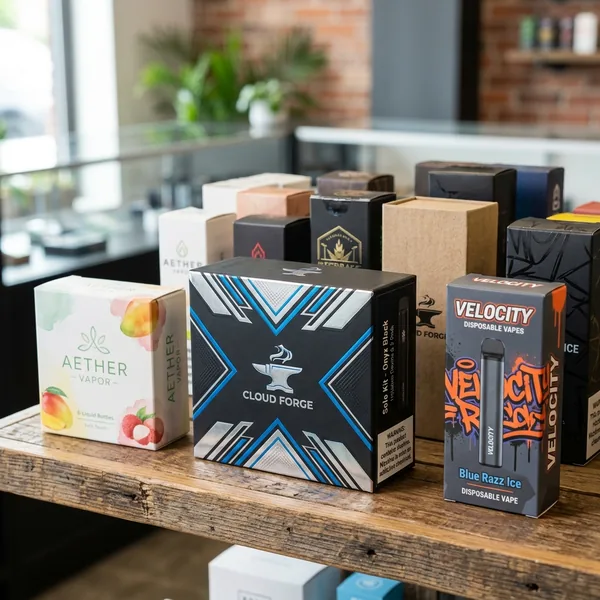
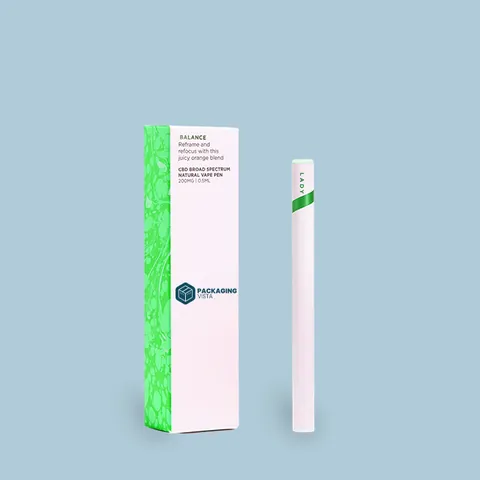
Custom vape boxes are printed cartons and rigid cases built to hold e-cig hardware. That means carts, disposables, pods, batteries, and e-liquid bottles. Snug inserts hold parts still, and child-resistant closures are added where needed.
Vape is a crowded, tightly ruled shelf. The pack has to do two jobs at once. First, keep fragile glass-and-metal devices from rattling in transit. Second, tell a brand story strong enough to earn a second look.
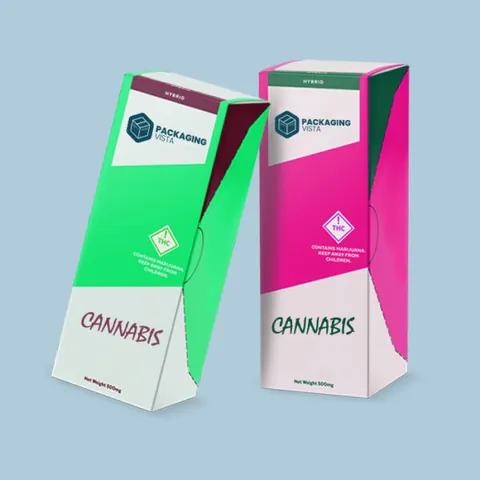
Whether you sell nicotine disposables, refillable pod systems, or cannabis vape carts, we build the box around your device and your rules. If your line is on the cannabis side, start with our cannabis packaging options and layer the vape shape on top.
Key takeaways
- Device-fit inserts: foam or paperboard trays cradle glass carts, pods, and batteries so nothing shifts or cracks in shipping.
- Child-resistant options: CR tuck locks and press-and-slide rigid mechanisms are ready to spec – check your own state and federal rules before you sign off.
- Warning-label ready: we lay out art with clear, open space for nicotine or THC warnings and lot/batch info.
- Low minimum: 100-box minimum, no die or plate fees, free dieline and 3D mockup, 8–10 business-day turnaround.
What is a vape box?
A vape box is child-resistant, FDA-warning-compliant printed packaging engineered around specific e-cig or cannabis vape hardware — a 510-thread cartridge, a JUUL-style pod, a disposable, a battery kit, an e-liquid bottle, or a pen mod — built to protect fragile glass-and-metal components in transit while carrying the regulatory warning stack the category demands.
Unlike almost any other retail packaging, a vape box has to be a compliance instrument first: US CR packaging sits under three standards (16 CFR 1700.20, ASTM D3475, ASTM F3358), the Child Nicotine Poisoning Prevention Act of 2015 requires CR for liquid-nicotine products, the FDA requires the 30% panel nicotine warning in Helvetica Bold with a black border on nicotine products, and the PMTA (Premarket Tobacco Application) authorization required for tobacco products since 2016 must be reflected on packaging.
Vape packaging has three unusual requirements that separate it from every other category: child-resistant certification (not an add-on — CR is required by federal law for liquid-nicotine and by most state laws for cannabis vape), strict FDA warning-panel formatting (30% panel coverage, Helvetica Bold, black border, specific wording), and anti-youth-appeal design constraints (FDA guidance and many state laws restrict cartoons, fruit/candy visuals, bubble-letter typography, and youth-appealing color palettes — art that reads as youth-appealing risks an FDA warning letter and SKU removal from shelves).
What vape packaging has to solve
A vape box is small, yet its contents are both fragile and tightly ruled. Inside sits a glass tank or cart, a lithium battery, a mouthpiece, and often e-liquid. These parts scratch, leak, or shatter if they move around.
On the outside, the box has to carry set warning text, brand marks, and shelf punch. It also has to stand out in a category where dozens of look-alike disposables sit side by side. Our job is to solve all that in one carton, so your product arrives whole and looks like it fits on a premium shelf.
Who orders custom vape boxes
Buyers span nicotine disposable and e-cig brands, refillable pod and open-system hardware makers, e-liquid bottlers, and cannabis or CBD vape lines that run cart and disposable SKUs. Start-ups launching a first device love the 100-piece minimum and free design help.
Bigger brands run flavors and nicotine strengths across many SKUs. They value Pantone match and repeatable inserts. If you also sell pre-filled joints, our pre-roll boxes keep the whole line-up on-brand.
Box styles that fit vape hardware
Most cart and disposable packs start as a tuck-end carton or a straight-tuck folding carton. These are cheap, quick to fill, and roomy enough for an insert. For premium pod systems or flagship devices, a two-piece rigid box or a press-and-slide rigid case reads as higher value and holds a cleaner CR mechanism.
Want the device seen at retail? We can add a window box cutout with a PET film patch so shoppers see the hardware without opening the pack. Not sure which shape fits your device? Our box styles guide walks through the trade-offs.
Inserts that stop the rattle
Loose hardware is the top cause of returns in this category. So the insert matters as much as the outer box. We build snug trays and cavities matched to your device size. That means a molded or die-cut well to cradle a glass cart, a foam bed for a battery, or a folded paperboard tray that holds a disposable and its charge cable with no slack.
Paperboard inserts keep the pack fully recyclable. Foam gives the most shock guard for fragile glass tanks and e-liquid vials. Either way, the goal is zero movement. Pick up the box, shake it, and hear nothing.
Child-resistant and compliance
Child-resistant closures are widely needed for vape products, above all those with nicotine or THC. US CR packaging sits under two standards:
- 16 CFR 1700.20 - the CPSC Poison Prevention Packaging Act protocol for CR and senior-friendly testing.
- ASTM D3475 - classification standard for CR package types.
- ASTM F3358 - test method for reclosable single-use CR packaging for e-liquid carts.
For nicotine products, the Child Nicotine Poisoning Prevention Act of 2015 says liquid-nicotine containers must meet 16 CFR 1700.15 and 1700.20. The FDA also asks for PMTA (Premarket Tobacco Application) approval. Plus, a "WARNING: This product contains nicotine..." statement must cover at least 30% of the main display panels.
Cannabis vape rules vary state by state (many follow ASTM D3475 or F3358). We offer:
- CR-style tuck locks for folding cartons
- Press-and-slide rigid CR mechanisms for premium boxes
- Push-and-turn rigid closures for higher-security builds
Treat our CR options as tools. Check what your product needs with your own legal counsel. Our overview of child-resistant packaging shows how these locks work in practice.
Print, finish, and shelf punch
Every vape box prints in full CMYK with Pantone (PMS) match. That keeps your brand colors the same across every flavor and reorder. These are small cartons seen up close, so finish choices carry real weight.
Soft-touch lam gives a rich matte feel. Spot UV makes a logo or flavor name pop against a matte field. Foil stamp in gold, silver, or holo adds the metal cue that shoppers link with good hardware. Gloss or matte lam also guards small-format print from the scuffs of pocket-carry. For cannabis lines, keep finishes tied to the rest of your CBD packaging so the family reads as one brand.
Sizing and how to spec your box
Send us the device and we handle the rest. Or give us three sizes – length, width, and depth of the hardware, plus any extras that ship with it.
Tell us if the device sits flat or stands upright. Say if a charge cable or spare pods go in the same pack. Note if you need a window or a CR closure. We build a free dieline and a 3D mockup so you can check the fit before anything prints. We can tune the cavity to the millimeter for a snug, rattle-free hold.
How much do custom vape boxes cost?
Custom vape box pricing tracks device form-factor, CR closure type, and finish stack. Typical ranges at a 500-unit run: $0.40 to $1.20 per box for a slim tuck-end cartridge or JUUL-style pod carton (90 × 15 × 8 to ø9 × 65 mm) on 18–20 pt SBS; $0.60 to $1.60 per box for a disposable vape carton (105 × 20 × 12 to 120 × 45 × 25 mm) with print-heavy flavor panel; $1.00 to $2.40 per box for a cart + battery kit two-cavity carton with foam or paperboard tray; $1.50 to $3.50 per box for a rigid two-piece premium pod system or pen mod build with EVA cavity insert; $2.50 to $6.00 per box for a magnetic-closure or press-and-slide CR rigid box for flagship devices.
CR closure adders: CR-style tuck lock $0.05–$0.15 per box (cheapest), press-and-slide rigid CR mechanism $0.50–$1.50, push-and-turn rigid closure $0.30–$1.00. Insert adders: die-cut EVA foam $0.20–$0.80, die-cut paperboard $0.10–$0.40, molded pulp $0.15–$0.60.
Multi-flavor variant runs on the same dieline share setup meaningfully. Per-box cost drops 30–40% moving from 500 to 5,000 units. No die, plate, or setup fees on any run.
What drives vape box price, in order of impact:
- Structure — tuck-end cheapest, magnetic-closure rigid 5–10x more expensive. Biggest lever.
- CR closure — certified rigid CR mechanisms (press-and-slide, push-and-turn) cost more than CR-style tuck locks but are required for many cannabis vape state programs.
- Insert material — EVA foam grips glass carts best; paperboard is recyclable; molded pulp is plastic-free.
- Quantity — per-box cost drops sharply from 100 to 500 to 1,000+.
- Finish stack — foil + soft-touch + spot UV is the premium vape standard; disposables often run one accent finish.
- Multi-flavor variants — running 4–8 flavors on the same dieline shares setup cost; digital press keeps unit cost flat across variants at low volume.
Send your device form-factor, CR requirements (nicotine or cannabis; which states), and quantity on the quote form for exact per-box pricing.
How long do custom vape boxes take to make?
Standard production is 8 to 10 business days after proof approval. Rush production runs in 4 to 6 business days on most orders at no additional charge, including CR-tuck-lock and single-finish builds. Rigid CR builds with press-and-slide or push-and-turn mechanisms add 1 to 2 days for hand-assembly.
Third-party CR certification testing (when a state program requires ASTM D3475 or F3358 verification) adds 2 to 3 weeks for the lab test cycle — flag this on the quote so a compliance requirement doesn't surprise your launch date. Stacked prestige finishes (foil + soft-touch + spot UV) add 1 to 2 days.
Multi-flavor variant runs add 1 to 3 days for staged press setups. Ground freight from Cheshire, Connecticut adds 2 to 5 days to reach the West Coast. Vape brands targeting PMTA product-launch dates: back-plan 60 to 90 days ahead so the co-packer has printed cartons before PMTA-authorized inventory ships.
Tuck-end CR vs rigid press-and-slide vs magnetic-closure rigid: which should you choose?
Three main structural decisions cover most vape programs. A tuck-end CR folding carton is the volume-disposable and mid-tier pod choice — cheapest, ships flat, quick to fill, CR-tuck-lock closure meets many state programs. A rigid press-and-slide CR box is the premium flagship-device choice — heavier chipboard wrapped in printed paper, holds a cleaner CR mechanism, signals premium quality on retail shelves.
A magnetic-closure rigid box is the ultra-premium hardware and collector-edition choice — magnetic snap plus fitted EVA cavity for flagship devices, corporate-gift vape gear, and multi-hardware kits.
| Tuck-end CR carton | Rigid press-and-slide CR | Magnetic-closure rigid | |
|---|---|---|---|
| Board | 18–22 pt SBS with CR-tuck-lock | 1.5–2 mm chipboard wrapped | 2–3 mm chipboard wrapped |
| CR mechanism | CR-style tuck lock (cheapest) | Press-and-slide (spring-loaded lock) | Push-and-turn or slide (highest security) |
| Ships to you | Flat, folds at pack-out | Assembled | Assembled |
| Insert compatibility | Paperboard cavity, thin EVA | EVA cavity, molded pulp | Full EVA + satin liner + cable well |
| Typical cost (500-run) | $0.60–$2.00 (CR-lock adder $0.05–$0.15) | $1.50–$4.50 (CR-mech adder $0.50–$1.50) | $2.50–$6.00 (CR-mech adder $0.30–$1.00) |
| Best for | Disposables, mid-tier pods, cart bundles | Premium pods, flagship devices, pen mods | Ultra-premium hardware, kits, collector editions |
Many vape brands run all three across a product line: tuck-end CR for volume disposable SKUs and cart bundles, rigid press-and-slide CR for the flagship pod system, magnetic-closure rigid for a limited-edition or hardware-kit tier. A matched art system keeps the family look consistent while each structure hits its own channel economics.
Minimums, pricing, and turnaround
Vape boxes start at a 100-box minimum with no die, plate, or setup fees. So a new device or flavor test does not need a warehouse-filling run. Every order comes with free design help, a free dieline, a 3D mockup, and a digital proof.
Pricing is quote-based and depends on structure, stock, finishes, and count. Production runs 8–10 business days after proof approval, with free US shipping. Request a quote with your device details and we'll turn around a spec and price fast.
Common vape hardware sizes to spec around
Vape hardware falls into a few standard form factors, and each has its own tight tolerance. Give us the exact device or its dimensions, but here are the sizes we build to most often as a starting reference:
| Device type | Typical dimensions | Insert notes |
|---|---|---|
| 510-thread cartridge (1 mL) | ø9 × 65 mm | Straight tube or slim tuck; die-cut foam collar |
| 510 cartridge with battery kit | ø10 × 110 mm | Two-cavity die-cut foam or paperboard tray |
| Pod system (JUUL-style) | 90 × 15 × 8 mm | Slim tuck-end with printed insert |
| Disposable vape (2 mL) | 105 × 20 × 12 mm | Straight tuck or auto-lock, snug fit, no rattle |
| Disposable vape (5000+ puff) | 120 × 45 × 25 mm | Rigid or heavy tuck, print-heavy panel for flavor |
| Pen mod / advanced device | 150 × 30 × 30 mm | Rigid two-piece box with fitted EVA or paperboard cavity |
Send us the device with your quote request, or share length, width, diameter, and net weight. We build the dieline to that hardware plus a 0.5 to 1 mm insert tolerance so the device slides in cleanly but does not rattle in transit.
Vape marketing and shipping rules to design around
Vape packaging faces more rules than almost any other category. Get these built into the artwork from the start and you avoid a reprint later:
- FDA nicotine warning. Any nicotine-containing product sold in the US must carry the FDA warning "WARNING: This product contains nicotine. Nicotine is an addictive chemical." on the principal display panel, in a specific size (at least 30% of the panel for cartons under a size threshold) and in Helvetica Bold with a black border. We reserve the exact panel space and typeset the warning on every proof.
- State-specific warnings. California Prop 65 requires an added exclamation-mark warning. Some states restrict flavor names for youth appeal. Send us the states you sell into and we flag any extra marks needed.
- No cartoon or youth-appeal imagery. FDA guidance and many state laws restrict artwork that could appeal to minors — cartoons, fruit characters, candy-style typography. We flag artwork that looks likely to draw a warning letter, but you and your regulatory advisor make the final call.
- Child-resistant marks. If the product is a cannabis vape or a nicotine pod covered by the Poison Prevention Packaging Act, add the ASTM D3475 child-resistant certification mark on the pack. We supply CR-certified structures on request.
- PACT Act and USPS. Since 2021, USPS cannot ship most vape products. Your outer shipping label and carrier are affected, not the retail box, but plan your fulfillment (UPS, FedEx, private carrier) before you finalize inventory.
None of this changes the box structure. It changes the panel layout and reserved space. Our free dieline includes room for every mark you tell us you need, at the right proportion, before we quote.
Are custom vape boxes worth it for an indie vape or cannabis-vape brand?
Yes, and indie vape brands — independent e-cig hardware makers, refillable pod-system startups, cannabis cart brands, THC disposable makers with state-legal distribution, e-liquid bottlers, hemp-derived Delta-8 and HHC vape brands, small nicotine disposable startups with PMTA-authorized products — are exactly who the 100-box minimum was built for.
Vape is one of the most compliance-heavy retail categories in the US and one of the most brand-crowded (dozens of look-alike disposables in every convenience-store cooler and every dispensary case). A stock white cart tube signals no-brand to shoppers, and worse, doesn't guarantee child-resistant certification or FDA nicotine-warning panel compliance — both of which trigger state and federal enforcement actions that pull SKUs from shelves.
Custom packaging is unusually consequential for indie vape brands for three reasons: CR certification is required by federal law (Child Nicotine Poisoning Prevention Act of 2015 for liquid nicotine; state cannabis programs enforce ASTM D3475 or F3358 with pull-from-shelf teeth), the FDA nicotine warning has strict formatting rules (30% panel coverage, Helvetica Bold, black border — an amateur label doesn't hit the panel-proportion requirement, which is one of the most common warning-letter triggers), and anti-youth-appeal design is a landmine (fruit visuals, cartoon-adjacent illustration, bubble-letter typography, and youth-appealing color palettes all draw FDA scrutiny, and a stock carton with a printed sticker offers no design guardrails).
Custom packaging on FDA-warning-ready dielines with certified CR structures also solves the packaging half of the PMTA process for nicotine products. Common indie launch pattern: 100 boxes for a single-flavor test of a hero disposable SKU (or 100 CR-certified cart tubes for a cannabis vape launch), then 500–1,000 across 4–8 flavors as retail placement builds.
For cannabis-heavy brands, cross-reference the packaging system with CBD packaging and cannabis boxes; for pre-roll adjacencies, see pre-roll boxes.
Are vape boxes recyclable?
Outer paperboard box: yes for most builds. SBS, kraft, and rigid chipboard vape cartons are all curbside-recyclable in nearly every US municipal program — paper and paperboard recovery in the US is 76% per US EPA. Soy and water-based inks keep the box recyclable and are FDA-compliant.
Small foil accents on a hero logo or flavor name are usually accepted by curbside programs; full-panel metallic wraps are not. PET or PVC window patches on window-cutout builds reduce recyclability — bio-film alternatives keep the box in the paper stream.
Insert-material recyclability varies: die-cut paperboard cavities recycle with the box; molded pulp cavities recycle; die-cut EVA foam cradles (the vape standard for glass-cart protection) do NOT recycle with the box but are removable and can be reused.
The device itself is the recycling challenge for vape: single-use disposables include a lithium-ion battery embedded with a plastic and metal shell, and disposal is complicated — the FDA and state programs increasingly require e-waste collection at retail (many US markets have vape-take-back programs at dispensaries and vape shops).
Print the recycling-stream mark for the outer box directly on the pack, and include a small note on the pack about the device's take-back or battery-drop-off options where applicable. Under FTC Green Guides (16 CFR Part 260), any recyclability claim needs substantiation.
See eco-friendly boxes for the full sustainable range.
Frequently asked questions
Do you offer child-resistant vape boxes?
Yes. We offer CR-style tuck locks for folding cartons and press-and-slide rigid CR mechanisms for premium boxes. CR rules vary by product type and by state, so check what your nicotine or cannabis product needs with your own legal counsel before you order.
Can the box hold both a cartridge and a battery?
Yes. We build custom inserts – foam or die-cut paperboard trays – with separate wells sized to your cart, battery, pods, and any charge cable. Every part sits snug and nothing rattles in transit.
Is there room on the artwork for warning labels?
Yes. We lay out the art with clear, open space for nicotine or THC warning text, needed symbols, and lot or batch codes. That way, set text stays easy to read without crowding your brand marks.
What box style works best for disposables versus premium pods?
Disposables and stock carts usually fit a tuck-end or folding carton. These are cheap and quick to fill. Premium pod systems and flagship devices suit a two-piece rigid or press-and-slide rigid box. These read as higher value and hold a cleaner CR mechanism.
What is the minimum order and turnaround?
The minimum is 100 boxes with no die, plate, or setup fees. Production runs 8–10 business days after you sign off the digital proof, and US shipping is free.
Can shoppers see the device through the box?
Yes. We can add a window cutout with a clear PET film patch so the hardware is seen at retail. Or keep the box fully closed with printed images – whichever fits your merchandising and rules.
Do you supply the FDA nicotine warning artwork?
We reserve the correctly-sized panel space and typeset the exact FDA warning text in Helvetica Bold with the required border. You confirm the wording matches current FDA rules for your product; we handle the layout so it lands at the correct proportion of the principal display panel.
Can you make child-resistant vape boxes?
Yes. We supply ASTM D3475-certified child-resistant structures for cannabis vapes and any nicotine product that requires them. Common CR formats are certified push-and-turn tucks and CR-fitted rigid boxes. Send us the state or program you sell under and we recommend the right certified build.
What art will get a warning letter from the FDA?
Artwork that could appeal to minors is the main risk area — cartoons, fruit or candy characters, bubble-letter typography, kid-focused color schemes. We flag anything on your artwork that looks at risk, but the final regulatory call is yours or your compliance advisor's. This is design guidance, not legal advice.
What is a vape box?
A vape box is child-resistant, FDA-warning-compliant printed packaging engineered around specific e-cig or cannabis vape hardware (510-thread cartridge, JUUL-style pod, disposable, battery kit, e-liquid bottle, pen mod). US CR packaging sits under 16 CFR 1700.20 + ASTM D3475 + ASTM F3358; Child Nicotine Poisoning Prevention Act of 2015 requires CR for liquid nicotine; FDA requires 30% panel nicotine warning in Helvetica Bold with black border; PMTA authorization must be reflected on packaging.
Three unusual requirements: CR certification (not optional), strict FDA warning-panel formatting, anti-youth-appeal design constraints.
How much do custom vape boxes cost?
Rough ranges at a 500-unit run: slim tuck-end cartridge or JUUL-style pod $0.40 to $1.20 per box; disposable vape $0.60 to $1.60; cart + battery kit two-cavity $1.00 to $2.40; rigid two-piece premium pod or pen mod with EVA cavity $1.50 to $3.50; magnetic-closure or press-and-slide CR rigid flagship $2.50 to $6.00.
CR closure adders: tuck-lock $0.05–$0.15, press-and-slide $0.50–$1.50, push-and-turn $0.30–$1.00. Insert adders: EVA foam $0.20–$0.80, paperboard $0.10–$0.40. Per-box cost drops 30 to 40 percent moving from 500 to 5,000 units.
Tuck-end CR vs press-and-slide vs magnetic-closure rigid — which should I choose?
Tuck-end CR carton: 18–22 pt SBS with CR-tuck-lock, cheapest, ships flat, $0.60–$2.00 at 500 — for disposables, mid-tier pods, cart bundles. Rigid press-and-slide CR: 1.5–2 mm chipboard wrapped with spring-loaded press-and-slide lock, $1.50–$4.50 at 500 — for premium pods, flagship devices, pen mods.
Magnetic-closure rigid: 2–3 mm chipboard with magnetic snap + fitted EVA cavity, $2.50–$6.00 at 500 — for ultra-premium hardware, kits, collector editions. Many brands run all three.
How do you design a PMTA and CR-compliant vape box, step by step?
Six steps: (1) measure device + pick form-factor carton (510-thread cart / JUUL pod / disposable / battery kit / pen mod all have standard dimensions), (2) spec CR closure per product + state (16 CFR 1700.20 + ASTM D3475 / F3358; nicotine falls under Child Nicotine Poisoning Prevention Act 2015; cannabis vape state programs vary), (3) reserve panel space for FDA nicotine warning (30% panel coverage, Helvetica Bold, black border), (4) plan for PMTA authorization + state-specific labeling (Prop 65, flavor-name restrictions, anti-youth-appeal), (5) design inserts to stop rattle (EVA foam grips glass carts, paperboard recyclable indie alternative), (6) print + finish + plan PACT Act shipping restrictions (USPS blocked since 2021, use UPS/FedEx/private carrier).
Are custom vape boxes worth it for an indie vape or cannabis-vape brand?
Yes — indie vape brands (independent e-cig hardware, refillable pod-system startups, cannabis cart brands, THC disposable makers, e-liquid bottlers, hemp-derived Delta-8/HHC vape, small PMTA-authorized nicotine disposable startups) are exactly who the 100-box MOQ was built for.
CR certification is required by federal law, FDA nicotine warning has strict formatting rules (30% panel + Helvetica Bold + black border), and anti-youth-appeal design is a landmine. Custom packaging solves the packaging half of the PMTA process for nicotine products.
A stock white cart tube signals no-brand and doesn't guarantee CR or FDA panel compliance.
Are vape boxes recyclable?
Outer paperboard box: yes for most builds. SBS, kraft, and rigid chipboard vape cartons are curbside-recyclable — US paper recovery is 76% (US EPA). Insert-material varies: paperboard and molded pulp cavities recycle with the box; die-cut EVA foam (vape standard for glass-cart protection) doesn't recycle but is removable/reusable.
The device itself is the recycling challenge — single-use disposables include a lithium-ion battery embedded with plastic/metal shell; FDA and state programs increasingly require e-waste collection at retail (vape-take-back programs at dispensaries and vape shops).
Under FTC Green Guides claims must be substantiated.
Who orders custom vape boxes?
Custom CBD and cannabis packaging is ordered by licensed operators who need compliant, brand-forward boxes across the full plant-touching supply chain.
- Licensed hemp and CBD brands — tincture boxes, gummy cartons, and topical packaging with FDA-style facts panels and warning statements pre-laid out.
- State-licensed cannabis dispensaries — flower jars, pre-roll tubes, and edible cartons that meet each state's child-resistant and opaque-window rules.
- Vape and e-cigarette manufacturers — cartridge boxes and battery kit packaging with nicotine warnings, batch codes, and QR-linked lab results.
- White-label and private-label formulators — unbranded or lightly-branded stock boxes ready to drop-ship as retailer-branded SKUs.
- Compliance-driven startups — child-resistant certified structures (ASTM D3475 / 16 CFR 1700.20) so a launch clears state inspection on the first try.
How to order custom vape boxes
Five steps from quote to delivery. Every order includes free design support, a free custom dieline, and a digital mockup for approval before anything hits the press.
- Share your specs. Send box dimensions (or a photo of the product), quantity, material preference, and any artwork or logo files. If you're unsure of the size, our design team can advise from a product photo.
- Get a quote and mockup. Within one business day we return a firm quote, a printable dieline, and a 3D digital mockup of your vape boxes. No die, plate, or setup fees are added.
- Approve the proof. Review the mockup, request color, layout, or dieline changes, and give final approval. Revisions are unlimited before press.
- Production (8–10 business days). Your order runs on offset or digital press, then moves through finishing — lamination, spot UV, foil stamping, embossing, die-cutting, and assembly if needed.
- Free US shipping. Orders ship flat-packed with tracking. Assembled bundles or master-carton packing are available on request at no charge.
Resources & tools
Free tools and trusted references to help you size, spec, and choose the right vape boxes before you order.
Free tools & guides
- US vape box sourcing – cartridge and device box options for US brands.
- Child-resistant CBD packaging – CR closures and what the rules require.
- CBD & cannabis packaging hub – compliant, child-resistant box styles we make.
Trusted references
- CPSC — Child-Resistant Packaging (PPPA) – federal child-resistant packaging requirements.
- FDA — Center for Tobacco Products – federal regulations for cigarettes, vapes, and ENDS products.
- How2Recycle – the standardized on-pack recycling label for paperboard and kraft packaging.
- FTC — Advertising & Marketing Guidance – federal truth-in-advertising rules for on-pack product claims.