Custom E-Cigarette Boxes
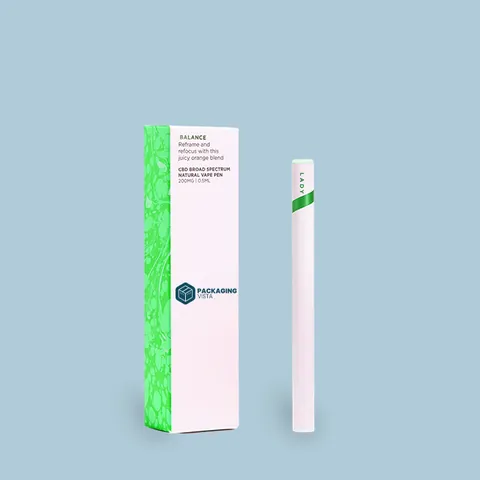
Custom e-cigarette boxes are printed retail cartons for an e-cig device or starter kit. They house the battery or mod, pods, cartridges, charger, and add-ons. Every part is cradled, safe, and set up to sell on the shelf.
Unlike packs for one-use disposables, kit packs hold a reusable device and its parts as a unit. So inserts and shape matter. Packaging Vista prints e-cig boxes in full CMYK and Pantone color. We add foam or paperboard inserts that seat the device and pods. Finishes include soft-touch film, foil, emboss, and window patching.
The minimum is 100 boxes. No die, plate, or setup fees. You get a free dieline and 3D mockup. Orders ship in 8 to 10 business days with free US delivery.
Key takeaways
- Built for the device: boxes for e-cig kits, mods, pod systems, batteries, and cartridges - not just disposables.
- Inserts that protect: custom foam or paperboard cradles hold the battery, pods & charger so nothing shifts in transit.
- Low barrier: 100-box minimum, no die, plate, or setup fees, free dieline & 3D mockup, 8-10 day turnaround, free US shipping.
- Go deeper: compare disposable vape boxes, CBD packaging, and cigarette boxes, then request a free quote.
What is an e-cigarette box?
An e-cigarette box is FDA-Deeming-Rule-compliant printed packaging engineered around a reusable e-cig device or starter kit and its accessories — a battery or mod, one or more pods or cartridges, a charging cable, spare coils, warranty and instruction cards.
Unlike vape boxes (which cover the broader category including single-use disposables), e-cigarette boxes are typically built around reusable multi-part kit systems where the pack has to hold a device plus its refill accessories in split-pocket inserts and still meet the same regulatory stack: FDA Deeming Rule 21 CFR 1140.16(d) nicotine warning at 30% of both principal panels, Child Nicotine Poisoning Prevention Act 2015 CR requirements for liquid-nicotine parts, PMTA authorization for the product itself, and PACT Act restrictions on outer shipping.
E-cigarette kit packaging has three unusual requirements that separate it from other vape packaging: multi-cavity insert engineering (a starter kit contains 4-8 discrete components — battery + 2-4 pods + charger + coil + warranty card + instructions — each requiring its own compartment so nothing shifts or scratches the device in transit), strict FDA warning-panel formatting on BOTH principal panels (30% coverage per panel with Helvetica Bold at 12pt minimum with rectangular border — the biggest branding real-estate constraint of any vape category since it consumes both front and back hero panels), and device compatibility and hardware-spec callouts (pod compatibility, nicotine strength, ohm rating, wattage range, contents list, lithium-ion battery notice for parcel shipping — repeat-purchase shoppers scan for compatibility before flavor).
E-cigarette box styles
The right shape depends on whether you ship a single device or a full starter kit. These are the styles we print most for e-cig brands:
Rigid device and kit boxes
A high-end, non-collapsible box wrapped in printed paper. It often has a magnet or lift-off lid. Rigid builds suit flagship mods and full kits where the open should feel rich. See our rigid boxes for closures and finishes.
Tuck-end folding cartons
A printed paperboard carton with straight or reverse tuck ends. It is the cost-friendly, retail-ready pick for pod systems, single devices, and refill packs. It folds flat for storage and snaps up fast on the line.
Window boxes
A clear PVC or PET patch lets shoppers see the real device before they buy. Window patching pairs well with tuck or two-piece styles when the hardware is the sales pitch. See window boxes.
Boxes with foam or paperboard inserts
The top kit format. A sturdy box holds a die-cut foam or paperboard tray. The tray seats the battery, pods, cartridges, and charger in split pockets. Each part has its own spot, so nothing rattles.
Blister-friendly and display-ready boxes
For pegged or counter sales, we build boxes sized for blister cards. Or with a built-in hang tab and a front display panel.
Inserts and device protection
An e-cig kit is fragile and multi-part. So the insert does the real work. We design die-cut foam, EVA, or paperboard trays that cradle the battery or mod. They seat pods and cartridges upright. They also keep the charger and add-ons from sliding into the device.
The insert is built into your dieline and 3D mockup. So you confirm that every part fits and stays put before we print. That guards the hardware from bumps and travel shock.
Compliance and warning label space
E-cigarette packaging in the US must comply with several federal requirements:
- FDA Deeming Rule (21 CFR 1140.16(d)) - the "WARNING: This product contains nicotine. Nicotine is an addictive chemical" statement must occupy at least 30% of both principal display panels, in Helvetica bold or Arial bold, 12 pt minimum on packaging, black text on white background (or vice versa) with a rectangular border.
- Child Nicotine Poisoning Prevention Act of 2015 - liquid nicotine containers need child-resistant packaging per 16 CFR 1700.15 and 1700.20.
- PMTA (Premarket Tobacco Application) - all e-cigarette products need FDA marketing authorization.
We lay out your panels with the needed 30% reserved for the warning. We offer CR closures for liquid-nicotine parts. You confirm the exact rules for your product and market. We build the structure to fit. This is packaging advice, not legal advice.
Custom e-cigarette boxes with your branding
We print your e-cig boxes to your exact art in full CMYK with Pantone-matched spot colors for brand-true logos. Add soft-touch, gloss, or matte film, foil stamping, emboss, spot UV, and window patching. These make the device or kit feel high-end on the shelf.
Every order includes a free dieline and 3D mockup. So you approve the shape, fit, and finish before we go to press. No die, plate, or setup fees. Your size, from the first 100 boxes.
How much do custom e-cigarette boxes cost?
Custom e-cigarette kit box pricing tracks structure, insert complexity, and finish stack. Typical ranges at a 500-unit run: $0.60 to $1.60 per box for a tuck-end folding carton for single-device retail SKUs or pod refill packs (single-cavity paperboard insert); $1.20 to $2.80 per box for a two-cavity tuck-end carton for a device + spare pods pack; $2.00 to $4.50 per box for a rigid two-piece starter-kit box (battery + 2 pods + charger + coil) with EVA foam insert; $3.50 to $7.00 per box for a magnetic-closure or lift-off-lid rigid premium starter kit with multi-cavity EVA cavity insert, satin liner, and stacked prestige finishes; $4.00 to $9.00 per box for a flagship-mod collector's-edition box with CR-mechanism + multi-accessory tray.
CR closure adders: CR-tuck lock $0.05–$0.15 per carton, press-and-slide rigid $0.50–$1.50, push-and-turn $0.30–$1.00. Insert adders: die-cut EVA foam multi-cavity $0.40–$1.60 (heavier than disposable inserts because of accessory count), die-cut paperboard multi-cavity $0.20–$0.70, molded pulp $0.25–$0.90.
Multi-flavor variant runs on the same dieline share setup meaningfully. Per-box cost drops 30–40% moving from 500 to 5,000 units. No die, plate, or setup fees on any run.
What drives e-cigarette box price, in order of impact:
- Structure — tuck-end cheapest, magnetic-closure rigid 5–8x more expensive. Biggest lever.
- Insert complexity — a starter kit's 4–8 discrete compartments make e-cig-kit inserts among the most expensive on the site.
- CR closure — certified CR mechanisms required for kits with liquid-nicotine refills; adds meaningful cost on rigid builds.
- Quantity — per-box cost drops sharply from 100 to 500 to 1,000+.
- Finish stack — premium mod kits reward soft-touch + foil + spot UV stacking; retail refill SKUs run one accent finish.
- Window patching — PET film patch to show the hardware costs $0.15–$0.40 per box but drives impulse purchase.
Send your device dimensions, kit contents (accessory list), CR requirements, and quantity on the quote form for exact per-box pricing.
How long do custom e-cigarette boxes take to make?
Standard production is 8 to 10 business days after proof approval. Rush production runs in 4 to 6 business days on most orders at no additional charge, including CR-tuck-lock and single-finish builds. Rigid CR starter-kit builds with hand-assembly and multi-cavity EVA inserts add 1 to 2 days.
Third-party CR certification testing (when a state program or product-safety review requires ASTM verification) adds 2 to 3 weeks for lab test cycle. Stacked prestige finishes (foil + soft-touch + spot UV + emboss) add 1 to 2 days. Ground freight from Cheshire, Connecticut adds 2 to 5 days.
E-cig brands targeting PMTA product-launch dates: back-plan 60 to 90 days ahead so the co-packer has printed kit boxes before PMTA-authorized inventory ships. Multi-flavor variant runs (starter kits sold in 4–8 flavors) add 1 to 3 days for staged press setups.
Tuck-end retail carton vs rigid starter-kit box vs magnetic-closure flagship: which should you choose?
Three main structural decisions cover most e-cigarette-kit programs. A tuck-end folding carton is the volume-retail choice — cheapest, ships flat, works for single-device SKUs and pod refill packs. A rigid two-piece starter-kit box is the standard for a complete starter-pack (battery + 2 pods + charger + coil) — holds a proper multi-cavity insert, signals kit-grade quality on retail shelves.
A magnetic-closure or lift-off-lid rigid box is the flagship-mod and collector-edition choice — premium hand-feel, best insert-and-accessory presentation, hero unboxing for enthusiast retail and gifting.
| Tuck-end folding carton | Rigid two-piece starter kit | Magnetic-closure flagship | |
|---|---|---|---|
| Board | 18–22 pt SBS | 1.5–2 mm chipboard wrapped | 2–3 mm chipboard wrapped |
| Kit contents supported | Single device or pod refill (1–2 items) | Battery + 2–4 pods + charger + coil (5–7 items) | Full mod + 4–8 pods + charger + spare coils + warranty + instructions |
| Insert | Paperboard cavity (single or 2-cavity) | EVA multi-cavity or paperboard multi-cavity | Multi-cavity EVA + satin liner + cable well |
| Ships to you | Flat, folds at pack-out | Assembled | Assembled |
| Typical cost (500-run) | $0.60–$2.80 (single/two-cavity) | $2.00–$4.50 (multi-cavity + EVA) | $3.50–$9.00 (full stack + CR-mech) |
| Best for | Single-device retail, pod refill packs, coil packs | Standard starter kit for pod system, mid-tier device | Flagship mod, collector edition, corporate gift, enthusiast retail |
Many e-cigarette brands run all three across a product line: tuck-end cartons for volume pod refill and single-device SKUs, rigid two-piece for the standard starter kit, magnetic-closure rigid for the flagship or limited-edition mod. A matched art system across the family keeps the brand consistent while each structure hits its own channel and price economics.
Pricing, minimums, and turnaround
E-cig box pricing depends on box size and style, the insert, your finishes, and quantity. The per-box cost drops as volume grows. We quote per project, not a flat price. So you pay for the spec you need.
There are no die, plate, or setup fees. The minimum is 100 boxes. Standard production runs 8 to 10 business days after proof approval, with rush on request. Every order includes a free dieline, 3D mockup, and free US shipping. Request a free quote with your device size and quantity for exact pricing.
PMTA authorization and state-level marketing rules on e-cig packaging
Every e-cigarette or vape product sold in the U.S. either has a Premarket Tobacco Product Application (PMTA) authorization on file with the FDA or is operating in a gray zone. The packaging does not carry the PMTA number itself, but it does carry the FDA nicotine warning statement in the required size, wording, and typeface.
That statement takes up meaningful surface area, and we plan the front and side panels around it so branding stays clean.
State-level rules add another layer. Several states restrict flavored vape sales, require pre-approval of on-pack marketing, or ban certain visual imagery (cartoon characters, fruit visuals, or candy-like styling). If a brand ships to New York, California, Massachusetts, or Utah, the box art has to clear the strictest of these before press.
We flag common landmines at the dieline stage: cartoon-adjacent illustration, youth-appealing color palettes, or copy that reads like a candy claim.
Battery, coil, pod, and nicotine strength callouts
Shoppers making a repeat purchase are looking for one thing on the box: does this match my device. Print the pod or cartridge compatibility on a side panel (“Compatible with [device]”) and the nicotine strength (usually 0, 3, 6, 12, 20, or 50 mg/mL) on the front near the flavor name.
For pod-based systems, list the coil resistance (“1.2 Ω”) and recommended wattage range so the buyer knows the flavor will hit correctly on their setup.
For device kits or starter boxes, the outer carton benefits from a “what is in the box” panel listing the pod count, coil count, cable, and warranty period. Keep this on the back or one long side so the front stays a hero shot. Battery-containing SKUs also need a small “contains lithium-ion battery” note on the box for parcel-shipping compliance, especially for direct-to-consumer.
Are custom e-cigarette boxes worth it for an indie e-cig brand or pod-system startup?
Yes, and indie e-cig brands — independent pod-system hardware makers, refillable open-system startups, pod-system e-cig brands with PMTA-authorized SKUs, boutique vape shops launching house-brand hardware kits, corporate-gift vape brands, enthusiast mod builders selling flagship devices, hemp-and-cannabis crossover brands entering the reusable-hardware side of vape — are exactly who the 100-box minimum was built for.
E-cigarette hardware kits sit in a unique commercial position: unlike disposables (which live in convenience stores and gas stations), reusable e-cig kits sell in vape shops, dispensaries, big-box retail, and DTC/enthusiast e-commerce where premium packaging noticeably lifts perceived value and repeat-purchase rates.
A stock white kit box signals no-brand and doesn't hold the multi-cavity insert engineering the accessory count demands. Custom packaging is unusually consequential for indie e-cig kit brands for three reasons: the 30% FDA warning on both principal panels is the biggest layout constraint in vape (unlike disposable vape where the warning sits on one panel, e-cig kit boxes must accommodate the warning on both front AND back principal panels, leaving less than 40% of front-panel real estate for hero branding — packaging that pretends the constraint doesn't exist gets rejected at retail), multi-cavity insert engineering is not a stock-carton capability (a starter kit with battery + 4 pods + charger + coil requires 6-7 discrete compartments that a stock retail carton cannot deliver — bespoke die-cut EVA or paperboard is the only workable path), and PMTA authorization and state marketing rules make packaging a compliance instrument (design that draws FDA warning letters or fails state pre-approval can pull SKUs from shelves and jeopardize PMTA status).
Common indie launch pattern: 100 rigid two-piece starter-kit boxes for a debut pod system, plus 100–250 tuck-end refill-pod boxes across 3–6 flavors, then 500–1,000 as retail placement expands. For nearby positioning, cross-reference vape boxes (for disposables and simpler cart-only builds), CBD packaging (regulated-category overlap), and cigarette boxes (adjacent tobacco-adjacent regulatory).
Are e-cigarette boxes recyclable?
Outer paperboard box: yes for most builds. SBS, kraft, and rigid chipboard e-cigarette kit boxes are all curbside-recyclable in nearly every US municipal program — paper and paperboard recovery in the US is 76% per US EPA. Soy and water-based inks keep the box recyclable and are FDA-compliant.
Small foil accents on a hero logo or device silhouette are usually accepted by curbside programs; full-panel metallic wraps are not. PET or PVC window patches on window-cutout builds reduce recyclability — bio-film alternatives keep the box in the paper stream.
Multi-cavity EVA foam inserts (the standard for kit boxes) do not recycle with the paperboard but are removable and reusable — many brands market the empty insert as a device-storage or travel-case keepsake, and the empty starter-kit box often ends up in customer collections.
Paperboard multi-cavity inserts recycle with the box; molded pulp inserts recycle. The device itself is the recycling challenge: reusable e-cig hardware contains lithium-ion batteries that require e-waste collection, not curbside recycling; disposable pod cartridges include plastic + metal + residual e-liquid that most curbside programs reject.
FDA and state programs increasingly require vape-shop and dispensary take-back programs for used devices and empty pods. Print the outer-box recycling-stream mark and include a small pack note about device take-back options where available. Under FTC Green Guides (16 CFR Part 260), any recyclability claim needs substantiation.
See eco-friendly boxes for the full sustainable range.
Frequently Asked Questions
Can you add inserts that fit my specific device and pods?
Yes. We design die-cut foam, EVA, or paperboard inserts with split pockets. They cradle the battery or mod. They seat the pods and cartridges. They hold the charger and add-ons. The insert is built into your dieline and 3D mockup. So you check the fit of every part before we print.
Do you offer child-resistant e-cigarette packaging?
Yes. We offer child-resistant closures and shapes where your product needs them. That is common for liquid-nicotine and refill parts. You confirm the rules for your product and market. We build the packaging to meet that spec. This is packaging advice, not legal advice.
Is there room for the needed nicotine warning label?
Yes. We lay out your panels with clear, saved space for the required nicotine health warning and any other legal or modified-risk copy. You send the exact wording and coverage your market needs. We place it cleanly in the art.
What finishes can I add to make the box look premium?
E-cig boxes pair well with soft-touch, gloss, or matte film, foil stamping, emboss or deboss, spot UV, and window patching to show the device. You can stack finishes. For example, a soft-touch matte box with a gold foil logo and a clear window over the hardware.
What sizes and dimensions can I get?
Any size. E-cig boxes are made to your device or kit size (length x width x depth). Not sure? Send a sample or product specs. We will size the box and the insert. Then we supply a free dieline and 3D mockup to lock in the fit before we print.
How much do custom e-cigarette boxes cost?
Cost depends on box size, style, insert, finishes, and quantity. It falls as volume grows. Every job is custom, so we quote per project, not a flat price. There are never die, plate, or setup fees. The minimum is just 100 boxes. Send your size and quantity for an exact, no-strings quote.
What is the lead time and minimum order?
The minimum is 100 boxes with no die or setup fees. Plan for the standard 8 to 10 business-day turnaround after proof approval. Rush is on the table if your launch date is tight. US shipping is free.
How large does the FDA nicotine warning have to be on e-cigarette packaging?
The current FDA rule requires the warning to occupy at least 30 percent of the two principal display panels and to be printed in the specified typeface and contrasting color. We build the warning into the dieline at the required size so no proof goes to press below spec.
Do you make separate boxes for pods, coils, and refill packs?
Yes. Pods usually ship in a small tuck end carton with a flavor callout and nicotine strength on the front. Coils ship in either a tuck carton or a two-piece box for premium lines. Refill packs (multi-pod packs) use a slightly taller tuck end or a mailer-style carton with a hanging tab so retail can peg them.
Can you print PACT Act adult-signature and shipping-compliance marks on the outer shipper?
Yes. Direct-to-consumer shippers for vape products need adult-signature-required and contains-tobacco-products marks on the outer parcel. We build these into the shipper artwork so warehouse staff do not have to hand-stamp cartons.
What is an e-cigarette box?
An e-cigarette box is FDA-Deeming-Rule-compliant printed packaging engineered around a reusable e-cig device or starter kit and its accessories — battery/mod + pods/cartridges + charging cable + spare coils + warranty and instruction cards. Unlike vape boxes (which cover disposables too), e-cigarette boxes are typically built around reusable multi-part kit systems with split-pocket inserts.
Three unusual requirements: multi-cavity insert engineering (4-8 discrete accessory compartments), strict FDA warning-panel formatting on BOTH principal panels (30% coverage per panel — biggest branding-real-estate constraint in vape), and device compatibility + hardware-spec callouts (pod compatibility, nicotine strength, ohm rating, wattage, contents list).
How much do custom e-cigarette boxes cost?
Rough ranges at a 500-unit run: tuck-end folding carton for single-device or pod refill $0.60 to $1.60 per box; two-cavity tuck-end for device + spare pods $1.20 to $2.80; rigid two-piece starter-kit box with EVA multi-cavity insert $2.00 to $4.50; magnetic-closure or lift-off-lid premium starter kit $3.50 to $7.00; flagship-mod collector's edition with CR-mech $4.00 to $9.00.
CR closure adders: tuck-lock $0.05–$0.15, press-and-slide $0.50–$1.50, push-and-turn $0.30–$1.00. Multi-cavity EVA insert $0.40–$1.60 (heavier than disposable inserts because of accessory count). Per-box cost drops 30 to 40 percent moving from 500 to 5,000 units.
Tuck-end vs rigid starter-kit vs magnetic-closure flagship — which should I choose?
Tuck-end folding carton: 18–22 pt SBS, single or two-cavity paperboard insert, $0.60–$2.80 at 500 — for single-device retail SKUs, pod refill packs, coil packs. Rigid two-piece starter kit: 1.5–2 mm chipboard wrapped with EVA multi-cavity insert (5-7 accessory compartments), $2.00–$4.50 at 500 — for standard pod-system starter kits.
Magnetic-closure flagship: 2–3 mm chipboard with full multi-cavity EVA + satin liner + cable well, $3.50–$9.00 at 500 — for flagship mods, collector editions, corporate gifts, enthusiast retail. Many brands run all three.
How do you design an FDA-compliant e-cigarette kit box, step by step?
Six steps: (1) inventory kit contents (battery + pods + charger + coil + warranty + instructions typically 4-8 items) + pick structure (rigid for kit, tuck-end for refill, magnetic-closure for flagship), (2) spec multi-cavity insert to cradle every accessory (EVA foam for kit-grade grip, paperboard for recyclable indie), (3) reserve 30% of BOTH principal panels for FDA nicotine warning per 21 CFR 1140.16(d) (Helvetica Bold or Arial Bold 12pt minimum with rectangular border), (4) spec CR closure for liquid-nicotine parts (Child Nicotine Poisoning Prevention Act 2015 + 16 CFR 1700.15/1700.20) + plan PMTA authorization, (5) add device-compatibility + nicotine-strength + ohm + wattage + "what's in the box" + lithium-ion-battery callouts, (6) print + finish + plan state marketing constraints + PACT Act shipping (USPS blocked; UPS/FedEx/private carrier with adult-signature-required marks).
Are custom e-cigarette boxes worth it for an indie e-cig brand or pod-system startup?
Yes — indie e-cig brands (independent pod-system hardware, refillable open-system startups, PMTA-authorized pod brands, boutique vape shops with house-brand kits, corporate-gift vape, enthusiast mod builders) are exactly who the 100-box MOQ was built for.
Reusable e-cig kits sell in vape shops, dispensaries, big-box retail, and DTC/enthusiast e-commerce where premium packaging lifts perceived value and repeat purchase. The 30% FDA warning on BOTH principal panels is the biggest layout constraint in vape (packaging that ignores this gets rejected at retail); multi-cavity insert engineering (6-7 compartments for battery + pods + charger + coil) is not a stock-carton capability; PMTA authorization + state marketing rules make packaging a compliance instrument.
Are e-cigarette boxes recyclable?
Outer paperboard box: yes for most builds. SBS, kraft, and rigid chipboard e-cig kit boxes are curbside-recyclable — US paper recovery is 76% (US EPA). Multi-cavity EVA foam inserts (kit standard) don't recycle with paperboard but are removable/reusable — many brands market as device-storage or travel-case keepsake.
Paperboard multi-cavity inserts recycle with box; molded pulp inserts recycle. The device is the recycling challenge — reusable e-cig hardware contains lithium-ion batteries requiring e-waste collection; disposable pods include plastic + metal + residual e-liquid rejected by most curbside programs.
FDA and state programs increasingly require vape-shop and dispensary take-back for used devices and empty pods.
Who orders custom e-cigarette boxes?
Custom CBD and cannabis packaging is ordered by licensed operators who need compliant, brand-forward boxes across the full plant-touching supply chain.
- Licensed hemp and CBD brands — tincture boxes, gummy cartons, and topical packaging with FDA-style facts panels and warning statements pre-laid out.
- State-licensed cannabis dispensaries — flower jars, pre-roll tubes, and edible cartons that meet each state's child-resistant and opaque-window rules.
- Vape and e-cigarette manufacturers — cartridge boxes and battery kit packaging with nicotine warnings, batch codes, and QR-linked lab results.
- White-label and private-label formulators — unbranded or lightly-branded stock boxes ready to drop-ship as retailer-branded SKUs.
- Compliance-driven startups — child-resistant certified structures (ASTM D3475 / 16 CFR 1700.20) so a launch clears state inspection on the first try.
How to order custom e-cigarette boxes
Five steps from quote to delivery. Every order includes free design support, a free custom dieline, and a digital mockup for approval before anything hits the press.
- Share your specs. Send box dimensions (or a photo of the product), quantity, material preference, and any artwork or logo files. If you're unsure of the size, our design team can advise from a product photo.
- Get a quote and mockup. Within one business day we return a firm quote, a printable dieline, and a 3D digital mockup of your e-cigarette boxes. No die, plate, or setup fees are added.
- Approve the proof. Review the mockup, request color, layout, or dieline changes, and give final approval. Revisions are unlimited before press.
- Production (8–10 business days). Your order runs on offset or digital press, then moves through finishing — lamination, spot UV, foil stamping, embossing, die-cutting, and assembly if needed.
- Free US shipping. Orders ship flat-packed with tracking. Assembled bundles or master-carton packing are available on request at no charge.
Resources & tools
Free tools and trusted references to help you size, spec, and choose the right e-cigarette boxes before you order.
Free tools & guides
- US vape box sourcing – cartridge and device box options for US brands.
- CBD & cannabis packaging hub – compliant, child-resistant box styles we make.
- Box Size & Dimensional Weight Calculator – size your box and see the billable weight UPS, FedEx, and USPS charge.
Trusted references
- CPSC — Child-Resistant Packaging (PPPA) – federal child-resistant packaging requirements.
- FDA — Center for Tobacco Products – federal regulations for cigarettes, vapes, and ENDS products.
- How2Recycle – the standardized on-pack recycling label for paperboard and kraft packaging.
- FTC — Advertising & Marketing Guidance – federal truth-in-advertising rules for on-pack product claims.