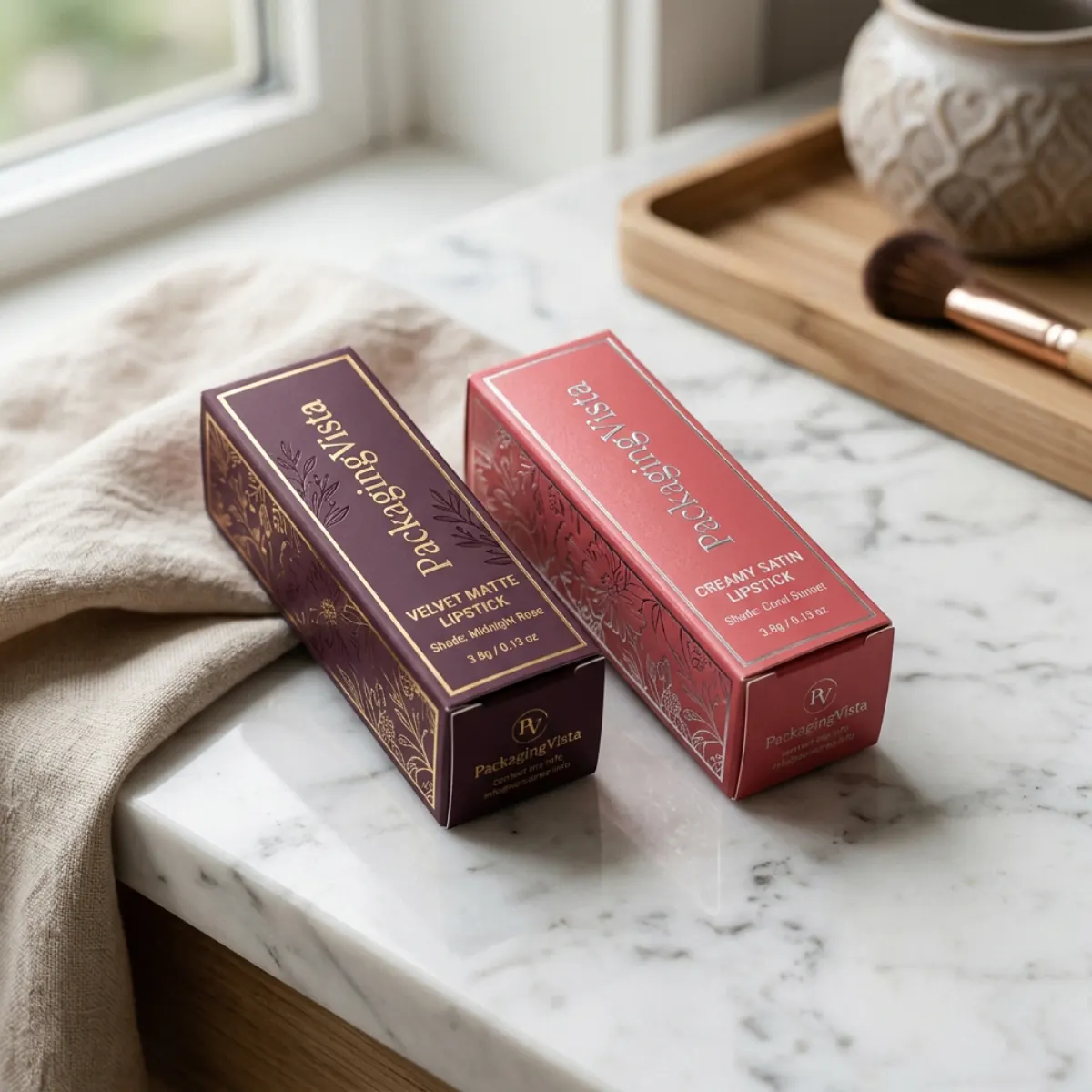
Custom Lip Gloss Boxes
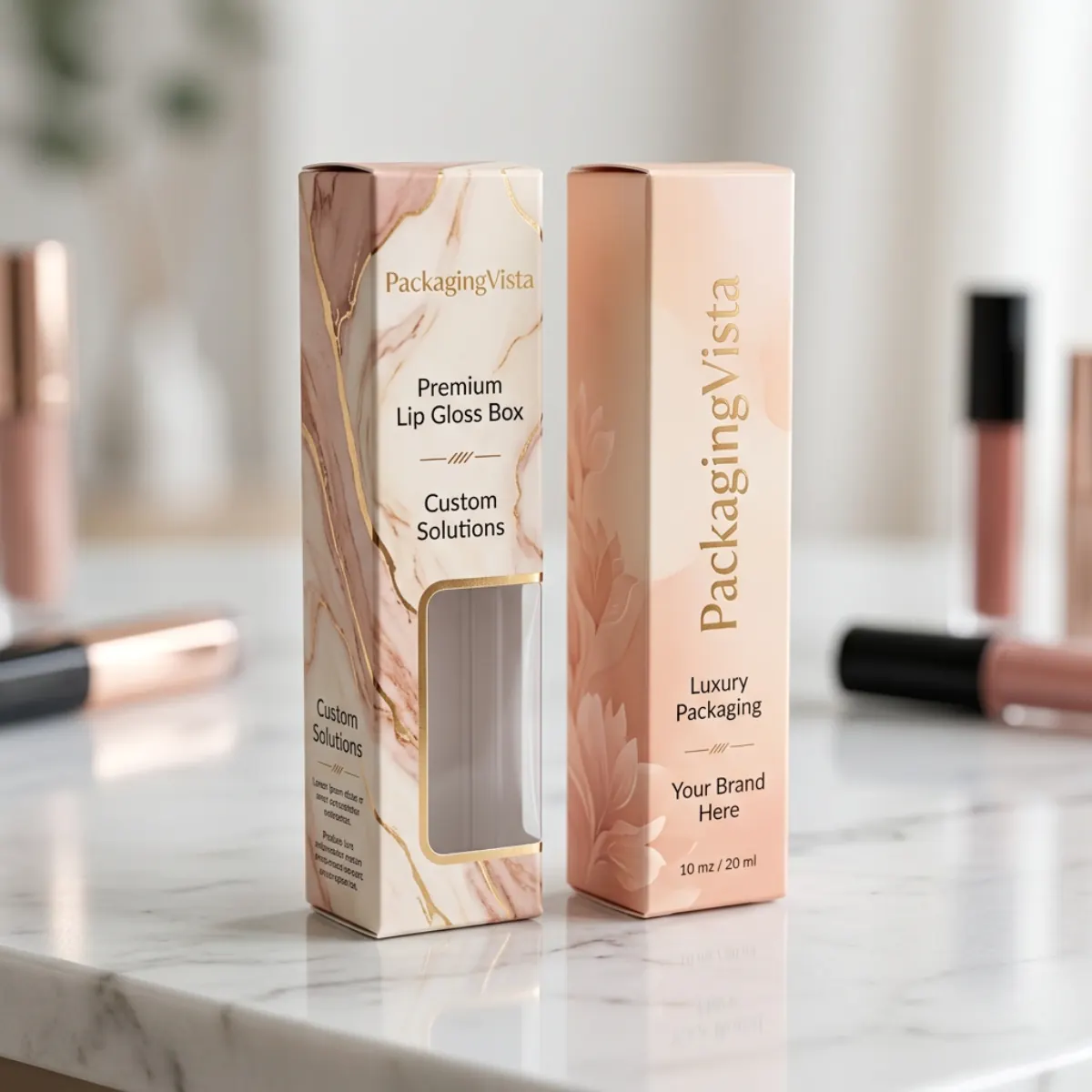
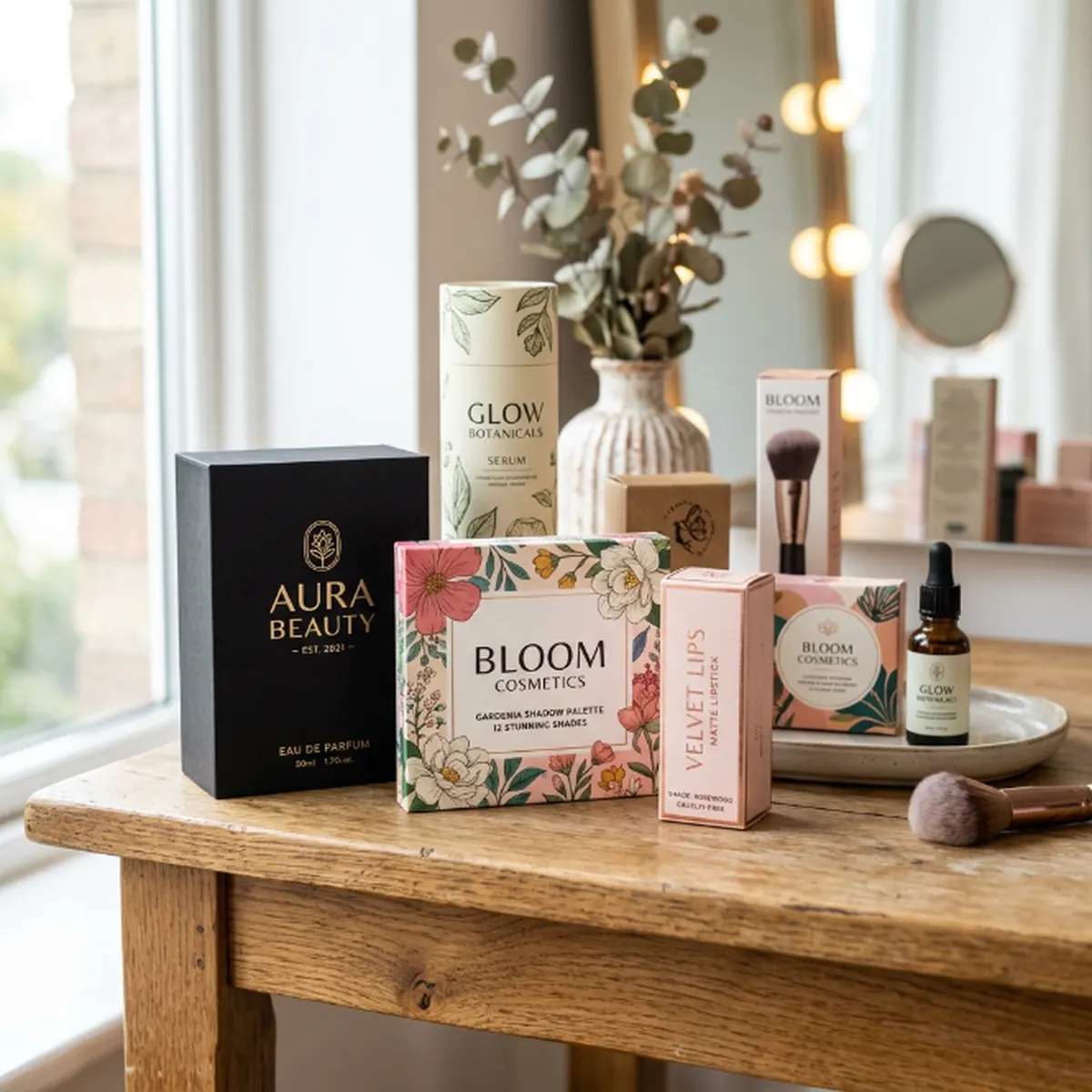
Custom lip gloss boxes are slim printed cartons built to hold gloss tubes, squeeze tubes, and doe-foot wands snugly, often with a die-cut window and an insert that keeps each tube upright and display-ready. Packaging Vista prints them with your logo in vivid CMYK or Pantone-matched color, with finishes such as soft-touch lamination, gloss or matte coating, foil stamping, embossing, spot UV, and window patching on cardstock, kraft, or rigid stock.
There are no die, plate, or setup fees, the minimum is just 100 boxes, and every order includes a free dieline and 3D mockup with an 8 to 10 business-day turnaround and free US shipping.
Key takeaways
- Built for gloss: slim tuck-end cartons, sleeves, and window boxes sized to squeeze tubes, doe-foot wands, and roller bottles.
- Inserts hold tubes upright: single and multi-cavity inserts cradle each gloss so shades stay organized and presentation-ready.
- Low barrier: 100-box minimum, no die, plate, or setup fees, free dieline & 3D mockup, 8-10 day turnaround, free US shipping.
- Go deeper: compare cosmetic boxes and lipstick boxes, or request a free quote.
Lip gloss box styles
The structure sets the shelf look and the unboxing moment. These are the lip gloss box styles we make most often:
Slim tuck-end cartons
A compact, straight-tuck or reverse-tuck carton sized to one gloss tube. It is the most economical, retail-friendly choice and the easiest to fold flat for shipping and storage.
Slide-out sleeves
An inner tray slides out of a printed sleeve, like a matchbox, for a tactile, interactive open that suits premium single-gloss launches and gifting.
Window boxes
A clear die-cut window patched into the carton shows the gloss color and applicator without opening the box, helping shoppers pick a shade on the shelf.
Boxes with inserts to hold tubes upright
A paperboard or foam insert cradles the tube so it stands upright and does not rattle. The insert is built into your dieline so the fit is dialed in before production.
Multipack and set boxes
Multi-cavity boxes hold several glosses upright in one carton - ideal for shade ranges, holiday sets, and influencer PR kits. There are no die fees for the extra sizes.
Standard lip gloss tube dimensions and box sizes
| Gloss format | Tube dimensions | Box size (L x W x H) |
|---|---|---|
| Slim doe-foot wand | 4.5-5 in x 0.7 in dia. | 4.88 x 0.82 x 0.82 in |
| Standard doe-foot | 4 in x 0.85 in dia. | 4.25 x 1 x 1 in |
| Squeeze tube | 3.5-4 in x 0.75 in dia. | 4.25 x 0.88 x 0.88 in |
| Chubby tube | 3 in x 1.1 in dia. | 3.25 x 1.25 x 1.25 in |
| Roller bottle | 3.5 in x 0.8 in dia. | 3.75 x 1 x 1 in |
| 3-shade multipack | 3 x doe-foot wands | 4.88 x 2.75 x 1 in |
Cosmetic label compliance (MoCRA 2022)
US lip gloss packaging follows the Modernization of Cosmetics Regulation Act (MoCRA) 2022 and FDA 21 CFR Part 700-740. Needed panel elements: INCI ingredient list (descending order), net contents in weight or volume, manufacturer/distributor identity, warnings where applicable, and PAO (Period After Opening) symbol for products intended for use beyond 30 months.
Minimum type is 1/16 in (1.6 mm) tall. We reserve dedicated panel space for regulated copy inside your dieline.
Inserts that hold tubes upright
We build single-cavity inserts for one tube and multi-cavity inserts for sets, in paperboard, foam, or molded fiber, so each gloss stays upright, protected, and organized in transit and on display. For a full sizing breakdown, read our guide to lip gloss box sizes and dimensions. Send your tube specs and we size the carton and supply a free dieline and 3D mockup.
Luxury finishes that sell beauty
Finish is where a gloss box earns attention online and at the counter. Combine any of the following:
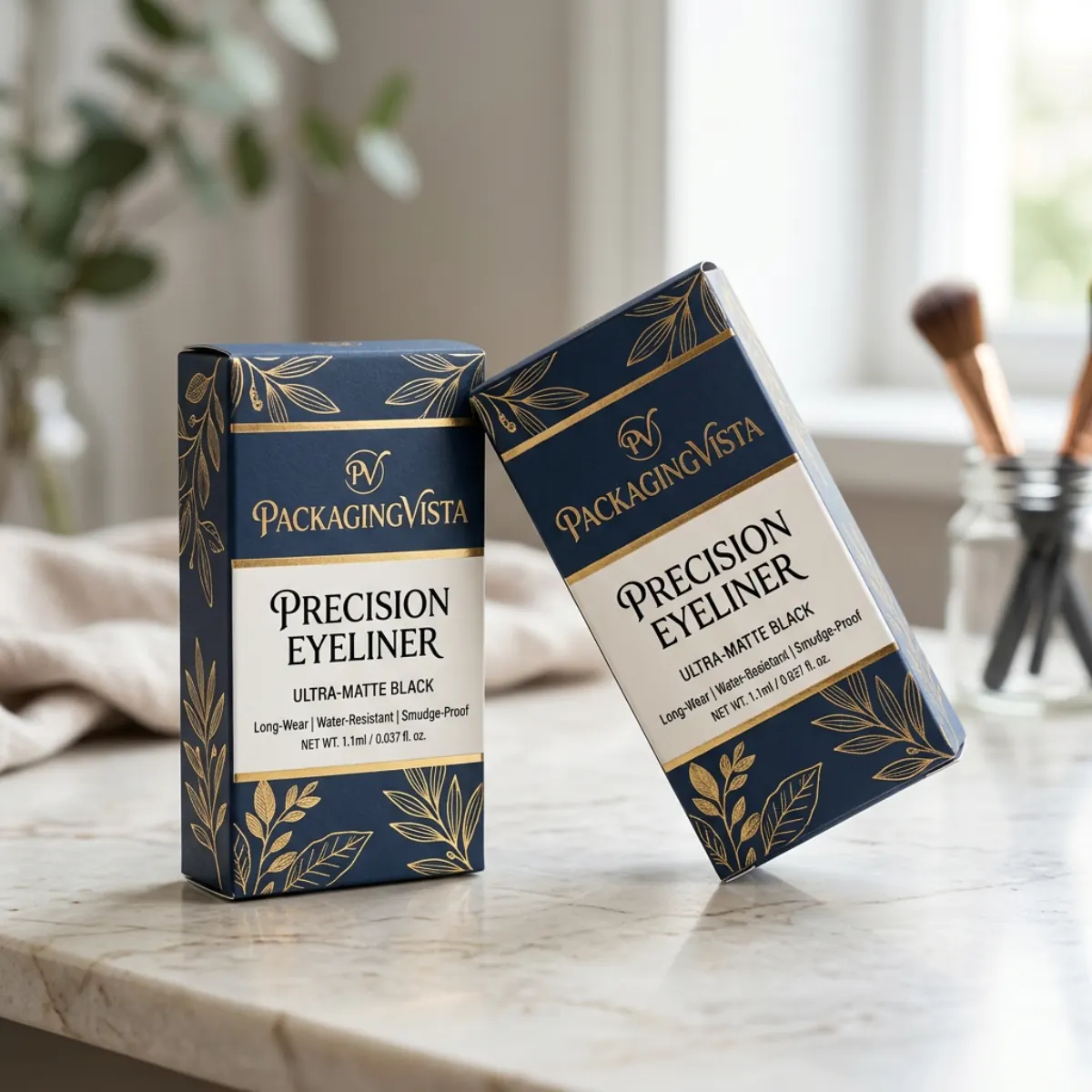
- Foil stamping in gold, silver, rose gold, or holographic to make your logo catch the light.
- Soft-touch lamination for a velvety, high-end hand-feel, or high-gloss coating to play up the product's shine.
- Spot UV to add glossy contrast against a matte wrap.
- Embossing and debossing for a tactile, three-dimensional mark.
- Window patching to show the shade, all printed in full CMYK or Pantone-matched color.
These trend-forward details photograph well for social and PR, which matters when a gloss launch lives or dies on shareable unboxing content.
Custom lip gloss boxes with your logo
We print lip gloss boxes to your exact artwork in full CMYK and Pantone-matched color, with a free custom dieline and 3D mockup so you approve the fit, window, and finish before production. No die, plate, or setup fees - your branding, your dimensions, from the first 100 boxes - which makes it practical for indie beauty brands to trial a new shade or seasonal drop without a large outlay.
Pricing, minimums, and turnaround
Price depends on the box size, style, finishes, and quantity, and the per-box cost drops as volume rises. There are no die, plate, or setup fees, the minimum is 100 boxes, and standard production runs 8 to 10 business days after proof approval, with rush available.
Every order includes a free dieline, 3D mockup, and free US shipping. Launching a US gloss line? See why brands choose a US lip gloss box manufacturer. Request a free quote with your tube size, finishes, and quantity for exact pricing.
Applicator format and formula viscosity drive the box choice
The right lip gloss box starts with the applicator. A wand-in-tube gloss (the everyday format) uses a slim tuck-end or two-piece box sized around the standard 10-15 mL tube diameter (about 15-20 mm) and 90-120 mm length. A squeeze-tube gloss (usually 8-10 mL) sits horizontally on shelf and needs a shorter, wider box or a bolder callout on a slim vertical box.
Pot glosses (little jars, usually 5-8 g) need a squared box with a small foam or paperboard cradle so the pot does not roll during shipping.
Formula viscosity matters too. Thin, watery glosses can leak through a loose cap during rough transit, so a thicker formula box is a good place to add a snug foam insert or a friction fit that locks the tube upright. Thick, high-viscosity glosses (plumpers, oils, balms) rarely leak but often have larger wand heads that force a wider box mouth.
Tell us the tube dimensions AND the formula viscosity at quote time and we spec the insert and box mouth to match.
Testers, minis, and multipack strategies for a launch lineup
A gloss launch usually has three package variants: full-size retail, testers for counter and PR, and minis or 2-3 mL trial sizes. Testers get a stripped-down two-color print on the same box silhouette with a “not for sale” mark on the flap so beauty advisors can hand samples without breaking a full retail unit.
Minis get their own smaller carton (typically 40-50 mm x 15 mm) that fits the trial tube and looks like a scaled-down version of the retail box.
Multipack sets (2, 3, or 6 shades) sell well as launch bundles, holiday sets, and travel kits. We build a shared outer box with individual carton wells inside so each gloss stays in its slot during shipping and looks curated when the box opens. Print a swatch dot per well on the inner tray so shoppers can pick their next favorite shade at a glance.
For a shade collection, use a shared art system across every SKU and swap only the shade name and swatch dot per unit so the whole lineup looks like a family.
What is a lip gloss box?
A lip gloss box is a slim paperboard carton built to hold a lip gloss applicator format — doe-foot wand-in-tube, squeeze tube, chubby tube, roller bottle, or pot gloss — snugly in an upright orientation with an insert or cavity that prevents both rattle and shimmer settlement.
Lip gloss sold in the US as cosmetic falls under MoCRA (Modernization of Cosmetics Regulation Act 2022) and FDA 21 CFR Part 700–740, so the carton must accommodate INCI ingredient list, net weight, manufacturer identity, warnings, and PAO (Period After Opening) symbol for >30-month shelf life at minimum 1/16 in type.
See lipstick boxes for the closely-related lip-tube category and cosmetic boxes for the broader beauty pillar.
Lip gloss packaging has three unusual properties: applicator format AND formula viscosity together drive the box choice — wand-in-tube vs squeeze vs pot vs roller need distinctly different carton dimensions; thin watery glosses can leak through loose caps in rough transit; thick plumpers need wider box mouth for larger wand heads, shimmer, glitter, and pearl-effect glosses settle if the tube sits flat for weeks in a warehouse — a carton with an insert holding the tube upright keeps shimmer distributed and the gloss looking fresh when the shopper opens it, and lip gloss launches live or die on shareable unboxing content — finish choices (foil, soft-touch, holographic, spot UV) drive Instagram/TikTok/Sephora UGC share rates more than any other cosmetic sub-category.
How much do custom lip gloss boxes cost?
Ballpark ranges by format at 500–2,000-unit runs: slim doe-foot wand tuck-end $0.30–$0.80; standard doe-foot or squeeze tube $0.35–$0.85; chubby tube $0.35–$0.90 (wider mouth for larger wand heads); roller bottle $0.35–$0.85; slide-out sleeve or window box $0.55–$1.60; 3-shade multipack with multi-cavity insert $1.20–$2.80; mini/trial-size (40–50 × 15 × 15 mm) $0.20–$0.55.
Finish adders: foil gold/silver/rose gold/holographic $0.20–$0.60 per stamped area, soft-touch matte $0.10–$0.25, high-gloss coating $0.05–$0.15, spot UV $0.08–$0.20, blind emboss/deboss $0.15–$0.35, die-cut window with clear PET film $0.15–$0.40.
Variable-data shade-name swap adds no per-unit cost on digital-print runs.
How long do custom lip gloss boxes take to make?
Standard production is 8–10 business days after proof approval; rush 4–6 days. Add 1–2 days for sleeve or window variant; 1–3 days for multi-shade collection variable-data runs; 2–4 days for premium metallic/holographic finish.
Beauty-launch back-plans unique to lip gloss: Sephora/Ulta seasonal shade drops on 60–90 day cycles with MoCRA + INCI + PAO compliance vetting 30–45 days ahead; PR seeding programs on 30–45 day cycles where influencer-send timing drives packaging urgency; DTC subscription 30–45 day cycles; TikTok viral-shade opportunity windows can compress to 14–21 days with rush production for indie brands responding to trending formulas.
Wand-in-tube vs squeeze vs chubby vs roller vs pot vs multipack
Seven format archetypes map to formula viscosity and channel:
| Format | Tube dimensions | Formula fit | Best for | Cost per box |
|---|---|---|---|---|
| Slim doe-foot wand | 4.5–5 × 0.7 in dia. | Thin to medium gloss | Everyday retail, indie | $0.30–$0.80 |
| Standard doe-foot | 4 × 0.85 in dia. | Medium to thick gloss | Premium retail, prestige | $0.35–$0.85 |
| Squeeze tube | 3.5–4 × 0.75 in dia. | Any viscosity (dispenser tip) | Balm-hybrid, tinted moisturizer | $0.35–$0.85 |
| Chubby tube | 3 × 1.1 in dia. | Thick plumpers, oils | Statement gloss, luxury | $0.35–$0.90 |
| Roller bottle | 3.5 × 0.8 in dia. | Thin oil, serum | Lip oils, tinted balms | $0.35–$0.85 |
| Pot gloss (jar) | 5–8 g little jar | Thick balm, jelly | Retro balm, artisan | $0.40–$1.10 |
| 3-shade multipack | 3 × doe-foot wands | Mix | Launch bundles, gift sets, travel | $1.20–$2.80 |
Formula-fit row unique to lip gloss: applicator format + formula viscosity together define box choice. Thin watery glosses need snug insert for leak prevention; thick plumpers need wider box mouth for larger wand heads; shimmer formulations need upright orientation to prevent settlement.
Are custom lip gloss boxes worth it for an indie beauty brand or DTC shade-collection launch?
For indie beauty brands launching shade collections, DTC gloss brands running TikTok-driven trending shade drops, prestige beauty brands with seasonal Sephora/Ulta launches, private-label makeup manufacturers, PR seeding programs for beauty influencers, and any brand where the gloss launch depends on shareable unboxing content — custom lip gloss boxes are the category baseline.
Typical buyers include indie brands with 6–24 shade launches on Etsy/Amazon/DTC, prestige brands running Sephora/Ulta shade drops (see cosmetic boxes, lipstick boxes), private-label white-label programs, beauty subscription programs (see subscription boxes), and PR seeding kits.
Three reasons: (1) applicator-format AND formula-viscosity engineering determines whether the gloss arrives intact or leaks in transit — thin watery glosses need snug insert or friction fit that a generic carton doesn't provide. (2) Shimmer settlement over 3–6 months of shelf storage undercuts the visual product hero — a $0.10 upright paperboard insert keeps shimmer distributed and the gloss photograph-ready when the shopper opens it. (3) Shareable-unboxing content drives launch success on TikTok/Instagram/Sephora UGC — foil-first, soft-touch matte, and holographic finishes photograph high-end and drive share rates that translate to sales; generic cartons don't compete in the algorithmic content ecosystem.
Are lip gloss boxes recyclable?
Plain lip gloss paperboard cartons are broadly curbside-recyclable across US municipal programs. Mono-material paperboard + paperboard insert scores highest on shopper eco-audits. FSC-certified board available on all runs. Nuances: soft-touch matte and gloss laminates reduce curbside acceptance (matte varnish is recyclable-friendly alternative); holographic and metallic foil at typical coverage (under ~30% surface) is generally accepted; window film patch requires removal before recycling (see window boxes).
Eco-maximum build: FSC SBS or recycled paperboard + paperboard insert (skip foam) + soy-based ink + matte varnish (skip laminate) + minimal foil coverage. FTC Green Guides (16 CFR Part 260) govern claim wording.
Frequently Asked Questions
Can you add an insert to hold my lip gloss tube upright?
Yes. We build single-cavity inserts for one tube and multi-cavity inserts for sets in paperboard, foam, or molded fiber, so each gloss stands upright, stays protected, and does not rattle in transit. The insert is built into your dieline and 3D mockup so you can confirm the fit before production.
Can I get a window box that shows the gloss color?
Yes. We patch a clear die-cut window into the carton so shoppers can see the shade and applicator without opening the box. Window patching pairs well with foil and soft-touch finishes for a premium retail look.
What finishes make lip gloss boxes look high-end?
Lip gloss boxes pair well with foil stamping in gold, silver, or holographic, soft-touch or high-gloss lamination, spot UV, and embossing. You can combine, for example, a soft-touch matte wrap with a holographic foil logo for a layered, trend-forward look that photographs well for social and PR.
How few lip gloss boxes can I order to test a new shade?
You can start at just 100 boxes, which makes it practical to trial a new color or seasonal drop without a large outlay. Because there are no die or setup fees, adding extra sizes for a shade range stays affordable.
What sizes and dimensions can I get?
A typical single-tube box runs roughly 0.8 to 1 inch square by 3 to 5 inches tall, but we make any size to your tube's diameter and height, given as length x width x depth. Send your tube specs or a sample and we will size the carton and supply a free dieline and 3D mockup to confirm the fit.
How much do custom lip gloss boxes cost?
Cost depends on the box size, style, finishes, and order quantity, and it falls as volume increases. Because every job is custom, we quote per project rather than list a flat price - but there are never die, plate, or setup fees, and the minimum is just 100 boxes. Send your dimensions and quantity for an exact, no-obligation quote.
What is the lead time on custom lip gloss boxes?
Standard production runs 8 to 10 business days after you approve the proof, with rush options available for tight launch windows. Every order ships with free US delivery.
What is the ideal box size for a squeeze-tube versus wand-applicator gloss?
A wand-in-tube gloss (10-15 mL) uses a slim vertical box roughly 90-120 mm tall by 20 mm wide by 20 mm deep. A squeeze-tube gloss (8-10 mL) uses a wider, shorter box (60-80 mm long by 25-30 mm wide) that sits horizontally on shelf. Send us the tube dimensions and we build a free custom dieline sized to fit.
Do glossier or shimmer formulations need special box protection?
Shimmer, glitter, and pearl-effect glosses can settle if the tube sits flat for weeks in a warehouse. A carton with an insert that holds the tube upright keeps the shimmer distributed and the gloss looking fresh when the shopper opens it. Foil-heavy formulas do not need extra protection but do photograph better through a window or die-cut opening.
Can I get boxes for a mini or trial-size gloss under 3 mL?
Yes. Trial-size glosses in the 2-3 mL range use a small carton roughly 40-50 mm x 15 mm x 15 mm, which fits inside a launch multipack or a subscription-box drop. We keep tooling and design charges the same on mini SKUs, so testing a new shade at trial size costs no more per unit than a full-size run.
What is a lip gloss box, and how does applicator format drive the box choice?
A lip gloss box is a slim paperboard carton built to hold a lip gloss applicator format (doe-foot wand-in-tube, squeeze tube, chubby tube, roller bottle, or pot gloss) snugly in an upright orientation with an insert that prevents both rattle and shimmer settlement.
Lip gloss falls under MoCRA (Modernization of Cosmetics Regulation Act 2022) and FDA 21 CFR Part 700-740 — carton must accommodate INCI ingredient list, net weight, manufacturer identity, warnings, and PAO (Period After Opening) symbol for >30-month shelf life at minimum 1/16 in type.
Three unusual properties: applicator format AND formula viscosity together drive box choice (thin watery glosses need snug insert for leak prevention; thick plumpers need wider box mouth for larger wand heads); shimmer/glitter/pearl glosses settle if tube sits flat — upright cavity insert keeps shimmer distributed; launches live or die on shareable unboxing content driving Instagram/TikTok/Sephora UGC share rates.
How much do custom lip gloss boxes cost by format?
Ranges at 500–2,000-unit runs: slim doe-foot wand $0.30–$0.80; standard doe-foot or squeeze $0.35–$0.85; chubby tube $0.35–$0.90; roller bottle $0.35–$0.85; sleeve or window $0.55–$1.60; 3-shade multipack $1.20–$2.80; mini/trial-size $0.20–$0.55.
Finish adders: foil gold/silver/rose gold/holographic $0.20–$0.60 per stamped area, soft-touch matte $0.10–$0.25, high-gloss coating $0.05–$0.15, spot UV $0.08–$0.20, blind emboss $0.15–$0.35, die-cut window with PET film $0.15–$0.40.
Variable-data shade-name swap adds no per-unit cost on digital-print runs.
Which lip gloss format do I need — wand, squeeze, chubby, roller, pot, or multipack?
Match to applicator format + formula viscosity. Slim doe-foot wand fits thin to medium gloss (everyday retail, indie collections). Standard doe-foot fits medium to thick (premium retail, prestige). Squeeze tube fits any viscosity via dispenser tip (balm-hybrid, tinted moisturizer).
Chubby tube fits thick plumpers and oils (statement gloss, luxury tier with wider mouth for larger wand heads). Roller bottle fits thin oils and serums (lip oils, tinted balms). Pot gloss (5–8 g jar) fits thick balm and jelly formulas (retro balm, artisan tier). 3-shade multipack fits launch bundles, holiday sets, travel kits.
How do I design a MoCRA + PAO-compliant lip gloss box step by step?
Six steps: (1) Identify applicator format AND formula viscosity (wand vs squeeze vs pot vs roller; thin vs thick vs shimmer). (2) Pick structure (slim tuck-end retail, slide-out sleeve, window box, or multi-cavity multipack). (3) Engineer upright cavity or fitted insert — prevents rattle AND shimmer settlement. (4) Reserve MoCRA + FDA 21 CFR Part 700–740 + INCI + PAO panel space at minimum 1/16 in type (25–35 mm side panel for INCI). (5) Add finishes for shareable-unboxing photography (foil gold/silver/rose gold/holographic, soft-touch matte, spot UV, embossing). (6) Design retail SKU + tester + mini variant lineup with shared art system across shade collection, swap only shade name + swatch dot per unit via digital-print variable-data.
Are custom lip gloss boxes worth it for an indie beauty brand or DTC shade-collection launch?
Yes, and the category baseline. Three reasons: (1) Applicator-format AND formula-viscosity engineering determines whether the gloss arrives intact or leaks in transit — thin watery glosses need snug insert or friction fit that generic cartons don't provide. (2) Shimmer settlement over 3–6 months of shelf storage undercuts the visual product hero — $0.10 upright paperboard insert keeps shimmer distributed and gloss photograph-ready. (3) Shareable-unboxing content drives launch success on TikTok/Instagram/Sephora UGC — foil-first, soft-touch matte, and holographic finishes photograph high-end and drive share rates; generic cartons don't compete in the algorithmic content ecosystem.
Fits indie brands with shade collections, prestige Sephora/Ulta drops, private-label white-label, subscription beauty, and PR seeding kits.
Are lip gloss boxes recyclable?
Plain lip gloss paperboard cartons are broadly curbside-recyclable across US municipal programs. Mono-material paperboard + paperboard insert scores highest on shopper eco-audits. FSC-certified board available on all runs. Nuances: soft-touch matte and gloss laminates reduce curbside acceptance (matte varnish is recyclable-friendly alternative); holographic and metallic foil at typical coverage (under ~30% surface) generally accepted; window film patch requires removal.
Eco-maximum build: FSC SBS or recycled paperboard + paperboard insert (skip foam) + soy-based ink + matte varnish (skip laminate) + minimal foil coverage. FTC Green Guides (16 CFR Part 260) govern claim wording.
Who orders custom lip gloss boxes?
Custom cosmetic and beauty packaging is ordered by shelf-facing brands where the box has to sell the product before the customer picks it up.
- Indie beauty and skincare brands — small-batch runs with premium finishes (soft-touch, foil, spot UV) to look shelf-ready alongside legacy prestige brands.
- Cosmetic contract manufacturers — high-volume folding cartons for lipstick, mascara, foundation, and serum SKUs across multiple retailer accounts.
- Direct-to-consumer beauty startups — rigid gift-box unboxings sized for the influencer-PR moment and DTC subscription drops.
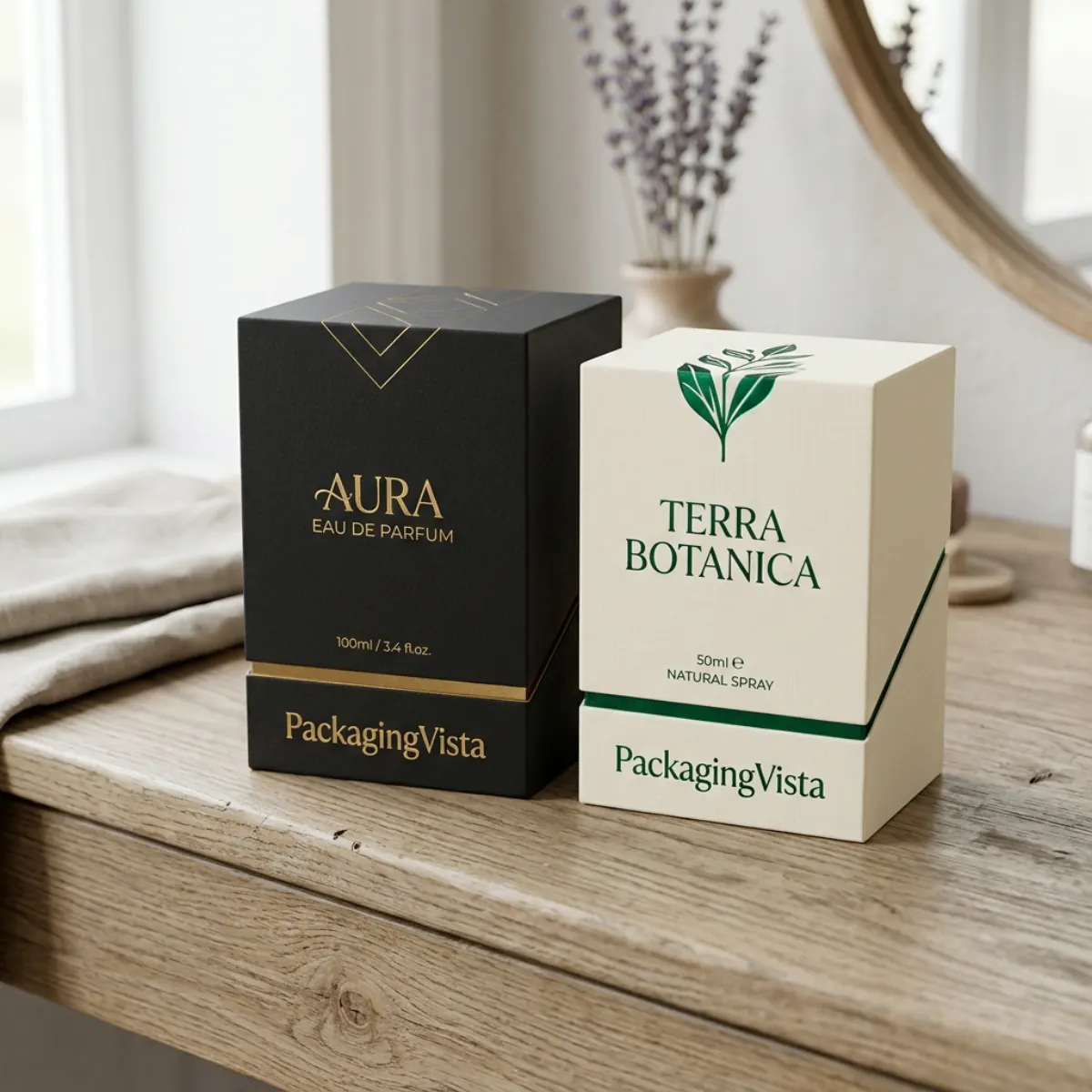
- Salon and spa retailers — hair-extension boxes, perfume cartons, and treatment kits printed with clinic branding.
- Amazon and Sephora sellers — boxes sized to the platform's dimensional-weight sweet spot with FNSKU / retailer barcodes on the flap.
How to order custom lip gloss boxes
Five steps from quote to delivery. Every order includes free design support, a free custom dieline, and a digital mockup for approval before anything hits the press.
- Share your specs. Send box dimensions (or a photo of the product), quantity, material preference, and any artwork or logo files. If you're unsure of the size, our design team can advise from a product photo.
- Get a quote and mockup. Within one business day we return a firm quote, a printable dieline, and a 3D digital mockup of your lip gloss boxes. No die, plate, or setup fees are added.
- Approve the proof. Review the mockup, request color, layout, or dieline changes, and give final approval. Revisions are unlimited before press.
- Production (8–10 business days). Your order runs on offset or digital press, then moves through finishing — lamination, spot UV, foil stamping, embossing, die-cutting, and assembly if needed.
- Free US shipping. Orders ship flat-packed with tracking. Assembled bundles or master-carton packing are available on request at no charge.
Resources & tools
Free tools and trusted references to help you size, spec, and choose the right lip gloss boxes before you order.
Free tools & guides
- Lip gloss packaging guide – sizes, inserts, windows, and finishes.
- Lip gloss box sizes – standard dimensions for tubes and squeeze bottles.
- Cosmetic & beauty packaging hub – every beauty box style and finish we print.
Trusted references
- FDA — Cosmetics Labeling – federal labeling rules for cosmetic and beauty products.
- FDA — MoCRA (Modernization of Cosmetics Regulation Act) – the current federal law governing US cosmetic products.
- FTC — Advertising & Marketing Guidance – federal truth-in-advertising rules for on-pack product claims.
- How2Recycle – the standardized on-pack recycling label for paperboard and kraft packaging.