Custom Lipstick Boxes
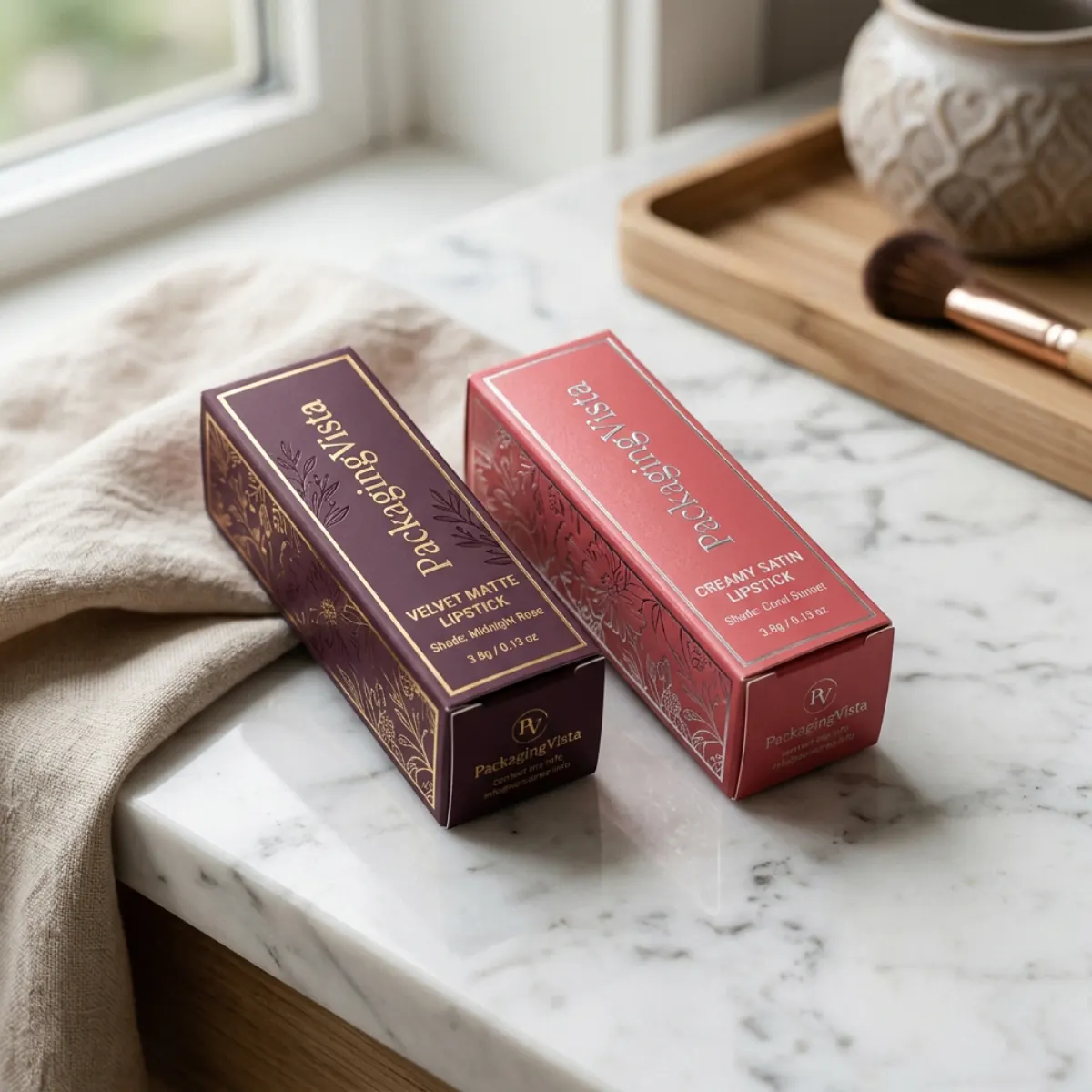
Custom lipstick boxes are slim, tall paperboard cartons built to hold a single lip tube or a curated set snugly, protect it in transit, and make a shade look premium the moment a shopper picks it up. Lipstick sits in a small footprint but carries a big brand story, so the packaging has to punch above its size on a crowded beauty shelf.
Whether you are launching an indie matte collection or scaling a private-label line, the right carton pairs a precise interior fit with the kind of finish that reads luxury. For a broader view of beauty formats, see our cosmetic boxes range.
Key takeaways
- Snug fit matters: a tall, narrow tube rattles unless the carton or a paperboard insert holds it in place.
- Finish sells the shade: foil, emboss, soft-touch matte, and spot UV do the heavy lifting in this category.
- Labeling is needed: plan panel space for INCI ingredients, net weight, shade name, and responsible-party info.
- No setup fees, 100-box minimum: free dieline, 3D mockup, and proof; ships flat in 8–10 business days.
What lipstick boxes need to do
A lipstick carton has three jobs at once: hold a slim tube without movement, survive shipping and shelf handling, and signal quality before anyone twists the cap. Because the product is small and high-margin, buyers expect the box to feel considered – clean edges, a smooth close, and a finish that matches the promise inside.
Most orders come from cosmetics and beauty brands, indie makeup lines, and private-label sellers who need retail-ready cartons that look consistent across an entire shade range.
Box styles that suit a lip tube
The default structures here are tuck-end and straight-tuck cartons. A reverse or straight tuck-end box gives you a quick-assembling, cost-efficient carton that ships flat and pops open on the packing line – ideal for single tubes and everyday runs.
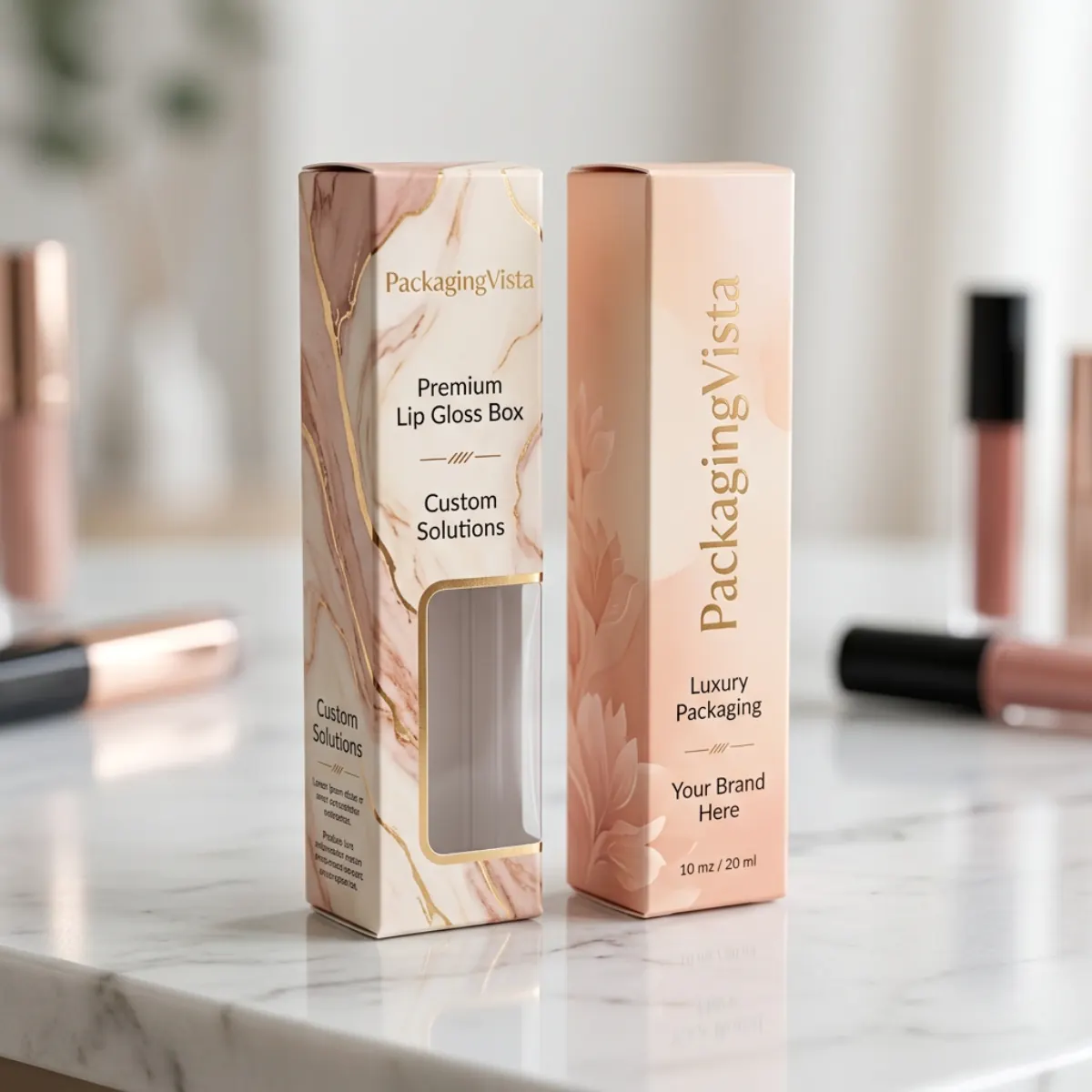
For a sturdier, more upscale feel or for gift sets, a full folding carton gives cleaner panels and better print real estate. If you want the shade visible on shelf, a die-cut window with a film patch lets shoppers see the actual color without opening anything.
Keeping the tube from rattling
A lipstick tube is tall relative to its base, so it tips and slides in an oversized box. The simplest fix is a carton dimensioned for a snug fit, where the tube stands upright with minimal side play. For sets, mixed shades, or a more premium unboxing, a fitted paperboard or foam insert cradles each tube in its own well so nothing shifts in transit.
Inserts also stage the reveal – the tubes sit at attention when the box opens. Our guide to custom inserts and unboxing walks through the options for slim, upright products like these.
Finishes that make a shade look premium
This is the category where finish earns its keep. Lipstick buyers respond to tactile, reflective detail, so most brands combine a base treatment with an accent:
- Foil stamping in rose gold, gold, or silver for logos and shade names – the signature beauty look.
- Soft-touch matte lamination for a velvety, expensive hand-feel that reads modern and clean.
- Emboss or deboss to raise a monogram or brand mark for a sculpted, luxe texture.
- Spot UV gloss over a matte panel to make one detail catch the light.
- Metallic or pearlescent board as a base for extra sheen under the ink.
We print full CMYK and match your exact brand color with Pantone (PMS) references, so a nude, a red, and a plum in the same line stay on-brand across every carton. For inspiration on pairing structure and finish, see cosmetic packaging by product.
Board and stock choices
Most lipstick boxes run on white SBS cardstock, which takes fine print and foil cleanly and holds a crisp edge at small sizes. For a heavier, gift-grade feel – think limited editions or luxury lines – a thicker board or a rigid setup adds weight and rigidity.
If sustainability is part of your story, uncoated kraft or FSC-certified stock supports a natural, recyclable positioning. We will recommend a caliper that keeps a slim carton from feeling flimsy while still folding and shipping flat.
Standard lipstick tube dimensions and box sizes
| Tube type | Typical tube | Recommended box (L x W x H) |
|---|---|---|
| Slim (standard bullet) | 3 in x 0.7 in dia. | 3.25 x 0.9 x 0.9 in |
| Jumbo bullet | 3.5 in x 0.85 in dia. | 3.75 x 1 x 1 in |
| Retractable crayon | 4.5 in x 0.55 in dia. | 4.75 x 0.75 x 0.75 in |
| Liquid lipstick (doe-foot) | 4 in x 0.85 in dia. | 4.25 x 1 x 1 in |
| Lip balm tube | 2.75 in x 0.65 in dia. | 3 x 0.85 x 0.85 in |
| Duo / 2-shade set | 2 x slim bullets | 3.25 x 1.9 x 0.9 in |
Cosmetic labeling under MoCRA
Lip products are regulated cosmetics under the Modernization of Cosmetics Regulation Act (MoCRA) of 2022 and FDA 21 CFR Part 700-740. The carton or an applied label must carry:
- INCI ingredient list - descending order of predominance (below 1%: any order), 1/16 in min type.
- Net contents - by weight in grams or ounces, front panel.
- Manufacturer / distributor identity - name and address (city, state, ZIP).
- Warnings and cautions - where applicable.
- Registration: facility and product listing with FDA needed annually under MoCRA.
The practical design takeaway: leave a clean panel for the mandatory copy early. Our overview of cosmetic label requirements is a useful starting point. This is packaging guidance, not legal advice.
How to size and spec your box
Sizing starts with the tube. Measure the closed tube at its widest point (usually the base or cap), then its full height, and decide whether you are packing a single unit or a set. Add a small clearance so the tube seats without forcing, but not so much that it rattles.
Tell us those numbers – or send a sample – and we produce a free custom dieline and a free 3D mockup so you can approve the exact fit before anything prints. Every carton is engineered to ship and store flat, then fold up fast on your end.
Pricing, minimums, and turnaround
Orders start at a 100-box minimum with no die, plate, or setup fees, so testing a new shade or a small launch does not carry heavy tooling costs. Free design support, a free dieline, a 3D mockup, and a digital proof are all included, and standard production runs 8–10 business days with free US shipping.
Share your tube dimensions, shade count, and finish wishlist and request a quote – or contact us to talk through a set or gift configuration.
Tester tubes, PR mailers, and gift-with-purchase kits
A launch lineup needs more than the retail SKU. Tester tubes usually come in a slimmer sleeve carton with a bold shade name on the front and a “not for sale” mark on the flap, so a beauty advisor can hand one to a shopper without breaking a full unit.
A PR seeding mailer is a taller two-piece box that holds the tube in a foam insert with room for a card, a mirror, or a swatch card. Gift-with-purchase kits pair the lipstick with a mini lip liner or gloss, so the box needs a slightly wider footprint and a shaped cavity that keeps both pieces from sliding.
Print each variant on a matching but distinct dieline so warehouse pickers can tell them apart at a glance. A common trick: retail SKU in full-color print, tester in a stripped-down two-color print, PR mailer in a foil-first premium finish. That keeps the retail price honest and lets the PR unit feel worth the send.
Refillable, mono-material, and sustainability-forward lipstick packaging
Refillable lipstick tubes are one of the fastest-growing sub-segments in prestige beauty. The retail box for a refill sale is smaller than the launch box because the outer bullet mechanism stays with the shopper. Print a “refill” icon on the front and a “fits [brand] refillable tube” line on a side panel so the shopper knows which mechanism it works in.
Mono-material paperboard cartons paired with a paperboard insert (instead of a foam or plastic cradle) score highest on shopper eco-audits and drop cleanly into curbside recycling. FSC-certified board is available on any of our tuck end or two-piece cartons at no material change.
Soy-based inks, water-based coatings, and skipping foil or lamination on the outer keep the whole carton in one recycling stream.
What is a lipstick box?
A lipstick box is a slim, tall paperboard carton built to hold a lip tube (bullet, jumbo bullet, retractable crayon, liquid doe-foot applicator, lip balm tube, or duo/set) snugly in an upright orientation, protect it in transit, and signal quality on a crowded beauty shelf.
The category is dominated by tuck-end retail cartons for single-tube everyday runs (see tuck end boxes), folding cartons with auto-lock or 1-2-3 base for premium retail and gift sets (see folding carton boxes), two-piece boxes with lift-off lid for PR seeding mailers and luxury launches, and window boxes with die-cut aperture showing the actual shade color at point of sale (see window boxes).
Lipstick sold in the US as cosmetic falls under MoCRA (Modernization of Cosmetics Regulation Act 2022) and FDA 21 CFR Part 700–740, so the carton must accommodate INCI ingredient list, net weight, manufacturer identity, and warnings at minimum 1/16 in type.
Lipstick packaging has three unusual properties that separate it from other cosmetic verticals: the slim-tube tall aspect ratio (typically 4–6× taller than wide) means an oversized carton lets the tube tip, slide, and rattle — snug cavity dimensioning or fitted insert is the difference between a premium unboxing and a shaken-up rattling box, brands rarely launch one SKU — a typical collection ships 6–24 shades sharing a design system that swaps only the shade name, batch code, and swatch dot per unit, making shared-art-system design + variable-data print the volume workflow, and the refillable-tube sub-segment is one of the fastest-growing prestige-beauty categories — refill sale cartons are smaller than launch boxes because the bullet mechanism stays with the shopper, driving distinct carton engineering for refill SKUs.
How much do custom lipstick boxes cost?
Lipstick box pricing scales by tube format, structure, cavity engineering, finishes, and quantity, with per-unit price dropping meaningfully as volume rises. Ballpark ranges by format (before finishes and volume discounts):
- Tuck-end retail slim bullet (3.25 × 0.9 × 0.9 in, 14–16 pt SBS) — $0.30 to $0.75 per box in 500–2,000-unit runs. The everyday retail SKU for lipstick.
- Tuck-end retail jumbo bullet or liquid lipstick (3.75 × 1 × 1 in through 4.25 × 1 × 1 in, 14–18 pt SBS) — $0.35 to $0.90 per box. Standard for larger tube formats.
- Tuck-end retail retractable crayon (4.75 × 0.75 × 0.75 in, 14–16 pt) — $0.35 to $0.85 per box. Taller slimmer format.
- Two-piece box with lift-off lid + paperboard insert (single tube) — $1.60 to $3.80 per box. Premium retail, PR mailers, gift-with-purchase kits.
- Duo / 2-shade set with fitted insert (3.25 × 1.9 × 0.9 in tuck or two-piece) — $0.80 to $2.20 per box. Gift-set and dual-shade launches.
- 4-shade collection or PR seeding kit with multi-cavity insert — $2.20 to $5.50 per box. Full-collection launch mailers, influencer sends.
Finish adders characteristic of lipstick category (per unit): foil stamping in rose gold, gold, or metallic $0.20–$0.60 per stamped area, soft-touch matte lamination $0.10–$0.25, blind emboss/deboss $0.15–$0.35, spot UV over matte $0.08–$0.20, metallic or pearlescent board $0.15–$0.40, die-cut window with clear PET film patch $0.15–$0.40 (see window boxes).
Variable-data shade-name swap adds no per-unit cost on digital-print runs. Request a free quote with tube dimensions, shade count, structure, and finish list.
How long do custom lipstick boxes take to make?
Standard lipstick box production is 8–10 business days after proof approval, with rush lanes available in 4 to 6 days for launch dates. Add 1–2 days for two-piece box with lift-off lid + paperboard insert (multi-cavity insert engineering).
Add 1–3 days for multi-shade collection runs where 6–24 shades share one dieline with digital-print variable-data shade-name swap. Add 2–4 days for foil stamping and specialty metallic finishes on premium tier.
Beauty-launch back-plans unique to lipstick vertical: Sephora, Ulta, and department-store retail launches typically operate on a 90–120 day back-plan because buyer packaging vetting (MoCRA + INCI + FDA compliance review) runs 45–60 days ahead of shelf date and cross-brand collection launches trigger co-op merchandising planning windows.
Seasonal shade drops (spring/summer, fall/winter, holiday collection, Valentine's red) operate on 60–90 day cycles from proof approval to retail shelf. PR seeding programs for influencer sends operate on 30–45 day cycles from creative brief to fulfillment.
Indie DTC lipstick brands typically operate on 30–45 day launch cycles with digital-print shade-name variant runs enabling small-batch shade testing before committing to volume.
Slim bullet vs jumbo vs retractable crayon vs liquid vs balm vs duo/set
Six tube formats map to structural + cavity engineering + shade-collection strategy:
| Tube format | Tube dimensions | Carton (L × W × H) | Best for | Cost per box |
|---|---|---|---|---|
| Slim standard bullet | 3 in × 0.7 in dia. | 3.25 × 0.9 × 0.9 in | Everyday retail SKU, indie collections | $0.30–$0.75 |
| Jumbo bullet | 3.5 × 0.85 in dia. | 3.75 × 1 × 1 in | Premium creamy/moisturizing lipsticks | $0.35–$0.90 |
| Retractable crayon | 4.5 × 0.55 in dia. | 4.75 × 0.75 × 0.75 in | Precision-application lip pencils | $0.35–$0.85 |
| Liquid doe-foot | 4 × 0.85 in dia. | 4.25 × 1 × 1 in | Liquid lipstick, long-wear, matte formulas | $0.35–$0.90 |
| Lip balm tube | 2.75 × 0.65 in dia. | 3 × 0.85 × 0.85 in | Tinted balm, tinted moisturizer | $0.30–$0.70 |
| Duo / 2-shade set | 2 × slim bullets | 3.25 × 1.9 × 0.9 in | Dual-shade sets, gift launches | $0.80–$2.20 |
Tall-aspect-ratio row unique to lipstick vertical: every tube format has aspect ratio 4–6× taller than wide, which is why rattle-prevention (snug 1/16 in cavity clearance or fitted paperboard insert) is a category-specific engineering rule not present in most cosmetic verticals. Retractable crayon has the most extreme ratio (4.5 × 0.55 in = 8× tall) and needs the tightest cavity dimensioning.
Are custom lipstick boxes worth it for an indie makeup line, prestige beauty launch, or refillable-tube sub-segment brand?
For indie makeup lines launching shade collections, prestige beauty brands running seasonal launches, private-label sellers scaling into retail, and refillable-tube brands in the fastest-growing prestige-beauty sub-segment, custom lipstick boxes are the category baseline — not an upgrade.
The typical buyers of custom lipstick boxes at the 100–5,000 box range include: indie makeup brands with 6–24-shade launch collections on Etsy, Amazon, and DTC; prestige beauty brands launching Sephora / Ulta / Nordstrom seasonal shade drops; private-label makeup manufacturers running white-label programs for boutique brands (see cosmetic boxes); refillable-tube brands (Hourglass, Kjaer Weis, Fenty Beauty, La Bouche Rouge and following waves) where the refill carton is smaller than the launch carton; PR seeding programs sending shade collections to influencers and beauty editors; gift-with-purchase programs bundling lipstick with mini lip liner or gloss; corporate gifting programs for beauty employees and B2B partners; wedding-favor programs featuring signature lipstick shades; and any gift box program where beauty is the gift.
Three reasons custom is worth the premium over generic stock lipstick cartons: (1) slim-tube rattle prevention is a category-specific engineering requirement — the 4–6× aspect ratio means an oversized generic carton lets the tube tip and slide, arriving as a shaken-up rattling box that undercuts even the best foil-stamped finish; a snug 1/16 in cavity or fitted paperboard insert is the difference between premium unboxing and cheap-feeling delivery. (2) The shade-collection art system + variable-data print workflow is unique to lipstick and volume-critical — a shared art system across 6–24 shades with per-SKU shade-name swap on digital-print runs enables 100–500 units per shade at a per-unit cost close to a 5,000-unit single-shade run, which is uneconomic at industry-standard printers charging per-plate setup. (3) MoCRA + FDA 21 CFR + INCI compliance is not optional for retail listing — Sephora, Ulta, Nordstrom, Whole Foods Beauty, and Amazon Beauty reject product without INCI ingredient list, net weight, responsible-person identity, and warnings; a custom carton reserves the panel space and stays legible at minimum 1/16 in type.
Are lipstick boxes recyclable?
Plain lipstick paperboard cartons are broadly curbside-recyclable across virtually every US municipal program, and the category has become one of the strongest sustainability-forward corners of prestige beauty. Mono-material paperboard cartons paired with a paperboard insert (instead of foam or plastic cradle) score highest on shopper eco-audits and drop cleanly into curbside recycling.
FSC-certified board is available on any lipstick tuck-end or two-piece carton at no material change. Soy-based inks, water-based coatings, and skipping foil or lamination on the outer keep the whole carton in one recycling stream.
Where recyclability gets nuanced: foil stamping is generally accepted at typical lipstick-carton coverage (under ~30% surface area for logo and shade name); soft-touch matte and gloss laminates reduce curbside acceptance because plastic laminate contaminates paper recycling — matte varnish or aqueous coating is the recyclable-friendly premium alternative that still delivers the modern hand-feel; metallic or pearlescent boards use a metallic-effect substrate that recycles as paper in most streams but may require separation from paperboard laminate in stricter programs; die-cut window with clear film patch requires film removal before recycling (see window boxes).
For the eco-maximum lipstick carton build: pair FSC-certified SBS or recycled paperboard with paperboard insert (skip foam and plastic cradle) + soy-based ink + matte varnish (skip laminate) + minimal foil to logo-only coverage. The refillable-tube sub-segment adds further eco-alignment because the outer bullet mechanism stays with the shopper across refills, reducing per-purchase packaging footprint by 60–80% on repeat purchases.
FTC Green Guides (16 CFR Part 260) govern "recyclable" claim wording.
Frequently asked questions
How do I keep the lipstick tube from moving inside the box?
Either size the carton for a snug upright fit or add a fitted paperboard insert. For single tubes a close-dimensioned tuck-end box is usually enough; for sets, an insert with a well per tube stops rattling and stages a cleaner reveal.
What finishes work best for lipstick packaging?
Foil stamping in rose gold or gold, soft-touch matte lamination, emboss or deboss, and spot UV are the most popular. They give the small carton the premium, tactile feel beauty shoppers expect. We also match your exact brand color with Pantone references.
Can I show the lipstick shade through the box?
Yes. A die-cut window with a clear film patch lets shoppers see the actual color on shelf without opening the carton, which helps at point of sale for color cosmetics.
What information has to appear on a lipstick box?
Cosmetic cartons generally need an ingredient list (often in INCI format), net weight, shade name, and brand or responsible-party details. Rules vary by market and change over time, so confirm what applies where you sell and plan a clean panel for that copy.
What is the minimum order and turnaround?
The minimum is 100 boxes with no setup or die fees. Standard production is 8 to 10 business days after proof approval, and US shipping is free. Free design, dieline, 3D mockup, and a digital proof are included.
How do I measure my tube for the right box?
Measure the closed tube at its widest point and at full height, and note whether you are packing one unit or a set. Send those numbers or a sample and we produce a free dieline and 3D mockup so you can approve the fit before printing.
Do you print custom shade names on the lipstick box?
Yes. Each shade in a lineup normally gets its own box with the shade name printed on the front and a small color swatch or dot on the side panel or bottom, so a beauty advisor can pull the right unit from a drawer of the same silhouette.
What is the difference between a lipstick sleeve and a two-piece lipstick box?
A sleeve is a single tuck end carton the tube slides straight into, which is the everyday retail carton. A two-piece box has a separate lift-off lid over a base and usually holds the tube in a paperboard or foam insert. Two-piece is the premium and gift-set format.
Can I get boxes for a full lip collection with a matching art system?
Yes. We lock a shared art system (logo, hero pattern, color swatches, and back-panel text zones) across every SKU in the collection, then swap only the shade name, batch, and swatch dot per unit. Runs can be printed together so per-box cost stays low even on shorter shade counts.
What is a lipstick box, and why does the tube aspect ratio matter?
A lipstick box is a slim, tall paperboard carton built to hold a lip tube (bullet, jumbo bullet, retractable crayon, liquid doe-foot, lip balm, or duo/set) snugly upright, protect it in transit, and signal quality on a crowded beauty shelf. Lipstick sold in the US as cosmetic falls under MoCRA (Modernization of Cosmetics Regulation Act 2022) and FDA 21 CFR Part 700–740, so the carton must accommodate INCI ingredient list, net weight, manufacturer identity, and warnings at minimum 1/16 in type.
Three unusual properties: the slim-tube tall aspect ratio (typically 4–6× taller than wide) means an oversized carton lets the tube tip, slide, and rattle — snug cavity dimensioning or fitted insert is category-critical; brands rarely launch one SKU — a typical collection ships 6–24 shades sharing a design system with per-SKU shade-name swap; the refillable-tube sub-segment is one of the fastest-growing prestige-beauty categories with distinct smaller-carton engineering for refill SKUs.
How much do custom lipstick boxes cost by tube format?
Ranges at 500–2,000-unit runs: tuck-end retail slim bullet (3.25×0.9×0.9 in, 14–16 pt SBS) $0.30–$0.75; tuck-end jumbo or liquid (3.75×1×1 in or 4.25×1×1 in) $0.35–$0.90; tuck-end retractable crayon (4.75×0.75×0.75 in) $0.35–$0.85; two-piece box with lift-off lid + insert (single tube) $1.60–$3.80 for premium/PR/gift; duo/2-shade set with fitted insert $0.80–$2.20; 4-shade collection or PR seeding kit with multi-cavity insert $2.20–$5.50.
Finish adders: foil rose gold/gold/metallic $0.20–$0.60 per stamped area, soft-touch matte $0.10–$0.25, blind emboss/deboss $0.15–$0.35, spot UV $0.08–$0.20, metallic/pearlescent board $0.15–$0.40, window with PET film $0.15–$0.40.
Variable-data shade-name swap adds no per-unit cost on digital-print runs.
Which lipstick tube format do I need — slim bullet, jumbo, retractable crayon, liquid, balm, or duo/set?
Match tube format to product formula and price tier. Slim standard bullet (3 in × 0.7 in dia., 3.25 × 0.9 × 0.9 in carton) fits everyday retail SKUs and indie collections. Jumbo bullet (3.5 × 0.85 in, 3.75 × 1 × 1 in) fits premium creamy or moisturizing lipsticks.
Retractable crayon (4.5 × 0.55 in, 4.75 × 0.75 × 0.75 in) fits precision-application lip pencils — extreme 8× aspect ratio needs tightest cavity dimensioning. Liquid doe-foot (4 × 0.85 in, 4.25 × 1 × 1 in) fits liquid lipstick, long-wear, and matte formulas.
Lip balm tube (2.75 × 0.65 in, 3 × 0.85 × 0.85 in) fits tinted balm and tinted moisturizer. Duo/2-shade set (2 × slim bullets side-by-side, 3.25 × 1.9 × 0.9 in) fits dual-shade sets and gift launches.
How do I design a MoCRA-compliant custom lipstick box for a full shade collection step by step?
Six steps: (1) Measure closed tube at widest point + full height (base or cap width, full height with cap on) — format falls into 6-size ladder. (2) Pick structure (tuck-end retail for cost efficiency, folding carton with auto-lock for premium retail, two-piece with lift-off lid for PR/gift, window box for shelf-shade-visible). (3) Engineer snug cavity or fitted insert for tall-aspect-ratio rattle prevention — 1/16 in cavity clearance for single-tube retail, fitted paperboard or foam insert for duo/set and PR mailers. (4) Reserve panel space for MoCRA + FDA 21 CFR Part 700–740 + INCI ingredient list at minimum 1/16 in type on one side panel (25–35 mm), plus net weight, manufacturer identity, and warnings. (5) Add finishes (foil rose gold/gold/metallic, soft-touch matte, blind emboss, spot UV, metallic/pearlescent board). (6) Design shared art system across shade collection (logo + hero pattern + color swatches + back-panel text zones lock across all SKUs; shade name + batch + swatch dot swap per unit via digital-print variable-data) — enables 100–500 units per shade at per-unit cost close to 5,000-unit single-shade run.
Are custom lipstick boxes worth it for an indie makeup line, prestige beauty launch, or refillable-tube brand?
Yes, and effectively the category baseline. Three reasons: (1) Slim-tube rattle prevention is a category-specific engineering requirement — 4–6× aspect ratio means an oversized generic carton lets the tube tip and slide, arriving as a shaken-up rattling box that undercuts even the best foil-stamped finish. (2) The shade-collection art system + variable-data print workflow is unique to lipstick and volume-critical — a shared art system across 6–24 shades with per-SKU shade-name swap on digital-print runs enables 100–500 units per shade at per-unit cost close to a 5,000-unit single-shade run, which is uneconomic at printers charging per-plate setup. (3) MoCRA + FDA 21 CFR + INCI compliance is not optional for retail listing — Sephora, Ulta, Nordstrom, Whole Foods Beauty, Amazon Beauty reject product without INCI ingredient list, net weight, responsible-person identity, and warnings.
Fits indie makeup brands with shade collections, prestige beauty Sephora/Ulta launches, private-label white-label programs, refillable-tube prestige sub-segment (Hourglass, Kjaer Weis, Fenty Beauty), PR seeding programs, gift-with-purchase, and gift-box beauty programs.
Are lipstick boxes recyclable?
Plain lipstick paperboard cartons are broadly curbside-recyclable across virtually every US municipal program — the category is one of the strongest sustainability-forward corners of prestige beauty. Mono-material paperboard cartons paired with a paperboard insert (instead of foam or plastic cradle) score highest on shopper eco-audits and drop cleanly into curbside recycling.
FSC-certified board available on any lipstick tuck-end or two-piece carton at no material change. Nuances: foil stamping accepted at typical lipstick-carton coverage (under ~30% surface area); soft-touch matte and gloss laminates reduce curbside acceptance (matte varnish or aqueous coating is recyclable-friendly premium alternative); metallic or pearlescent boards recycle as paper in most streams but may require separation in stricter programs; die-cut window with clear film patch requires film removal.
Eco-maximum build: FSC SBS or recycled paperboard + paperboard insert (skip foam and plastic cradle) + soy-based ink + matte varnish (skip laminate) + minimal foil to logo-only coverage. Refillable-tube sub-segment adds further eco-alignment — outer bullet mechanism stays with shopper across refills, reducing per-purchase packaging footprint by 60–80% on repeat purchases.
Who orders custom lipstick boxes?
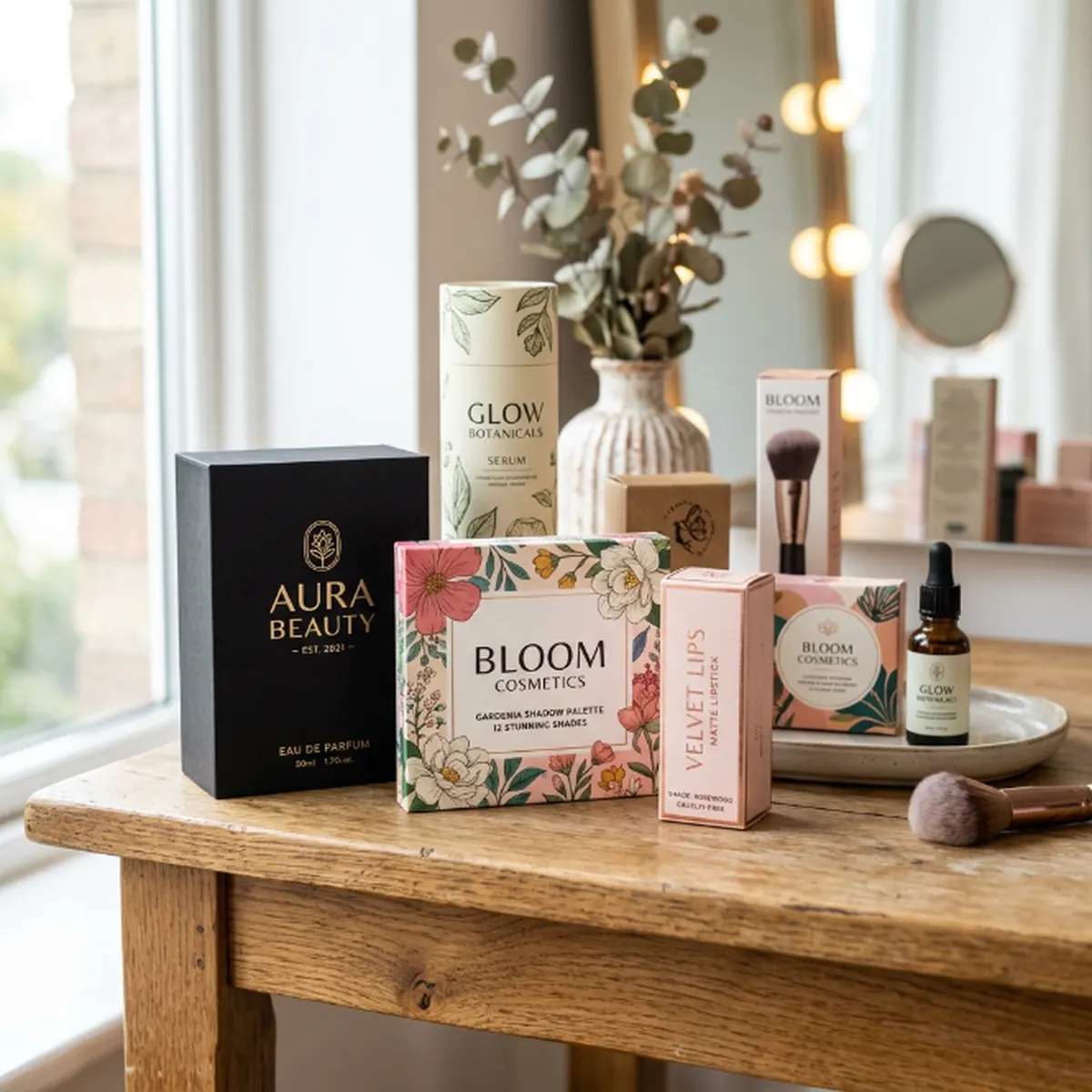
Custom cosmetic and beauty packaging is ordered by shelf-facing brands where the box has to sell the product before the customer picks it up.
- Indie beauty and skincare brands — small-batch runs with premium finishes (soft-touch, foil, spot UV) to look shelf-ready alongside legacy prestige brands.
- Cosmetic contract manufacturers — high-volume folding cartons for lipstick, mascara, foundation, and serum SKUs across multiple retailer accounts.
- Direct-to-consumer beauty startups — rigid gift-box unboxings sized for the influencer-PR moment and DTC subscription drops.
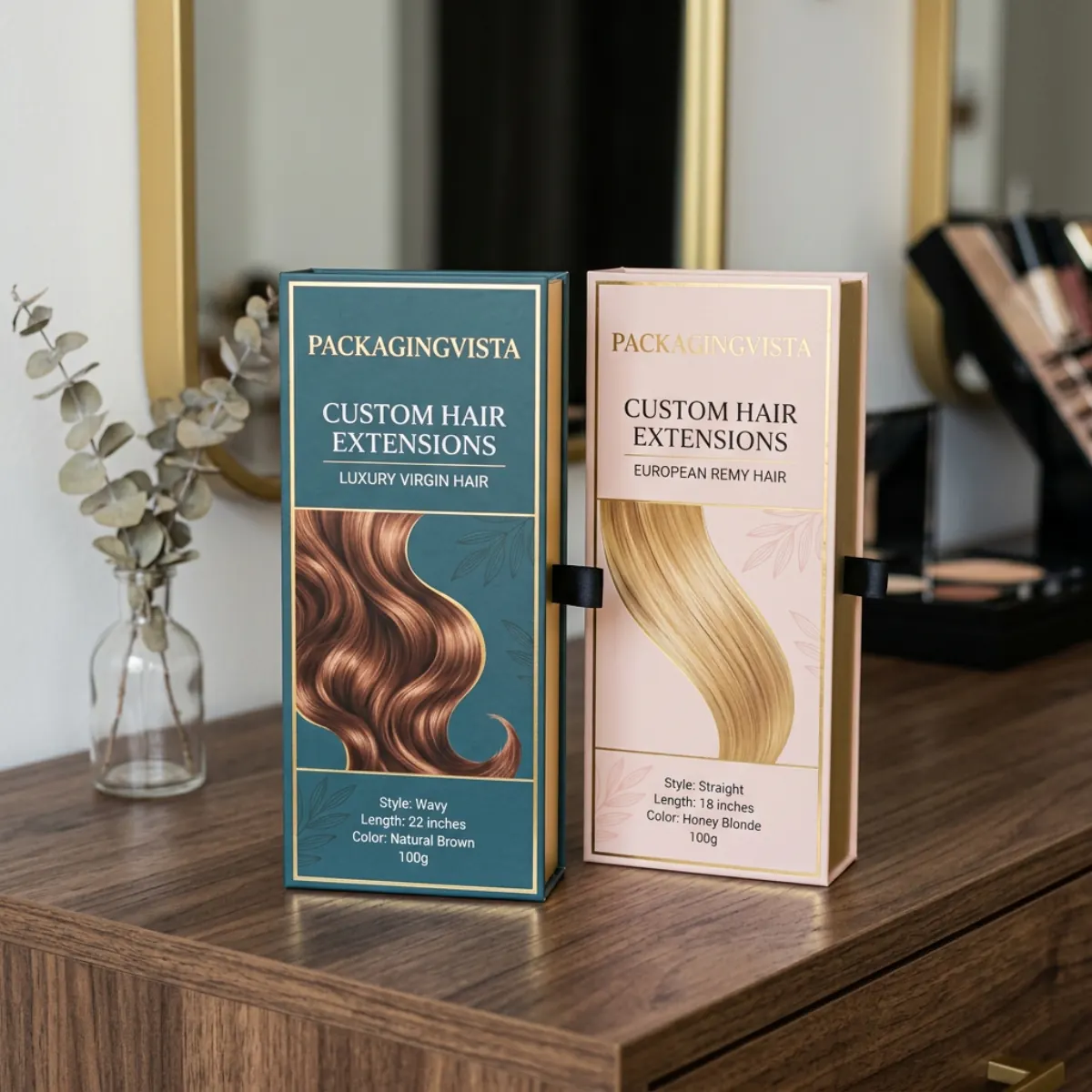
- Salon and spa retailers — hair-extension boxes, perfume cartons, and treatment kits printed with clinic branding.
- Amazon and Sephora sellers — boxes sized to the platform's dimensional-weight sweet spot with FNSKU / retailer barcodes on the flap.
How to order custom lipstick boxes
Five steps from quote to delivery. Every order includes free design support, a free custom dieline, and a digital mockup for approval before anything hits the press.
- Share your specs. Send box dimensions (or a photo of the product), quantity, material preference, and any artwork or logo files. If you're unsure of the size, our design team can advise from a product photo.
- Get a quote and mockup. Within one business day we return a firm quote, a printable dieline, and a 3D digital mockup of your lipstick boxes. No die, plate, or setup fees are added.
- Approve the proof. Review the mockup, request color, layout, or dieline changes, and give final approval. Revisions are unlimited before press.
- Production (8–10 business days). Your order runs on offset or digital press, then moves through finishing — lamination, spot UV, foil stamping, embossing, die-cutting, and assembly if needed.
- Free US shipping. Orders ship flat-packed with tracking. Assembled bundles or master-carton packing are available on request at no charge.
Resources & tools
Free tools and trusted references to help you size, spec, and choose the right lipstick boxes before you order.
Free tools & guides
- Cosmetic packaging by product – match the right box to each beauty product.
- Luxury cosmetic packaging – premium structures and finishes for prestige beauty.
- Cosmetic & beauty packaging hub – every beauty box style and finish we print.
Trusted references
- FDA — Cosmetics Labeling – federal labeling rules for cosmetic and beauty products.
- FDA — MoCRA (Modernization of Cosmetics Regulation Act) – the current federal law governing US cosmetic products.
- FTC — Advertising & Marketing Guidance – federal truth-in-advertising rules for on-pack product claims.
- How2Recycle – the standardized on-pack recycling label for paperboard and kraft packaging.