Blog · By The Packaging Vista Team · October 27, 2026
Custom Cereal Boxes for Brand Visibility and Freshness: The Shelf, Barrier, and Finish Decisions That Decide a Launch
A great custom cereal box has to win twice. On the retail shelf (where 7 inches of face panel fights 15 other brands at eye level) and in the pantry across 60–120 days of fresh taste. The two jobs pull in opposite ways.
Standing out pushes toward big die-cut windows, metal finishes, and bold color panels. Keeping fresh pushes the other way. You want opaque laminated board, oxygen and light barrier liners, and tight heat-sealed inner bags.
Done well, a cereal box does both. Most use a 300–400 GSM SBS or coated kraft outer carton with a PE or metalized BOPP inner liner, 4/0 or 4/4 litho print, an optional UV-blocking window, and FDA 21 CFR 176.170 food-contact rules.
This guide walks the build, barrier, print, and rules choices that decide a US cereal launch. Packaging Vista supplies custom cereal boxes and food-grade cartons. We also handle the inner-liner work US SMB cereal brands need before their first retail or DTC ship.
Key takeaways
- Outer board: SBS 300–400 GSM for printed retail. Coated kraft 300–350 GSM for eco-friendly brands. Both give crisp litho print and shelf-stack stiffness.
- Inner liner: PE for standard. Metalized BOPP for premium (20–40% longer fresh taste via oxygen and light barrier). The liner is the real food-contact surface.
- Print: 4/0 litho is standard. 4/4 adds brand print inside the box for premium or kids' cereals.
- Windows: use for premium granola or muesli. Use UV-blocking film to guard oils and vitamins.
- Rules: inner liner FDA 21 CFR 176.170. Outer inks low-migration per 21 CFR 174-178. Nutrition and ingredient panels per 21 CFR 101.
Build: the cereal carton anatomy.
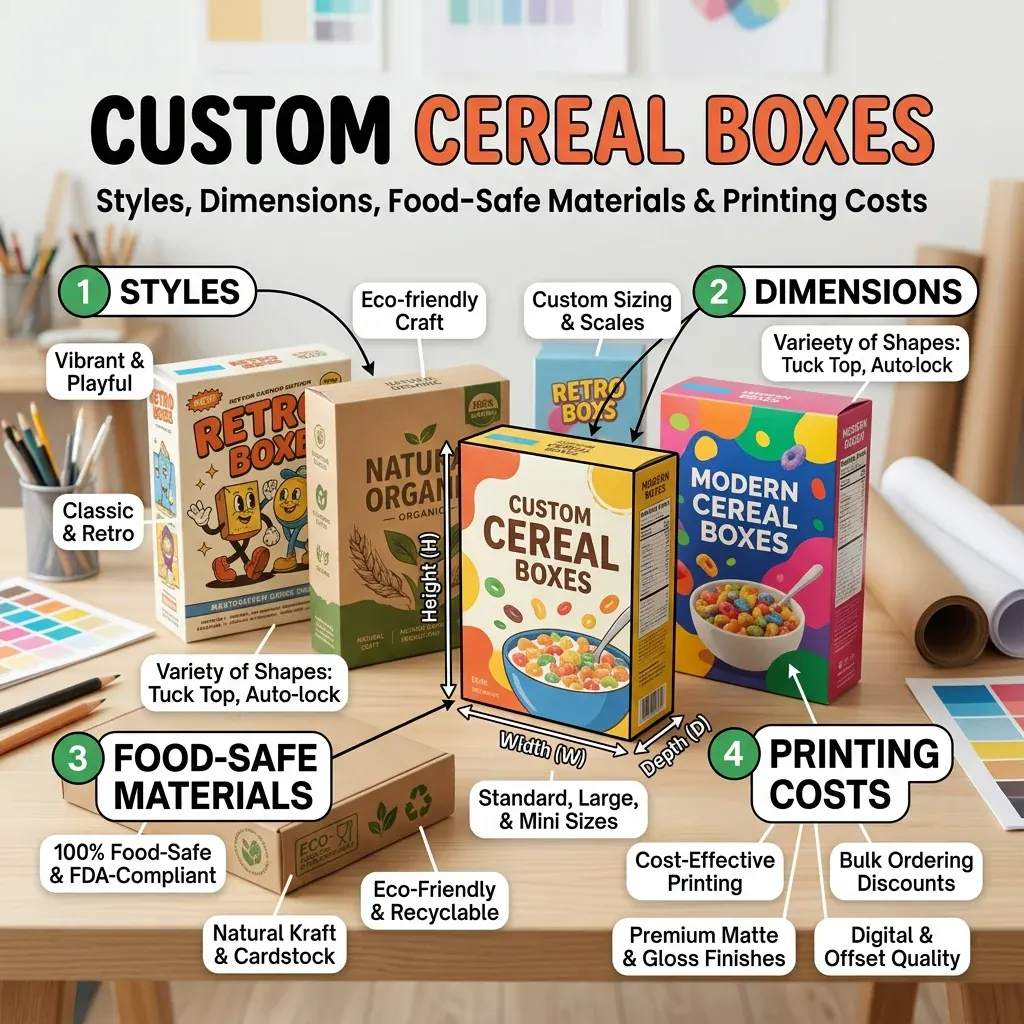
A standard retail cereal box is a two-piece build. An outer printed carton is the brand surface. An inner sealed liner is the food-contact and fresh-taste surface. The outer is usually a tuck-end or auto-lock bottom folding carton. The inner is a flex pouch heat-sealed at the top and bottom. Common US retail sizes:
| Size category. | Typical dimensions. | Fill weight. | Shelf placement. |
|---|---|---|---|
| Single-serve. | 4 × 1.5 × 5 inch. | 1–2 oz. | Variety pack / impulse. |
| Small / sample. | 6 × 2 × 8 inch. | 8–10 oz. | Specialty / sampling. |
| Standard retail. | 7.5 × 2.5 × 11 inch. | 10–14 oz. | Eye-level planogram. |
| Family / tall. | 8 × 2.75 × 12 inch. | 14–18 oz. | Eye-level planogram. |
| Jumbo. | 9 × 3 × 13 inch. | 18–24 oz. | Club / value tier. |
Standing out: winning the shelf.
Face panel order.
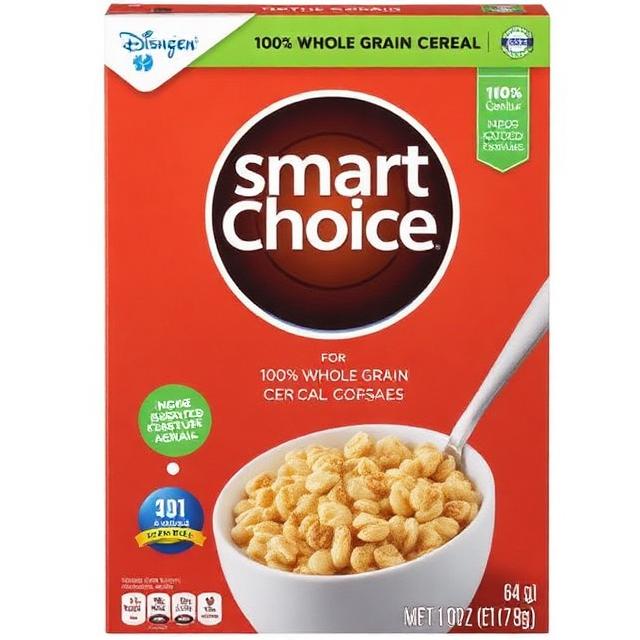
US cereal shelf plans face boxes at eye level in the aisle center column. You get about 7 inches of face per SKU. The shopper walks past at ~3 feet per second. The three-second scan reads: brand mark, product name, hero shot, size. The tight order:
- Top 1/3: brand mark, large and high-contrast against the panel. This is the shelf-recall zone.
- Center 1/3: product hero shot (bowl shot, ingredient photo, or iconic cereal piece). This carries the appetite pull.
- Bottom 1/3: flavor name, “New!” or “Limited Edition” cues, claim stickers (gluten-free, high-protein, organic), net weight. This is the stand-out zone.
Color plan.
Cereal is one of the most color-coded aisles in grocery. Shoppers link box color with cereal type. Red = corn, chocolate, or kids’ sweet. Blue = oat or healthy adult. Green = organic, natural, or granola.
Yellow = corn, honey, or breakfast staple. Brown or kraft = premium granola or muesli. Fighting the rule costs shelf-recall seconds. Following it loses standing out. The usable middle: take the category hue for 60–70% of the panel.
Then stand out with a signature accent color or hero shot.
Finishes that signal premium.
- Soft-touch matte lamination: premium feel without visual gloss.
- Spot UV on brand mark or hero shot: touch and visual contrast against a matte base.
- Foil accent: for “Limited Edition,” seasonal, or holiday runs.
- Debossed brand mark: a touch luxury signal. It works on both coated and uncoated kraft.
Mass-market cereal usually runs 4/0 litho on gloss or satin coated SBS. Premium granola and muesli often skip gloss for soft-touch and kraft. That signals the artisan tier. Our spot UV guide covers the finish trade-offs.
Fresh taste: the barrier stack.
Cereal fresh taste is hit by three forces. Oxygen turns oils rancid and spoils nuts and seeds. Damp makes cereal lose crunch, mainly in humid US regions. Light breaks down added vitamins, mostly B2 and B9, and triggers oil spoilage. The barrier stack handles each one:
Inner liner choices.
| Liner type. | Moisture barrier. | Oxygen barrier. | Light barrier. | Cost / shelf life. |
|---|---|---|---|---|
| Standard PE (polyethylene). | Good. | Minimal. | None (transparent). | Low / 6–9 months. |
| Metalized BOPP. | Excellent. | High. | Full (opaque metalized). | Mid / 12–18 months. |
| Foil-laminated multi-layer. | Excellent. | Excellent. | Full. | High / 18–24 months. |
| Compostable PLA. | Moderate. | Low. | Partial. | Mid / 4–8 months. |
Standard PE is the mass-market default. It costs the least and gives 6–9 months of fine fresh taste. Metalized BOPP is the premium default and bumps shelf life a lot. It also fits the eco-friendly story better than foil-laminated multi-layer. Compostable PLA is only right for very short-run DTC with 1 to 2 month stock turn.
The window trade-off.
A die-cut window with a glassine or clear PE insert shows the cereal through the carton. That is strong standout for premium granola, muesli, and specialty cereals where the product is the hero.
The fresh-taste trade-off: light speeds up oil and vitamin spoilage. Lower it with UV-blocking window film. It cuts 95%+ of UV light and guards nuts, seeds, and vitamin-fortified cereals.
Skip windows for cereals with high nut or seed content and a 12+ month target shelf life.
Seal strength.
The inner liner is only as good as its seals. Weak heat-seals at top and bottom are the top fresh-taste fail mode. Spec a solid seal (not spot-weld), with a 10 mm minimum seal width. Also run a short burst test. Fill a liner, press, and check for leaks. On resealable zip-top liners, add a cap-seal strip under the zip for a first-open guard.
Print: 4/0 vs 4/4 and plate tech.
4/0 vs 4/4.
4/0 (CMYK outside, no inside print) is the mass-market standard. Buyers see the inside of a cereal box only on the trip from pantry to bowl. They don’t check it. 4/4 (CMYK outside and inside) adds inside printing for brand pattern, QR codes to recipes or sweepstakes, back-of-box games or stories for kids’
cereals, or SKU-specific nutrition notes. The cost add is 25–40%. The brand lift is real for kids’ and premium DTC lines.
Litho vs flexo vs digital.
- Offset litho: the best print quality for mass retail. Sharp CMYK, Pantone matching, fine screen for photos. Minimum run ~5,000 units. The default for shelf-primary cereal.
- Flexo: faster and cheaper on long runs (100,000+). Lower print resolution. Good for simpler-art SKUs or roll-fed making.
- Digital: zero setup fee. 500–2,000 unit short runs work. Best for test runs, DTC-only launches, and seasonal runs. Print quality now rivals litho for most cereal art.
Rules: FDA food-contact and nutrition labels.
Cereal is a human-food SKU ruled under the FDA Food, Drug, and Cosmetic Act. The packaging has four rules layers:
- Inner liner food-contact: must meet 21 CFR 176.170 (paper and paperboard parts touching aqueous and fatty foods) if paper-based. Or meet the right parts of 21 CFR 177 for plastics. Keep the FDA letter of guarantee from the liner supplier.
- Outer carton inks: low-migration inks safe under FDA 21 CFR 174-178 for indirect food contact. The outer may not touch cereal. But migration through the paperboard is ruled.
- Nutrition Facts panel: per 21 CFR 101.9. Place it on the side or back panel. The format is set.
- Ingredient and allergen notes: per 21 CFR 101.4, plus the Food Allergen Labeling and Consumer Protection Act (FALCPA), plus the FASTER Act (sesame as the 9th major allergen as of 2023).
Eco-friendly: where cereal packaging is going.
The US cereal field is moving toward lower-plastic packaging. The main paths:
- Mono-material cartons: coated kraft outer with an aqueous barrier in place of a PE-laminated inner liner. Fully curbside recyclable. Trade-off: shorter shelf life (6–9 months) and higher cost.
- Recycled-content outer carton: 30–100% PCR SBS or kraft board. Cost-neutral at scale.
- How2Recycle labels: Target, Walmart, and Whole Foods more often ask for them on cereal cartons.
- Thinner liners: same fresh-taste work at lower material use. Micro-barrier films, 25–40 micron metalized BOPP.
We cover the wider frame in how to extend the lifecycle of paper packaging.
Frequently asked questions.
What is the standard material for a US cereal box?
Solid bleached sulfate (SBS) paperboard at 300–400 GSM for the outer carton. Pair it with a polyethylene (PE) or metalized BOPP inner liner. Coated kraft at 300–350 GSM is the eco-friendly take on SBS. Both give crisp litho print and shelf-stacking stiffness.
Do I need an inner liner in a custom cereal box?
Yes, for any cereal with a target shelf life past a few weeks. The outer carton alone can’t block damp, oxygen, or light at the levels cereal needs. The liner is where fresh taste is kept. Mono-material cartons with aqueous barriers can skip the plastic liner. But they cut shelf life to 6–9 months.
What’s the minimum order for custom cereal boxes?
Packaging Vista’s minimum is 100 cartons for the outer. Liners are sourced on the side or sized to match. For litho-printed retail-grade cereal boxes, run volume starts around 1,000–2,000 units. Digital print brings short-run economics down to 100–500 units.
How long does cereal stay fresh in a custom box?
With a metalized BOPP liner, 12–18 months typical. With a standard PE liner, 6–9 months. With a compostable PLA liner, 4–8 months. With a mono-material coated-kraft carton (no plastic liner), 6–9 months. Products with high nut and seed content (granola, muesli with sunflower seeds) sit at the low end of their liner’s range due to oil spoilage.
Can I use a window on my cereal box?
Yes, and it’s a strong standout lever for premium granola, muesli, and specialty cereals. The trade-off is light speeding up oil and vitamin spoilage. Use UV-blocking window film to guard shelf life. Skip windows on cereals with high nut or seed content aimed at 12+ month shelf life.
What’s the right print spec for mass-retail cereal?
4/0 offset litho CMYK with Pantone matching for brand colors, on 300–400 GSM coated SBS. Run volume starts at ~5,000 units. For short-run and premium DTC, digital print at 300–350 GSM coated kraft gives like-for-like quality with zero setup fee.
Do I need a Nutrition Facts panel on my cereal box?
Yes, it is a must per 21 CFR 101.9. The panel must sit on the side or back panel. Use the FDA format. Reflect the current serving-size rule. Ingredient list and allergen note are a must under FALCPA plus the FASTER Act (sesame added in 2023 as the 9th major allergen).
What are the shelf-standout differences between a kraft box and an SBS box?
SBS gives whiter brights, more color pop, and sharper hero photos. It is the classic for mass-retail cereal. Coated kraft gives a brown earth-tone base that reads premium, artisan, or natural. It works well for granola, muesli, and specialty organic cereals. The right pick is category-based. SBS for mainstream, kraft for premium-natural.
Can I use compostable packaging for cereal?
In part. Compostable PLA inner liners exist and work for short shelf life (4–8 month) specialty cereals. But they don’t match metalized BOPP for fresh taste. Fully compostable mono-material cartons with aqueous barriers exist. But they need a specific supply chain. Cost add is 15–30% today.
What’s the biggest custom cereal packaging mistake?
Three ties. Skipping the inner-liner spec (cereal goes stale on shelf). Over-doing window area on a nut or seed cereal (oil and nutrient spoilage speeds up). And letting the face-panel brand mark shrink below the hero shot (you lose the shelf-recall zone). All three are fixable with a tighter spec sheet before the first run.
The bottom line.
Custom cereal boxes have to win on the retail shelf (standout, color, order, finish) and in the pantry (barrier, seal, light block) at the same time. The playbook that works for US SMB cereal brands is a 300–400 GSM SBS or coated kraft outer carton, a metalized BOPP inner liner for premium shelf life or standard PE for mass-market, 4/0 litho (or 4/4 for brand-inside messaging), an optional UV-blocking window for premium granola and muesli, and FDA 21 CFR 176.170 rules on file.
The build and finish mix that wins is category- and spot-based, but not pricey at normal volumes.
Packaging Vista supplies custom cereal boxes at a 100-unit minimum, no die or plate fees, free dieline and design help, FDA food-contact rules on file, inner-liner work, and 8–10 business-day making. Request a quote with your cereal type, target shelf life, retail or DTC channel, and format choice. We’ll spec the carton, liner, and print mix that holds up on both shelves.
Reviewed by Kate Johnson — Packaging Specialist
12+ years in folding carton, corrugated, and rigid-box production at US contract packaging houses; FDA 21 CFR 176.170 (food contact) + 21 CFR 701 (cosmetic) labeling expert; FEFCO code-literate structural reviewer; FSC Chain-of-Custody auditor; G7 GRACoL color-management training. Reviews every structural, material, and compliance spec on this page. Last reviewed: November 2026.