Blog · By The Packaging Vista Team · October 27, 2026
How Can We Extend the Lifecycle of Paper Packaging? 12 Design, Material, and Reuse Moves That Actually Work
Reviewed by Kate Johnson — Paper & Food-Contact Wrap Specialist
12+ years in food-grade paper production — greaseproof, parchment, wax, deli, butcher, kraft wrap, and tissue. FDA 21 CFR 176.170 expert; reviews every stock weight, barrier chemistry, and print spec on this page.
Credentials: ASTM + FSC Chain-of-Custody trained, 500+ brand builds overseen on the plant floor. Last reviewed: November 2026.
Paper packaging has one of the strongest end-of-life stories out there. US corrugated boxes recycle at roughly 91% (EPA 2018 figures). That is higher than any other material. The real wins live upstream.
You get them from good fiber sourcing, repulp-safe coatings, right-sized boxes, mono-material design, and fold-flat reuse. You also need claim wording that holds up to the FTC Green Guides.
Done well, a paper box can run through five to seven recycling cycles. After that the fiber is too short to re-pulp. And the reuse step in front of that adds months or years of real-world life.
This guide walks through 12 moves US brands can make to stretch the life of their paper packaging. You get the rule footnotes and the claim wording that keeps the story credible. Packaging Vista supplies eco-friendly boxes, kraft packaging, FSC-stamped corrugated, and PCR paperboard across every box format we ship.
Key takeaways
- US corrugated recycles at ~91%. Paper already wins on end-of-life. The design job is to keep it that way at your SKU level.
- Paper fiber lasts 5–7 recycling cycles before it is too short to re-pulp. Fresh FSC fiber refreshes the loop.
- Coatings decide recycling. Water-based coatings repulp cleanly. PE lamination, wax, and foil often do not. For food contact, use PFAS-free aqueous grease barriers.
- Mono-material design wins. One material, one bin, zero sorting friction. Drop plastic windows, metal layers, and mixed laminates unless they do real work.
- Specific claims survive FTC Green Guides. “FSC certified,” “100% PCR,” and “curbside recyclable per How2Recycle” hold up. “Eco-friendly” and “green” do not.
Upstream: fiber sourcing (moves 1–3).
1. Specify FSC-certified virgin fiber.
The Forest Stewardship Council (FSC) chain-of-custody stamp proves the wood fiber came from forests run for re-growth, wildlife, and worker rights. FSC-stamped virgin kraft and bleached paperboard add new fiber to the loop.
That fiber then cycles 5–7 times before it is too short to re-pulp. Without an FSC, SFI, or PEFC stamp, virgin fiber is a gray zone. It also fails buyer rules at Whole Foods, Target, and Sephora more often each year.
Our kraft boxes ship FSC-stamped by default on request at no extra cost.
2. Use 30–100% post-consumer recycled (PCR) content.
PCR paper reuses fiber already in the waste stream. So every pound of first-cut fiber runs across more cycles before landfill. 30% PCR is in stock everywhere with no look change. 50–70% PCR is common in kraft. 100% PCR is standard in brown corrugated mailers.
At high PCR, you may see a slightly less even surface and a hint of color shift. That is a brand asset, not a flaw. For bright white board where high PCR is harder, use 30% PCR plus FSC on the virgin side.
3. Blend in farm-waste fiber (where it fits).
Want a stronger upstream story? Blend in farm-waste fibers. Wheat straw, bagasse (sugarcane), and bamboo blend into paperboard at 10–100%. These fibers divert farm waste that would be burned or landfilled.
Trade-off: shorter fiber length means fewer recycling cycles than wood pulp (3–4 vs 5–7). The fiber can also drop the board’s burst strength a bit. Good fit for cosmetic, candle, and gift SKUs where load is light.
Skip it for heavy-duty shipping boxes.
Coatings and finishes (moves 4–6).
4. Switch to water-based (aqueous) coatings.
Coatings are where paper packaging most often falls out of the recycling loop. UV-cured coatings, solvent coatings, PE lamination, and wax coatings can each break repulping. Or they need special recycling streams the city system does not have.
Water-based (aqueous) coatings give you the same gloss, matte, soft-touch, and barrier results. And they repulp cleanly in normal mills. Spec your print finishes as aqueous unless you need a specific barrier.
We cover finish trade-offs on spot UV.
5. Use PFAS-free aqueous grease barriers for food contact.
For food-contact paper (bakery boxes, takeout containers, greasy products), the old grease barrier was PFAS-coated paper or PE lamination. PFAS is being phased out by state rules (California AB 1200, New York, Washington, Minnesota).
PE lamination breaks repulping. The current best option is aqueous grease-barrier coatings (clay or starch). They are PFAS-free, FDA food-contact safe under 21 CFR 176.170, and repulp cleanly.
Our bakery boxes and food & beverage boxes can be specced with PFAS-free aqueous grease barriers.
6. Print with soy or veg-based inks.
Soy and veg-based inks replace oil-based inks. They cut VOC fumes at print and de-ink more cleanly during repulping. The buyer sees no change. But the recycled fiber comes out cleaner. Most US flexo and litho printers now offer soy ink by default or at no extra cost. Worth asking for by name on the spec sheet.
Structural design (moves 7–9).
7. Right-size the box.
Oversized boxes use more fiber. They need more void fill (often plastic air pillows or foam). And they get hit with DIM-weight shipping fees. A box that fits the product with ~1/4 to 1/2 inch of slack on each side cuts material use 10–25% vs a one-size-up stock box.
It cuts shipping cost in the same range. Green goals and shipping savings stack here. It is the single highest-ROI life-extension move most brands can make.
8. Design mono-material by default.
Mixed-material packaging is harder to recycle. The city stream cannot split the layers. Think a paper box with a plastic window, a carton with a foil liner, or a kraft mailer with a bubble layer.
Mono-material design uses one material throughout. So the box stays in the single-stream flow. Common swaps: swap plastic window film for a die-cut window (open or glassine insert).
Swap foil liner for coated paperboard. Swap bubble-mailer lining for paperboard honeycomb or crinkle-paper fill.
9. Make the box fold-flat and reuse-ready.
A box that folds flat ships lighter. That means lower fuel use and lower cost. It also stores more neatly for a second use. For e-commerce mailers, a reseal design (double adhesive strip, tuck-end that re-engages) lets the box go back out as a return. That is both a buyer win and a life boost. Our mailer boxes can be specced with a dual-adhesive seal for return-ready reuse.
Reuse and end-of-life (moves 10–12).
10. Print reuse cues on the box.
A plain brown mailer gets tossed. A mailer printed with “Reusable storage. See fold-flat tips inside” or “Keepsake storage box” nudges the buyer to keep it. Studies on reuse show these cues lift reuse rates 20–40%. Same material cost. More real-world life. For rigid two-piece gift boxes, buyers already keep them. For folding cartons and mailers, the reuse cue is what unlocks the habit.
11. Add How2Recycle labels.
The How2Recycle label is used by Target, Walmart, Costco, and ~500 brands. It tells buyers exactly how to recycle each piece of a package in US city streams. For a paper box, the label reads “Recycle”
or “Store Drop-off,” with pictograms. The result: more boxes get sorted into the right bin. And you get a solid on-pack claim that holds up in retailer green-goals audits.
Pair it with FSC and PCR numbers for a full story on the panel.
12. Use specific, provable claim wording.
The story only works if the claims hold up. The FTC Green Guides ban vague claims like “eco-friendly” and “green.” They are too fuzzy to prove. Specific, provable claims are the safe path:
- “FSC certified” — with FSC license code.
- “100% post-consumer recycled” or “30% PCR” — with a spec to back it up.
- “Curbside recyclable” — qualified for US zones where it holds.
- “Recyclable per How2Recycle” — with the pictogram label.
- “SFI chain-of-custody” — with license code.
- “Printed with soy inks” — checkable through the printer.
We cover the claim-wording rules on our eco-friendly boxes page.
The math: how many times can paper be recycled?
Paper fiber gets shorter each time it is re-pulped. A new wood-pulp fiber is 2–3 mm long. Each cycle lops off about 10–20% of that length. At 5–7 cycles the fiber is too short for the box-making stream.
Then it moves into lower-grade uses: tissue, egg cartons, insulation, and animal bedding. Or it gets composted. That cascade is why the system needs fresh FSC fiber coming in. Without it, the paper economy would run out of long fibers in a few years.
The moves in this guide add up and stretch the real life of each fiber batch:
| Move. | Lifecycle effect. | Typical cost impact. |
|---|---|---|
| FSC-certified fiber. | Introduces new high-quality fiber responsibly. | 0–5% premium. |
| 30–100% PCR. | Extends each fiber batch by 1–2 cycles. | 0–8% premium (often cost-neutral). |
| Agricultural residue blend. | Diverts waste; shorter cycle count. | 5–15% premium. |
| Water-based coatings. | Keeps box in curbside stream. | Cost-neutral vs UV coatings. |
| PFAS-free aqueous grease barrier. | Rule-safe + repulpable. | 0–10% premium vs PE lamination. |
| Soy/veg inks. | Cleaner repulp output. | Cost-neutral. |
| Right-size the box. | 10–25% less fiber, less void fill. | Negative cost (saves 10–25%). |
| Mono-material design. | Single-stream curbside flow. | Cost-neutral or saves (fewer materials). |
| Fold-flat / reusable. | Months to years of first-use extension. | Cost-neutral (same dieline). |
| Reuse cues printed on box. | 20–40% lift in reuse rate. | Cost-neutral. |
| How2Recycle label. | Lifts curbside recovery; retailer-approved. | Program fee + minimal print cost. |
| Specific verifiable claims. | Keeps brand FTC-safe; buyer trust. | Cost-neutral. |
Common pitfalls to avoid.
- Greenwashing with vague claims. “Eco-friendly” and “green” without proof fail FTC Green Guides. They now draw buyer-guard lawsuits in CA, NY, and WA.
- Virgin kraft with no stamp. Virgin fiber with no stamp may come from clear-cut forests. The brown-kraft look does not prove anything. FSC or SFI paperwork is what makes the claim real.
- Compost-ready claims with no compost system. “Compost-ready” means nothing in a US city with no industrial compost plant (most of them). Say “industrially compost-ready” and do not promise home compost unless the material breaks down at home heat.
- Plastic windows on “eco” cartons. A window film fouls the paper recycling stream even in trace amounts. Die-cut windows or glassine paper inserts keep the box recyclable.
- Oversized “green” boxes. A box printed with “100% recycled!” that is 40% too big burns more fiber than a right-sized plain carton. The build math beats the label claim.
Frequently asked questions.
How many times can paper packaging be recycled?
Paper fiber lasts 5–7 cycles before the fibers are too short to re-pulp into boxes. After that the material cascades into tissue, egg cartons, insulation, animal bedding, or compost. Fresh FSC-stamped virgin fiber coming in keeps the whole system in balance.
Is kraft packaging more green than bleached?
Usually yes, for two reasons. Kraft skips the bleach step (less water, fewer chemicals). And bare kraft is easier to repulp than coated bleached board. The catch is fiber sourcing. Virgin kraft with no stamp may come from badly run forests. FSC-stamped kraft is the real choice. See our kraft boxes.
Can I recycle paper packaging with print on it?
Yes. Most inks, including soy and veg-based inks, de-ink cleanly during repulping. Even plain oil-based inks do not block recycling. The fiber gets washed clean in the pulp process. The only print finishes that cause trouble are heavy UV coatings, PE lamination, foil stamps, and wax coatings in large amounts.
Does spot UV or foil ruin recycling?
Small amounts do not. Large amounts can. A spot UV logo on a bare carton still repulps fine. A fully foil-stamped front panel can cause split issues. If green is the lead claim, keep foil and heavy UV at logo size. Or use water-based swaps.
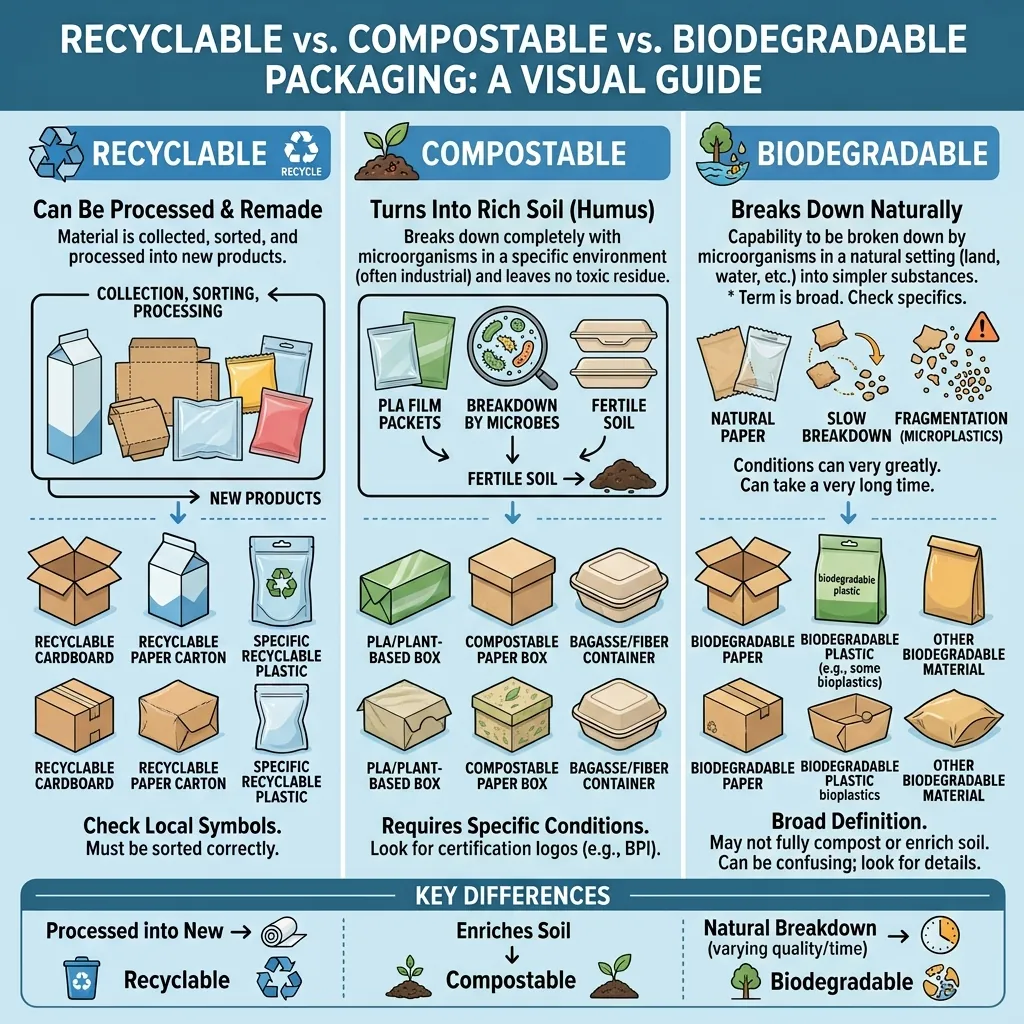
What is the difference between recyclable and compost-ready paper packaging?
Recyclable paper goes into the city paper stream and comes back as new paper. Compost-ready paper breaks down into soil in a compost setting. That is an industrial plant or, rarely, home compost. The two are different end streams. A package can be built for one, the other, or (rarely) both.
Does PCR (recycled content) paper look different from virgin?
A little. 30% PCR looks the same as virgin to the naked eye. 70–100% PCR kraft has a slightly less even surface and some color shift. Most brands treat that as a plus (“visibly recycled”). 100% PCR bleached board can look a bit less bright than virgin. Brands often spec 30–50% PCR on bleached board and 100% PCR on brown kraft.
Is PFAS still allowed in paper food packaging?
It is being phased out. California (AB 1200), New York, Washington, Minnesota, and others have active bans. Federal action is pending. The industry standard is now PFAS-free aqueous grease barriers for food-contact paper. Any brand selling food packaging into these states should spec PFAS-free from the start.
What’s the biggest lifecycle win most brands miss?
Right-sizing the box. It costs nothing (often saves money). It cuts fiber use 10–25%. It cuts void fill (often plastic) by a lot. And it cuts shipping cost in the same range. Green goals and P&L both win. Most brands over-order one or two sizes above true need because stock sizes feel safer.
Can we claim “eco-friendly” on our packaging if it’s FSC and PCR?
Technically yes, but it is risky under FTC Green Guides. The safer claim is the specific one that proves it: “FSC certified” and “100% PCR” rather than “eco-friendly.” Specific claims are also more real to buyers.
Does a How2Recycle label help lifecycle extension?
Yes, in two ways. It nudges buyers to recycle right (less waste, more fiber saved). And it is widely accepted by major US retailers in their green-goals audits (Target, Walmart, Costco). The program fee is small and worth it for shelf-primary SKUs.
The bottom line.
Paper packaging already does the heavy lifting on end-of-life: ~91% US corrugated recycling rate, 5–7 cycles per fiber batch, and mature setups in every US town. The brand moves that stretch that life further are mostly cost-neutral or cost-negative.
FSC fiber, 30–100% PCR, water-based coatings, PFAS-free grease barriers, soy inks, right-sizing, mono-material design, fold-flat and reuse-ready structure, reuse cues on the box, How2Recycle labels, and specific provable claim wording.
Twelve moves. No agency retainer needed. And the P&L usually improves on the way through.
Packaging Vista supplies FSC-stamped corrugated and paperboard, 30–100% PCR options, water-based aqueous coatings, PFAS-free grease barriers, and soy-ink printing across every box format we ship.
Eco-friendly boxes, kraft boxes, mailer boxes, bakery boxes, and more. With a 100-box minimum, no die or plate fees, and 8–10 business-day making. Request a quote with your SKU and green goals.
We’ll spec the fiber, coating, and structure mix that stretches your lifecycle without pumping up your landed cost.